Rainforest Alliance Cupping for Quality winners
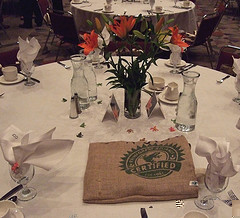
My husband and I attended the Rainforest Alliance Sustainable Coffee Breakfast this morning, at which the winners of the fifth annual “Cupping for Quality” event were announced. These awards recognizes Rainforest Alliance (RA) certified coffee farmers dedicated to growing top quality beans, while protecting the environment and the rights of workers.

The first year of the competition, eight countries participated submitted 40 coffees to be judged. This year, 90 RA certified farms in 11 countries participated; judging was held last month in New York and Long Beach, CA. Coffee from 94 percent of the participating farms received scores of 80 or above.

The top scoring farms that received scores of 85 or above are listed below. I’ve provided links or additional information if available.

  • Hacienda La Esmeralda (Panama) — 89.93. This is not the famous geisha Jaramillo Especial coffee which I wrote about here, but I did discuss their sustainability initiatives. Although the sustainability section of their web site has not been substantially updated recently, I have read more about the work of the Peterson’s (owners of
    Hacienda La Esmeralda) and think they are doing a good job.
  • COMISAJUL (Cooperativa Mixta San Juancito Limitada) La Montana (Honduras) — 87.22
  • Daterra — Boa Vista (Brazil) — 86.58.  I wrote about Daterra here.
  • Grupo Yariguies (Colombia) — 86.32. I believe these producers are in Santander province, in the region where the Cerulean Warbler preserve is located. Terrific!
  • Aguadas (Caldas, Colombia) — 86.08
  • Victoria (El Salvador) –85.98
  • Carmen Estate (Panama) — 85.55. I wrote about Carmen Estate in a review here. This is one of only five farms that have participated in this competition every year so far.
  • Coagro Brisas (Colombia) — 85.50
  • Finca Arroyo Negro (Chipas, Mexico) — 85.46. More info here.
  • La Merced (Colombia) — 85.25
  • Finca San Luis (Colombia) – 85.13
  • Santa Rita (Jinotega, Nicaragua) — 85.00. I think this is the same producer that is also Utz Certified.

Below, I’ve listed the top three scorers (fewer means there were fewer than three farms competing) from each country.

Panama: Hacienda Esmeralda (89.93), Carmen Estate (85.55), La Fortuna (81.00)
Guatemala: La Retiro (84.93), San Diego Buena Vista (84.64), La Pampa (84.63)
Peru: Pronatur — Monterrico (84.81)
Costa Rica: Coopronaranjo R.L. (84.82), Cooperativa de Caficultores de Dota R.L. (83.31)
El Salvador: Lictoria (85.98), La Mecca (84.48), Santa Isabel (84.42)
Honduras: Comisajul La Montana (87.22), Cohorsil (83.67), Café Tierra (80.72)
Colombia (39 farms participating!): Grupo Yariguies (86.32), Aguadas (86.08), Coagro Brisas (85.50)
Tanzania: Uru Estate (83.48), Machare Estate (83.12)
Nicaragua: Santa Rita (85.00), La Bastilla (83.27), Momimboo (83.13)
Brazil: Daterra — Boa Vista (86.58), Fazenda Lambari (84.75), Fazenda Sete Cachoeiras Estate Coffee (84.35)
Mexico: Finca Arroyo Negro (85.46), Finca Santa Elena (81.35), Espana (80.25)

The Specialty Coffee Association of America annual conference

The SCAA‘s 20th Annual Conference & Exhibition takes place in Minneapolis on May 2-5, and I will be attending along with Coffee & Conservation tasting panel member (also my dashing partner) Kingfisher. I will miss the Sustainability Symposium but will be attending lectures on sustainability and agroecology issues. It will be very interesting for me, as an ecologist, to see how these topics are handled and received by those in the coffee industry. There will also be several receptions where various sustainability awards are handed out, as well as the opportunity to hit the exhibit hall.

The SCAA is making this a “green” conference. They report,

The association’s carbon neutrality program will help offset emissions related to conference travel, lodging and energy consumption. Conference attendees will pay a small tariff [$7 person] to participate in the program, and funds collected from registrants—included in the conference fee—will be donated to the sustainable agroforestry non-profit organization, Trees for the Future, for the purchasing and planting of new trees. SCAA and specialty coffee importer, Sustainable Harvest representatives will provide oversight on funding the project.

There are many other green initiatives at the conference site, including elimination of paper hand-out; locally grown, in-season and organic food (with waste sent to a hog farm for use as animal feed and non-perishable, unopened food products donated to a local homeless shelter; and lots of recycling.

Stay tuned: I have a full schedule, but will try to keep up with posting on sustainability issues from the SCAA annual meeting!

Coffee review: Café Alta Gracia

In a previous post, I gave background information on coffee growing on the Caribbean island of Hispaniola. We gave a some of these coffees a try. First, a selection from the Dominican Republic (DR).

Plainspoken Coffee. A Coffee Review for Ordinary People by Ordinary People, #34.

Café Alta Gracia — Vermont Coffee Company. Certified organic and Fair Trade.

Finca Alta Gracia is a 25 ha farm located at 1100 m on the slopes of Pico Duarte, the highest mountain in the West Indies, 17 km west of Jarabacoa near the town of Los Marranitos. Although the web site notes “volcanic soils,” to the best of my knowledge the last volcanic activity in the region was in the Cretaceous period. So although this is technically correct, Pico Duarte doesn’t have the types of recent volcanic soils typical of Central America, for instance. As I mentioned in the previous post, Pico Duarte is primarily underlain with granite. These soils are said to contribute to a unique taste.

Finca Alta Gracia was established in 1996 by Julia Alvarez and her husband Bill Eichner. Alvarez, a DR native, is a well known author of novels such as the powerful In the Time of the Butterflies, How the Garcia Girls Lost Their Accents, and the great little semi-biographical tale about coffee farming, A Cafecito Story. Fittingly, proceeds from this coffee help support literacy efforts — the farm includes a small literacy center with a resident volunteer teacher. I had read several books by Alvarez before coming across A Cafecito Story. I was intrigued and knew one day I’d have to see if I could track down and try the coffee.

Café Alta Gracia roasted by the Vermont Coffee Company, with about 16,000 pounds roasted annually. I believe great coffee consists of two components: a well-grown bean and an artisan roaster. Nobody can do much with a bean with poor heritage, grown in poor soil or low elevation without proper care, and sloppily processed. And an unskilled or hasty roaster can kill the taste of a perfectly good bean (Starbucks accomplishes this on a regular basis). So I was a bit unsure of what to expect from a little farm and an unknown (to me) roaster.

The coffee was a pleasant surprise. Beans appeared to be a medium roast, with a light sheen and a few pinpricks of oil. The aroma was summed up as “spicy nuts.” In the French press, it was mild, light to medium-bodied, smooth, and sweet with hints of chocolate; one reviewer also noted a bit of licorice. One thing we all noticed was a near-minty zing, especially when slurped. One person said it reminded him of a thin mint cookie, a couple others called it “refreshing.” The coffee lost some character brewed, but overall was quite an interesting cup. It garnered a solid 3.5 motmots.

Finca Alta Gracia is now managed by the Dominican Institute for Agriculture and Forestry Research (Instituto Dominicano de Investigaciones Agropecuarias y Forestales  or IDIAF), although Alvarez and Eichner are still involved. IDIAF uses Finca Alta Gracia as a demonstration and research facility to help teach other farmers about organic and sustainable agriculture. This strong commitment to sustainability, literacy, and giving back to the community makes this a unique and important project to support. The coffee makes it a pleasure.

Vietnam planting more coffee

From Vietnam’s Thanh Nien News:

[Robusta] Coffee bean prices [recently] reached a 13-year high of … US$2.50 per kilo. As a result, the 434,000 hectares of coffee plantations in the Central Highlands, which produces 80 percent of Vietnam’s coffee output, is forecast to expand by more than 22,000 hectares this year.

The last peak [US$2.19 per kilo in 1995], also led to a boom in coffee farming in the Central Highlands. But a surplus of coffee sent prices to a record low of…US$0.25 per kilo four years later.

Indeed, this sad story has played out repeatedly over history. High coffee prices motivate farmers to plant more coffee, which takes three to five years to produce beans. Then the resulting glut in supply makes coffee prices plunge again.

Inevitably, not only does a substantial increase in coffee planting have the potential to depress prices, it can often mean the destruction of habitat and damage to the environment. The same article notes that expansion of coffee farming was threatening forests in the area. “Wherever coffee was grown, forests have disappeared,” said a former agricultural engineer.

This is tragic, as Vietnam is one of the most biologically diverse countries in Southeast Asia. The Central Highlands, with many important biodiversity hotspots, timber reserves, and watersheds, account for about 30% of Vietnam’s natural forest cover.  Forest cover in Dak Lak province in the Central Highlands went from 90% to less than 50% in the late 1990s, mostly from coffee production [1]. A portion of Dak Lak province is a designated Endemic Bird Area. Despite efforts to preserve land, Vietnam has been losing ground when it comes to protecting biodiversity.

Further, the article stated that local agricultural agencies have encouraged local people to stop expanding the coffee farming area and instead grow other drought-resistant crops, since coffee requires three or four times the volume of water of other crops — and the Central Highlands has experienced many droughts in recent years.

Much of what is being planted is low-quality seeds and seedlings, which will lead to low and poor-quality coffee yields. Vietnam has a chronic problem with quality, with 88% of the coffee rejected on the world market being from Vietnam. In response, the Vietnamese government developed new quality standards, which were set to go into effect in October 2007. The implementation was delayed, however, as the high world prices are expected to “override” quality concerns.

Where does this coffee go? This is overwhelmingly sun-grown robusta coffee; only 2.3% of Vietnam’s current production is arabica. This coffee is mainly used for low-quality blends and instant coffee; Nestlè buys 25% of Vietnam’s coffee. Other large buyers are Kraft and Sara Lee.

Discover Vietnam’s biodiversity through a slide show from American Museum of Natural History. Consider the fate of unique birds found only in restricted ranges of Vietnam’s coffee growing regions, like the endangered Collared Laughingthrush (right). Then decide if you really need to save a few minutes by purchasing instant coffee, or a few cents by purchasing cheap supermarket coffee (especially that not marked “100% arabica,” which contains this low quality robusta).

I think the choice is obvious.

Update, May 2015: In Vietnam, “Deforestation, monocropping and intensive pesticide use that helped create the boom now leaves coffee farms more vulnerable to climate change,” reports an article in The Guardian outlining the disastrous effects of drought on coffee in the country.

Another update: Nestlè is still buying a large percentage of Vietnam’s coffee.

[1] Thanh Ha, D. and G. Shively. 2008. Coffee boom, coffee bust, and smallholder response in Vietnam’s Central Highlands. Review of Development Economics 12:312-326.

Photo of a Vietnam coffee farm by Lanz.