My year in beans: Winners, losers, and the future

In a previous post I mentioned that I had kept track of all the coffee I had in 2008. That post emphasized the low price ($2.70 a day) of drinking only really good, sustainable, specialty coffee.

Here, I’d like to make some brief comments on a few of the coffees themselves.

As I noted, my 2008 list included 63 different coffees, nearly all single origin  coffees, from 22 countries. Most were Latin American, with El Salvador leading the pack; Kenya topped the choices from the rest of the world. I drank coffee from 23 roasters, turning most often to Counter Culture and Terroir Coffee Company.

My three favorite coffees were:

  • Mamuto, Terroir Coffee Company, Kenya. Coffee Review gave this coffee an amazing 97 points, deservedly so.
  • Finca Kilimanjaro, PT’s Coffee Company (I mentioned roaster and coffee here). A Kenyan bean grown in El Salvador, literally the best of both worlds.
  • Finca Nueva Armenia, Counter Culture, Guatemala. From a Smithsonian Bird-Friendly certified farm, it has to be the current best certified sustainable coffee in the world (my review here).

One disappointing coffee stood out: Trader Joe’s Cafe Feminino Peru. I’ve tried these beans from this source before, as they are widely available; my brief review from Grounds for Change was very positive. The Trader Joe’s version, which was supposed to be a medium roast, was very dark and oily, more like a French roast. That shouldn’t be a problem — I liked the Grounds for Change in a dark roast. Yet I found the Trader Joe’s was awful: thin, harsh, and sooty. Trader Joe’s doesn’t use roast dates, and the (lack of) bloom indicated this batch was not particularly fresh. I will be devoting a post to Trader Joe’s coffee in the future.

A few of you may be wondering why, if I drink so many different coffees, so few are reviewed here on Coffee & Conservation (eleven reviews were published in 2008). There are several reasons. First, although I’ll occasionally give just my own opinion on a coffee, fair reviews involve a bunch of people tasting each coffee, often more than once. Sometimes, it’s just hard to corral a panel. Second, as I pointed out in the introduction to how we do reviews, most coffee ratings are lumped in the middle of the 1 to 5 motmot range. The value in the reviews is the background information provided about the origin/region, farm, growing methods, and roaster. This research is time-consuming. Sometimes, I don’t come up with enough solid information to make a good review.

In 2009, reviews will focus on sustainability stars and outstanding coffees, as well as more reviews of the coffee of popular retailers, such as I’ve done with Panera, Einstein Bros, or Tim Hortons.  Starbucks and Caribou will also get more attention since they are how many people are introduced to “specialty” coffee. In many ways, these are more difficult to write…the more corporate the company, the less they divulge about their sources.

As always, if you have any suggestions or things you’d like to see, please drop me a line (contact info here).

Coffee bag photo by Biskuit.

Bird-Friendly fees: where do they go?

Roasters that sell Bird-Friendly coffee, certified by the Smithsonian Migratory Bird Center, pay a per-pound fee to Smithsonian (around US$0.25, I believe). These fees go to support bird conservation research and education, with an emphasis on coffee as bird habitat. In 2015, the Smithsonian Migratory Bird Center summarized the research supported by the fees paid by roasters for Bird-Friendly certified coffee, and they have a page where you can read about some of these projects. Let me take this one step further and tell you why this is so important, because they didn’t take the opportunity to really drive this point home.

Most people don’t understand how research is paid for. I’m a working scientist. I can tell you from direct experience that this type of research relies heavily — if not totally — on outside funding (e.g., it’s not part of the budget of the sponsoring institution, whether a university, non-profit, or government agency). Grants are the typical funding mechanism, and often they only fund very specific aspects of particular research projects, such as field equipment and supplies. It’s hard to find money for the mundane things that allow these research programs to continue functioning, and unrestricted funds such as these royalties are very helpful in that regard.

I know that roasters have business decisions to make, and consumers (who ultimately pay these premiums) have budgets as well. Roasters and the public need to understand that at least in the case of Bird-Friendly fees, they don’t just go to fund the annual office party or expensive haircuts for the boss. Virtually all that we know about the importance of coffee to biodiversity comes from this research. Smithsonian pioneered it and continues this work today. That’s what you’re paying extra for when you buy Bird-Friendly coffee. It’s totally worth it.

Photo by Scott Feldstein.

Research: Ethiopian garden coffee preserves epiphyte biodiversity

Home garden coffee as a repository of epiphyte biodiversity in Ethiopia. 2008. K. Hylander and S. Nemomissa. Frontiers in Ecology and the Environment. 6:524-528.

Nearly all the work that’s been done examining the relationship between shade coffee and biodiversity has taken place in Latin America, so it’s good to see studies like this coming out of Africa.

This study looked at the diversity of epiphytes and bryophytes (mosses, liverworts) in home coffee gardens and forest patches in southwestern Ethiopia near Bonga. People often grow coffee under shade trees in their gardens, and this study not only compared the gardens versus the forest, but also the epiphytes growing on the coffee shrubs and shade trees.

Six to 27 species of epiphytes were found growing on coffee shrubs in home gardens, and only liverworts were more diverse on forest coffee shrubs. Eleven to 33 species were found on shade trees in home gardens. Overall, epiphyte/bryophyte diversity was higher on forest shade trees, but there was a lot of overlap and many garden shade trees had richer diversity than those in the forest. It was also noted that heavily pruned coffee in more intensively managed farms did not host many epiphytes.

The authors concluded that coffee shrubs and shade trees in home gardens are important hosts of epiphytes and bryophytes, helping to preserve the biodiversity of these plants. They also felt that epiphytes and bryophytes likely provide nest material, nest sites, and food sources for birds as has been proven in Latin America. Shaded home coffee gardens also had the added benefit of providing resources such as honey and firewood, and environmental services such as erosion control.

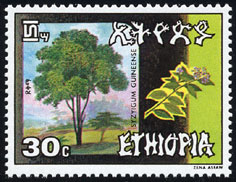
The tree depicted on the stamp, Bicoloured waterberry, Syzygium guineense, is a common canopy tree in the region of Ethiopia examined in this study.

K. Hylander, S. Nemomissa. (2008). Home garden coffee as a repository of epiphyte biodiversity in Ethiopia. Frontiers in Ecology and the Environment, 6 (10), 524-528 DOI: 10.1890/080001