Research: Pollination and fruit set in India

Status of pollinators and their efficiency in coffee fruit set in a fragmented landscape mosiac in South India. Krishnan, Kushalappa, Shaanker, and Ghazoul. 2012. Basic and Applied Ecology 13:277-285.

The role of various types of pollination — self, wind, and insect — on robusta coffee (Coffea canephora) was studied in the Kodagu (Coorg) region in Karnataka state in south India. Robusta coffee is generally thought to be wind-pollinated, with fruit set being enhanced if cross-pollinated by insects.

Many insects (as well as other arthropods and birds) can act as pollinators, but in this study bees made up nearly 97% of the floral visitors to the coffee. The main pollinator was the giant Asian honeybee (Apis dorsata, a relative of the familiar European honeybee).  Apis cerana and Tetragonula iridipennis were the other two bee species that most frequently visited coffee flowers, and together with the giant Asian honeybee comprised 98.3% of all visits to coffee flowers. While pollination can occur from wind, bee pollination increased fruit set by 50% over wind.

Amegilla bee on lantana. This genus of bees were once common in coffee plots, but now feed on non-native lantana flowers. Photo from Wikimedia Commons.

The authors noted that in other countries studied, the suite of pollinators usually comprised of many more species, rather than being dominated by so few as in the present study. They looked at a similar, though limited, study of pollinators of coffee done in the same area in 1915.  In that study, Apis cerana was the most common; this species has recently (early 1990s) declined due to a virus. The older study listed the second most abundant bees pollinating coffee as those in the genus Amegilla; in the present study these made up a mere 0.1% of visits.  The authors observed Amegilla bees foraging instead on a non-native invasive plant, Lantana camara. This indicates that invasive species may change the behavior of coffee pollinators — and this role of invasive species deserves more study.

The giant Asian honeybees nest in nearby forests in large trees. The authors concluded that, given the high dependence on pollination by this species, preservation of these trees in remnant forests within the foraging range of the bee is crucial to the successful production of coffee in this area.

This post is in recognition of Pollinator Week, an international celebration of the valuable ecosystem services provided by bees, birds, butterflies, bats and beetles.

Smitha Krishnan, Cheppudira. G. Kushalappa, R. Uma Shaanker, & Jaboury Ghazoul (2012). Status of pollinators and their efficiency in coffee fruit set in a fragmented landscape mosiac in South India. Basic and Applied Ecology: dx.doi.org/10.1016/j.baae.2012.03.00

Sips: Climate impact and adaptation, FT4All evaluation

Recent coffee news. (I’m behind. I should just let everybody know that May is a month my day job prevents me from doing anything related to coffee except drinking it!)

Know your coffee birds: Ovenbird

The Ovenbird (Seiurus aurocapillus) is often heard before it is seen, a loud ringing “tea-cher, TEA-cher, TEA-CHER!” broadcast from close to the forest floor through much of the eastern U.S. and Canada during the nesting season. Ovenbirds are large warblers, no relation to the Ovenbird family Furnariidae found in the tropics. However, both the warbler and the family share a basic brown color palette, and are named for their curious domed, Dutch oven-like nests which, in the case of the warbler, are build on the ground.

Ovenbirds winter primarily in the Caribbean and Central America. There, they forage on or close to the ground, where much of their diet is comprised of ants. This habit of scratching and leaf-flicking on the forest floor has earned them the name “Betsy Kick-up” in Jamaica! Ovenbirds are frequently found in shade coffee plantations, where they may also feed on female coffee berry borers that are laying eggs in fallen coffee cherries, thus performing a great service to coffee farmers.

Migrant (and resident) bird species have been monitored in Puerto Rico since 1973 in a study where Ovenbirds have been one of the most common species. Their numbers have declined to less than 20% of their original abundance. Some of the declines are related to variable rainfall patterns (which will be exacerbated by climate change), and some to conditions on their breeding grounds (see below). But similar declines in resident Puerto Rican birds in the same study indicate there are undiscovered factors occurring on the wintering grounds as well.

On their North American breeding grounds, Ovenbirds need large forests to breed in, and habitat loss and fragmentation has taken its toll. Even in large forests in northern regions, declines in reproductive success are tied to, believe it or not, earthworms.
Due to the last glaciation, Canada, the upper Midwest, and New England have no native earthworms — all of the worms are introduced. Their efficient consumption of leaf litter on the forest floor has greatly altered many forests. Plants that require a thick organic layer in some forests have declined, leaving less cover for Ovenbird nests, which then fall to predators. Ovenbirds also rely on the insects and invertebrates that live in leaf litter, which are also far less abundant in habitats invaded by non-native worms. These factors are thought to be driving declines in some breeding populations of Ovenbirds.

Ovenbirds found on shade coffee farms help farmers by eating pests, and have found safe haven in winter. Choosing shade-grown coffee can help support populations of this charismatic songbird so that future generations can enjoy its distinctive summer song.

More coffee birds here.

Ovenbird photo by Julie Craves, all rights reserved. Banded by the Rouge River Bird Observatory, Dearborn, MI.

Finca Dos Gatos…harvest!

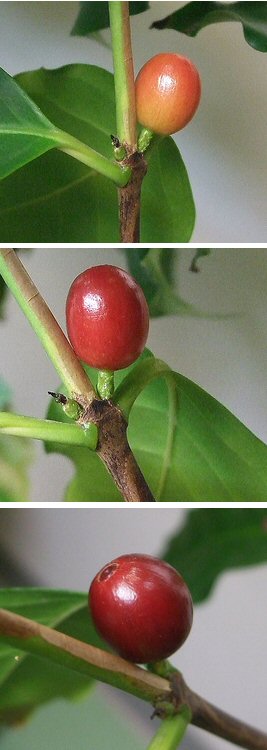
Finally, ripe cherries!

This is my third post regarding my growing (literally) little coffee farm in southeast Michigan. My first post, Growing coffee at home, documented my initial attempts at germinating coffee beans I collected on a trip to Panama in January 2008, one of which flowered in April 2011. My second post, Update on Finca Dos Gatos, covered the bean development, transplanting, and other outdoor accommodations.  Here is one more update.

Panama plants

These were my original plants, which I grew from seed collected around Volcan, Panama. The chronology:

  • Seeds harvested from ripe cherries in January 2008.
  • Seeds germinated in May 2008.
  • First flower buds: 12 April 2011, only on one plant.
  • Flowers opened 25 May 2011.
  • Two fruit begin to develop 15 July 2011.
  • Fruit full size, but green September 2011.
  • Fruit finally begins to ripen mid-February 2012.
  • Fully ripe and harvested by mid-March.

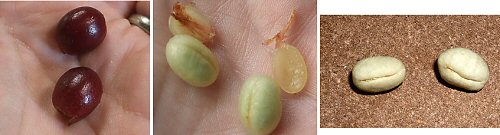
The last interesting thing about this crop was that after I picked the cherries and removed the skin, I discovered that both contained peaberries instead of two flat beans. This occurs due to one of the ovules not developing, usually from lack of fertilization. Arabica coffee is self-pollinating, but perhaps this is to be expected when there are only two flowers! After the two beans dried, I noticed they are much less dense than a normal bean…nearly as light as a roasted bean. My first crop is just souvenirs.

Nicaragua plants

I have collected seeds twice from Nicaragua. My first batch was from Finca Esperanza Verde which I planted in March 2009. These germinated in June 2009, and now have their first flower buds. I have three plants and have given others away.

The second set was collected in March 2011 from El Jaguar and Selva Negra; they germinated in mid-May 2011. I’ve given away some seedlings and have chosen to keep just two plants: one from Selva Negra and one of the yellow catuai variety from El Jaguar.

In November, I performed an experiment where I provided a “dry season” for the Panama and first batch of Nicaraguan plants. I restricted water for a couple weeks, then stop watering for three weeks. Then, I watered like crazy, and began switching over the fertilizer from the Earth Juice ”Grow” to the Earth Juice “Bloom”.  Further, I swapped out half the lights in the system to 3000K red spectrum bulbs instead of 6500K blue lights (Sun Blaze T5 in four-foot fluorescent fixtures).

And sure enough, I have a ton of flower buds, which began to develop in early February. Although the first time around, the buds developed quickly, in a month, so far all the buds I have are growing slowly, and have not yet opened.

Honduras – new additions

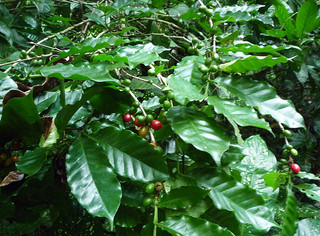
In November 2011, I was in Honduras. This trip was not to coffee farms, as we were staying in a lowland area on the northern coast. However, there was coffee growing in the region, and I picked up cherry from a semi-tended plot owned by the Lodge at Pico Bonito that had both coffee and cacao, as well as some at Pico Bonito itself. Traditional old varieties of arabica coffee don’t grown at this altitude with the heat and humidity. I figured it must be some varietal that included robusta heritage, and Daniel Humphries identified it from photos as catimor, a hybrid between caturra and Hybrido de Timor (itself a naturally-occurring hybrid between arabica and robusta).

In Honduras, two lines of catimor are common. One is IHCAFE 90, released in the 1990s and derived from the T5175 line out of Portugal or Brazil. The other is Lempira, from the T8667 line out of Brazil.

I had a bunch of it sprout by mid-January, and gave away some seedlings, saving a couple for myself.

Cacao

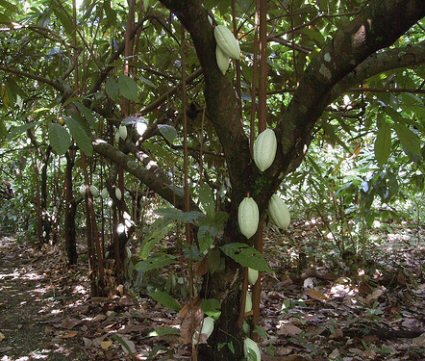
Okay, this is a coffee “finca” but I had to see if I could also grow some cacao, which was growing all over the place, including outside our cabin and next to the coffee. Here are some trees at Pico Bonito with their bizarre unripe pods.

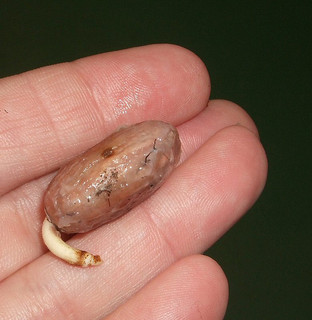
These pods are tough and leathery and often have to be opened with a machete, but animals had opened some and we were able to retrieve the large seeds. I read that they must always be kept warm and moist, so I wrapped them in damp paper towels. No long wait like coffee. By the time I got home a few days later, they were beginning to sprout.

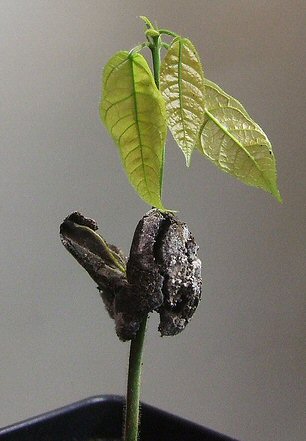
By early December, I had little plants about five inches tall.

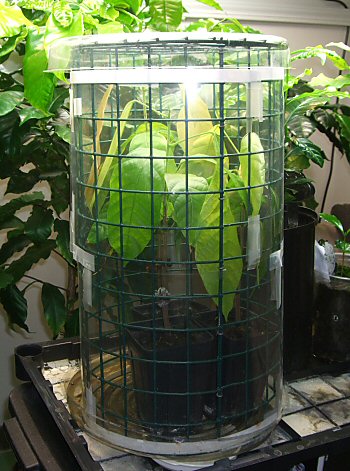
In order to maintain a little more warmth and humidity, I constructed a little enclosure for the three cacao plants by wrapping overhead transparency plastic around a wire bird feeder squirrel-excluder. It sits on top of a cheap, twelve-inch plastic flower pot saucer. Another saucer went on top.

I look forward to bringing the finca outdoors for the summer, when I know everything will take off; the cacao should especially enjoy our hot, humid Michigan summer.  Perhaps I’ll do one more update with photos of more of my coffee in flower, and any resulting crop.