
Botanical varieties of coffee

There are over 100 species of coffee (Coffea) in the world, and all are native to tropical Africa and some Indian Ocean islands (Madagascar, Macerenes). Most have very limited distribution, and over 70% are threatened with extinction.

Usually only two species, C. arabica and C. canephora, are commonly grown commercially.  They are described below, along with a few other interesting species, and the most common commercial varieties of these species.  Because certain types grow best in the shade and others in the sun, knowledge of these names can be a convenient clue as to how your coffee may have been grown.

Don’t confuse these botanical varieties with coffees named for their growing regions, such as Ethiopian Harrar, Guatelmalan Antigua, or Hawaiian Kona.

  • Coffea arabica. This is the highest quality coffee, used by specialty roasters. It grows best at higher altitudes — 3000 to 6500 feet — and because it grows slowly the flavors are more concentrated. This species tend to be susceptible to various diseases, and has a lower caffeine content than C. canephora (below). Arabica is a deep-rooted shrub. Unlike other coffee species, arabica has two sets of chromosomes. Arabica has two common varieties, typica and bourbon. These traditional, older varieties are the types most often grown in the shade. Because arabica is self-pollinating, these varieties are stable, but sometimes do mutate into strains that are then cultivated. Just a few of the most common are described.
    • Coffea arabica var. typica.
      • Maragogype — large-beaned (“elephant bean”) Brazilian mutation. Porous beans are not especially flavorful, and low-yielding. (Roasting a larger bean correctly takes some finesse, so buy from a specialty roaster.)
    • C. a. var. bourbon. Old variety originating on the Indian Ocean island of Bourbon (Reunion) with broad leaves, and small fruits. In Kenya, bourbons are sometimes called “French mission ” or “Scottish mission.”
      • Catuai — cross between Mundo Novo and Caturra. There are red (rojo) and yellow catuais, named for the color of the cherries. High yield and hardy. Often grown as sun coffee.
      • Caturra — compact, multiple-branching form of bourbon, common in Brazil and Colombia. Disease resistant and fast-maturing, the higher yield of Caturra apparently comes at a cost to good taste. Considered lighter-bodied and more acidic than traditional bourbons. Often grown as sun coffee, it requires a lot of management and fertilizer.
      • Mundo Novo — cross between typica and bourbon, high yield, popular in Brazil.
      • Paca — a high yielding cross between bourbon and Caturra.
      • Pacamara — cross between Maragogype and the Paca variety of Caturra.  Not considered very flavorful, as neither parent is especially revered for taste.

If you’d like to see a “family tree” of some of the arabica coffee varietals, check out this post by Jim Hoffman and a table of coffee genotypes from a paper published in the Brazilian Archives of Biology and Technology. More less-commonly referred to arabica varieties are described in the coffee glossary.

  • Coffea canephora.  This species is more commonly referred to as “robusta,” although this actually refers to the upright variety of canephora; there is a spreading variety known as nganda.  Robusta is a lower-growing and shallow-rooted, harsher and more bitter variety that is used in cheaper coffees, or as fillers.  Robusta tends to be more hardy and disease-resistant, will grow better in the sun than arabica, and tends to have higher yields. It has a higher caffeine content than arabica. I’ve written an entire post about robusta here.  Although there is such a thing as a decent quality robusta, Kenneth Davids at Coffee Review sums up the problem with most robustas in today’s market:

    Apparently with the support of the World Bank, robustas recently have been planted in very large quantities in Vietnam. These are mass-produced coffees at their most dramatic: stripped from the trees, leaves, unripe, ripe and overripe fruit and all, and dried in deep piles. All of which means the essentially bland, grainy robusta character is topped off with an assortment of off-tastes, mainly musty/mildewed and fermented. These coffees sell for considerably less than all other coffees, including better quality robustas. I am told that production costs for Vietnamese robustas are about 20 cents per pound or less, compared to, for example, production costs of 80 to 90 cents per pound for the excellent “100% Colombia” coffees competing in the supermarket. And now the current episode: Commercial dealers and roasters have learned to steam the often foul-tasting Vietnamese robustas, removing the waxy covering of the bean and muting (but not entirely eliminating) the offensive flavor notes.

There are some hybrids between arabica and canephora. They include:

  • Hibrido de Timor — a natural hybrid, with two sets of chromosomes like arabica.
  • Icatubackcrosses of Hibrido de Timor with Mundo Novo or Caturra.
  • Catimor — cross between Caturra and Hibrido de Timor. High yields, often grown as sun coffee, with a reputation for inferior quality.

One other species is grown commercially:

  • Coffea liberica. Similar to robusta, grown at low altitudes in Malaysia and West Africa, it accounts for less than 1% of commercial trade. In the cup, it is thick and pungent, but has its fans in some countries.  It is known as Barako in the Phillipines.  Two subspecies are commonly recognized, C. liberica var. liberica, just called “Liberica” or “Liberian” coffee, and C. liberica var. dewevrei, known as “Excelsa.”

There are a number of varieties in Madagascar and the Mascarene Islands that have little or no caffeine, including C. kianjavatensis, C. lancifolia, C. mauritiana, C. macrocarpa and C. myrtifolia. These species are in the taxonomic section Mascarocoffea; this is not a genus as is frequently reported on the Internet. Arabica and robusta coffees are in the section Eucoffea, and attempts to breed Eucoffea varieties with caffeine-free traits from Mascarocoffea types has not been successful.

Finally, peaberry (“caracol”) coffee is not a botanical variety, but a bean mutation where the cherry produced one small, rounded, fused bean rather than two flat-faced beans. May occur in any botanical variety, usually accounting for about 10% of the crop.  Some think peaberries have a superior taste, but choose a roaster widely, since peaberries roast quickly and are easily charred.
 

Research: Birds and lizards as insect predators in shade coffee

Borkhataria, R. R., J. A. Collazo, and M. J. Groom.  2006.  Additive effects of vertebrate predators on insects in a Puerto Rican coffee plantation.  Ecological Applications 16:696-703.

The authors used an exclosure study to see if birds and lizards had an impact on the abundance of insects in a shade coffee plantation, in particular two that damage coffee (the coffee leafminer and flatid planthopper).  When birds or birds and lizards were excluded, the abundance of larger insects increased.  In particular, planthoppers increased greatly when birds were unable to prey upon them. The leafminers, which are serious pests of coffee and are small insects, increased if lizards were not able to prey on them.   

This study indicates that birds and lizards (which the senior author found more abundant in shade coffee than sun coffee in Puerto Rico, presented in her Masters’s thesis) may help control the numbers of some coffee pests in shade plantations. Another important finding is that neither birds nor lizards interfered with the numbers of other natural insect enemies of coffee pests, parasitoid wasps.

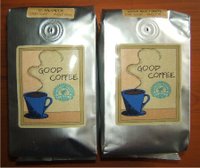
Review: Good Coffee Co.

Every month, I like to try out a new shade-grown coffee.  This month, it was from the Good Coffee Company of South Carolina, which sells only Rainforest Alliance certified coffee. Since their coffees are available in 8 oz. packages, I tried two: El Salvador and their Costa Rica/Brazil blend.  I wish more roasters would offer small packages like this for folks to try, especially online vendors.  I don’t like to buy several pounds of coffee if I might not like it, not to mention I can’t drink that much in a week and hate to evaluate stale coffee. But just buying one pound and paying shipping is pretty pricing.  The option of buying several small bags is really appealing to me.

I ordered these beans as dark roasts.  A peek at the beans when they arrived showed a lighter color than what I’m used to seeing in a “dark roast.”  Only a few beans with oils barely showing on the surface, and a flat, milk-chocolate brown color.  The roast description on the Good Coffee site is a close match to this…I should have read it first! I tried the El Salvador first, noted to be of mild acidity and medium body.  I thought it was really nice when prepared as a strong cup in an Aeropress.

The Costa Rica/Brazil blend was described as an “Experimental blend. This product is a blend of our 05-06 crop RA Costa Rican SHB and Brazil NY2 Screen 19 coffees with a dash of RA Guatemalan and Kenya AA for balance.”  The beans were roasted to an identical medium, not dark, roast like the El Salvador, but I actually liked it a little better, and it was especially good in the Aeropress.   Both of these coffees “aged” better than a dark roast, I must admit, whether cooking in the pot or sitting in a thermal mug.  Since I like strong coffees, I actually liked them better a little old.  They also made a fine blend with a darker roast.

Coffee growing in Africa

Since shade certification is not available for coffee grown outside of Latin America, it can be helpful to understand coffee cultivation practices in the Old World.  This can help consumers choose sustainable coffees.  Certified organic is a good choice where available, although in many African countries, it is grown organically by default because small farmers cannot afford chemicals and fertilizers (“passive organic”) and may not be certified.

The whole concept of “shade grown” and what it means to biodiversity is different in Africa (and other Old World countries). Many Eurasian breeding bird species winter in Africa, but the most species are not found in tropical forests, but scrub savannas north of the equator, areas that do not coincide well with coffee-growing regions.  Thus the issues are not quite the same as in Latin America, but generally the most biodiversity is preserved on small farms, in diverse mixed crop farms, and farms that do not use chemicals.  If anybody has further information on biodiversity issues in African coffee plantations, drop me a line at coffeehabitat AT gmail.com.

Coffee originated in Africa, and today Africa still produces some great high quality arabica (Coffea arabica) coffees.  Africa is also the source of a lot of cheap robustas (Coffea canephora), which is also the easier variety to grow in the sun.  Sun plantations are more likely to be monocultures, and by virtue of that harbor less biodiversity.

The following countries produce primarily or entirely robusta coffee. Coffees from these sources are likely to be of lower quality, or not grown in a sustainable manner.  I would avoid them: Angola, Benin, Central African Republic, Congo, Gabon, Ghana, Guinea, Equatorial Guinea,  Ivory Coast, Liberia, Nigeria, Sierra Leone, Togo, Uganda, Zaire.

The following countries grow Arabicas, or both varieties. Links provide more growing, historical, or quality information. A star (*) indicates the best bets in sustainable coffees.

*Burundi — Nearly all arabica. Most is grown in full shade, and most is organic, since farmers cannot afford chemicals.  Coffee is a major export crop for Burundi.  A specialty coffee marketed as Ngoma is traditionally grown and especially sought-after.  Bird info for Burundi.

Cameroon — Mostly (>80%) robusta.  Most arabicas grown in the west, northwest, and east at high altitudes. There are Important Bird Areas in these regions. Choose arabica coffee from Cameroon, which is grown in small mixed plots (shade) or harvested nearly wild, and without the use of chemicals.  Bird/birding info for Cameroon.

*EthiopiaNearly all coffee in Ethiopia is grown in shade, either as ”forest coffee,” nearly wild, or ”cottage coffee,”  interplanted with other crops without the use of chemicals.  Some is now being grown on plantations.

The two main growing regions are Harrar, the province east of the capital of Addis Ababa, and Yirgacheffe in southwestern Ethiopia (also known as Sidamo).  Both regions grow coffee on small plots using traditional methods, and there are Important Bird Areas in these regions. Bird/birding info for Ethiopia.

Kenya – Grows Arabica almost exclusively, but rarely grown in shade. While it may be that the growing areas are not along migratory routes, and shade trees are less important to birds there, monocultures of anything are generally not good for any type of wildlife, and replace native habitats. Large estates generally use a variety of herbicides, pesticides, fungicides, and fertilizers. Bird/birding info for Kenya.

Madagascar — Both arabica and robusta are grown. Interestingly, Madagascar has 55 endemic species of coffee, including a bean without caffeine.  This island is one of the richest areas of biodiversity on earth, and has been severely deforested, and the farming of coffee was a major reason.  Unless you can determine the specific origin and growing practices of a Madagascar coffee, I’d avoid it.  I’ll try to dig deeper into this situation.  Bird/birding info for Madagascar.

Malawi —Arabicas are grown in several regions.  Due to the steepness of the terrain, coffee in Malawi is usually grown on terraces, using organic mulches to prevent erosion, and usually without pesticides.  It is sometimes grown interplanted with bananas, but it is often in fairly sunny conditions, or under bananas.  Bird/birding info for Malawi.

*Rwanda – Only arabicas are grown.  After the genocide and political unrest, various organizations have been helping to repair the Rwandan coffee industry (see my review of One Thousand Hills here, with accompanying links). Rwandan coffee is generally grown in small mixed plots with little or no chemical inputs.  It is often grown on steep slopes.  Bird/birding info for Rwanda.

Tanzania Grows both arabica (70%) and robusta. When coffee is grown in shade, it is under banana trees. Most arabicas are grown in the north, near the Kenyan border, on the slopes of Mt. Kilimanjaro and Mt. Meru (they may be called Kilmanjaros, Moshis, or Arushas).  Coffees called Mbeyas or Pares are Arabicas grown in southern Tanzania, between the rift lakes of Lake Tanganyika and Lake Nyasa.  With snow caps on the mountains diminishing (global climate change is a factor), farmers are struggling with irrigation issues.  Quality has been declining, but some organizations are working at reviving Tanzania’s coffee industry. Full post on Tanzanian coffee here.  Bird/birding info for Tanzania.

Zambia — All arabica, of variable quality.  Some avoid buying Zambian (and Zimbabwean) coffee because proceeds have been known to end up fueling the bloodshed in the Congo. Bird/birding info for Zambia.

Zimbabwe — Mostly Arabicas, grown on medium to large farms, mainly in eastern Zimbabwe bordering Mozambique, in the Chipinge region. Some avoid buying Zimbabwean (and Zambian coffee because proceeds have been known to end up fueling the bloodshed in the Congo. Bird/birding info for Zimbabwe.

Extensive information on African birds can be found at the African Bird Club web site.