Poverty and conservation, how coffee fits

The current issue (summer 2006) of the Nature Conservancy magazine has several articles on the poverty and conservation equation.  When I posted on “What is Fair Trade?” I wrote,

Worldwide, habitat destruction is the leading cause of bird population declines and loss of biodiversity. The link between poverty and environmental degradation is inescapable. Making sure that coffee farmers receive a living wage is one way to help preserve habitat — both by  encouraging sustainable coffee farming methods that produce the highest quality coffee, and by empowering farmers economically and reducing their need to exploit the environment for survival.

These points are expanded upon in the Nature Conservancy pieces. They give an example of coffee farming in the Dominican Republic:

Today, the farmers in this idyllic mountain community [Los Dajaos] in the Dominican Republic’s central highlands no longer denude the hillsides to plant beans and graze cattle. Instead, they tend organic shade coffee beneath a canopy of flowering guama trees. … After once clearing thousands of acres of habitat critical to preserving biodiversity and the island watershed, they have come to view the forest as a friend.

These articles surely help elucidate why sustainable agriculture is important to biodiversity, and it’s not hard to understand how sustainable coffee — as one of the world’s top commodities — can fit into this equation.
Colombia to produce more RA coffee

According to this article in Financial Express, by 2007, ten percent (about 1 million 60 kg bags) of Colombia’s coffee will be certified by social and environmental programs. One of these programs is the Rainforest Alliance sustainable agriculture program (my overview here).  Colombia is one of Latin America’s top producers of sun coffee, so this is a step in the right direction.  Meanwhile, look for Colombia’s Mesa de los Santos coffee, which is certified organic and shade grown (by both Smithsonian and Rainforest Alliance). Review at Coffee Cuppers, and carried by a number of the roasters in the sidebar.

Starbucks responsible coffees

Under the Starbucks category, you can read more about the company’s struggles with committing to Fair Trade and environmentally-responsible coffees.  In particular, Green LA Girl has two posts (here and here) regarding the Starbucks point-based CAFE Practices as they compare to Fair Trade. (Update: an in-depth overview of the latest version of CAFE Practices and their environmental standards here.)

Many people go to Starbucks and want to know — or should know — about which coffees are their most responsible. Here is a run-down on their current offerings.

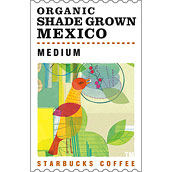
  • Organic Shade Grown Mexico.  Medium roast, origin Chiapas, Mexico.  Grown near the El Triunfo Biosphere Reserve, a park threatened in part by coffee plantations. This is one of the coffees produced in partnership with Conservation International, their “Conservation Coffee.”  Although the description on the Starbucks web page says “traditional shade-growing,” as noted in the post about the partnership, it does not appear that these coffees are grown with any specific or enforced rules regarding degree of shade management or level of organic practices.  Therefore, it does not seem that this coffee is comparable to coffees that are certified organic or bird-friendly. (Update: review and background of this coffee here.)
  • Shade grown Mexican decaf. Medium roast, origin Chiapas, Mexico. Description makes it sound like the same coffee as above, yet it is not labeled organic.
  • Serena Organic. Medium roast, origin Latin America and east Africa. No indication what organization, if any, certifies this as organic.  Coffee Review review.
  • Cafe Estima. Bold roast, origin not specified.  Their featured “Good Coffee, Doing Good” blend.

Starbucks has a line of Black Apron limited edition coffees. They give $15,000 to the farmers of each Black Apron coffee for community projects.  These beans are pricey, and $3 of each half pound must go into producing the fancy laser-cut box.  I just tried the Rwanda Blue Bourbon Black Apron, which is just about at the end of its run, and liked it quite a bit.  But then, I’m a fan of Rwandan coffees.

On the one hand, I give Starbucks some credit for attempting to buy and market responsible coffees; the fact they do it is what counts for me, I don’t care whether they are dragged into it kicking and screaming.  On the other hand, I personally am not a Starbucks fan and think a lot of their coffee is over-roasted.  Click on the Starbucks category for more on the company’s coffees and policies.

Caribou Coffee and Rainforest Alliance

Caribou Coffee, based in Minneapolis with stores in 15 states, announced last July that it was partnering with Rainforest Alliance (RA) to provide certification for much of their coffee.  They expected 20% of their coffee to be certified by the end of 2006, with a goal of half of all the green beans purchased to be RA certified by 2008.  The phase-in is necessary because Caribou wants to preserve existing relationships.  This has an upside in that new producers will be adhering to certification standards.  Considering that a number of Caribou offerings are from Africa and Asia, which are not eligible for shade certification and which often are grown under shade as a matter of course, this means that well over half of Caribou’s coffees will represent shade coffees, in one shape or form.

(Update: 100% of all Caribou coffees will be 100% Rainforest Alliance certified by 2011. More on this here.)

As the second largest U.S. specialty coffee company, selling over 4 million pounds of coffee annually, the purchase of half their beans from certified sustainable sources is nothing to sneer at, and it makes Caribou one of the only big coffee houses where this kind of sustainable coffee will be readily available.

Caribou has a commitment to responsible coffee sourcing, social responsibility (including work in coffee growing areas) and frequently donates to local communities and charities.