Attention: East Timor

I’d like to occasionally profile a coffee-growing country, where the current situation merits special attention from coffee consumers, whose purchase of sustainable coffee from the country can provide extra benefit.  I’ll try to include these items: the current status, why your purchase will help, cultivation and characteristics of coffee in the country, and some links to sustainable coffees.  You can usually expect the C&C tasting panel to follow up with a review of one or more coffees from the country.

I will start with East Timor, half of one of the easternmost coffee-growing islands in Indonesia.

Situation: Once a Portuguese colony, which was invaded by Indonesia in 1975, only a few days after declaring independence. For over 20 years, conflict and clashes gripped the island as the Timorese resisted the Indonesians.  East Timor joined the UN as an independent nation in 2002, but clashes continue, currently involving violence between eastern and western soldiers that is at a crisis stage requiring international intervention. Some background can be found at BBC News.

The role of coffee: East Timor’s economy has been crippled by the ongoing fighting, and its people are among the poorest in the world.  Coffee is one of the most important mainstays of the East Timorese economy.   In 1994, with help from USAID, the Cooperativa Cafe Timor was organized, and is now the largest single-source producer of organically certified coffee in the world. It has 20,000 farm families and employs another 3,000 local people during processing time, about 25% of the population! Starbucks has been a major customer of East Timor coffee; it was used
in their Arabian Mocha Timor blend, which is currently listed as out of stock.  May and June are harvesting time for coffee in East Timor, and the current wave of violence has nearly stopped production, with coffee not making it to the processing mills, many of which are unmanned due to the fighting.

Coffee Review notes: “Buying a Timor coffee at this moment in history means making a small but valuable gesture of support for one of the many peoples of the world caught up in sectarian and political conflict.” Not only does buying specialty coffee from East Timor help the people, it will also help the environment, adding value to biodiverse farmland when so much forest and farmland was napalmed and destroyed in the war.

About East Timor coffee: There are two main growing regions in East Timor, Aifu and the higher altitude Maubesse. The bean grown most often in Timor is a natural hybrid between arabica and canephora (robusta), often called Hibrido Timor or some variation (it is also used to cross with the Caturra variety to make Catimor, which is higher yielding than either parent, but not as good as either one; more on botanical varieties here).

East Timor has some rugged terrain and a very hot climate.  Coffee is always grown under shade, the only way the plants would survive.  Coffee is grown on small plots, in a primitive and nearly wild state. Because the farmers have not been able to afford chemicals, East Timor coffee is organic.

Coffees are wet-processed in the new mills.  However, the 2006 crop is in question due to the current civil unrest described above, and it may be that coffee that comes from East Timor from this season will be in limited supply and dry processed.

Variously described as sweet and nutty, medium-bodied, with a sweet cedar finish, cleaner than Sumatrans, with more acidity than Javas, and generally clean and mild. You can read some reviews of older crops at Coffee Review.

Map image: pbs.org.

Coffee review: Caribou Rainforest Blend

Plainspoken Coffee. A Coffee Review for Ordinary People by Ordinary People, #3.

Today, a more pedestrian coffee, the organic and Fair Trade Rainforest Blend from Caribou Coffee, a Starbucks rival in many northern states.  Caribou not only has better coffee, in my opinion, but clearly has a stronger commitment to sustainability.  As I wrote about before, Caribou is on its way to having half of its beans Rainforest Alliance certified.  It also supports Coffee Kids, Grounds for Health (women’s health in coffee producing counties), the National Breast Cancer Foundation, and helped build a medical clinic in Guatemala.


The coffee:
This blend is certified Fair Trade and organic, and is labeled as shade grown.  The web site states the beans are from Papua New Guinea, Guatemala, Mexico, and Brazil.

The beans: It is given a roast darkness of “6” on a 10-point scale.

Brewed: The first sip brought us all a surprising “zing” that Coal Tit accurately described as “juicy.”  Contrary to logic, this effect was hard to detect when a gold filter was used, but seemed to show up better with an unbleached paper filter after several trials. I find complex coffees really intriguing, but for the most part, on a daily basis I do not want to be mindful of my coffee.  I want it to taste good, but I don’t want to pay attention to it every time I sip it.  The Rainforest blend fit the bill.  Star[bucks]ling found it to be sweet, bright, and crisp.  Really, you can’t say a lot more than that.  But after our previous more flavorful coffee tastings, he went on to try to come up with more subtle tastes. “You don’t get any kind of wood?” he asked.  Uh, no.  But good for you!

Bottom line: We expected this to be a pretty ho-hum, good but without any distinguishing characteristics.  We were wrong and pleasantly surprised.  Pleasant is a good word, not complex or fascinating, but just distinct enough to be interesting, very balanced, clean and mild, a nice everyday coffee.

When to drink this coffee (field oriented): All day long, doing spring migration counts or breeding bird census work, even on warm days.

We’re rating this 3.5 motmots. This average came about from lower scores from people who like more forthright flavors, and high scores from those who reward friendly coffees they can drink all day.

Intelli on Fair Trade

Geoff Watts of Intelligentsia Coffee wrote a long e-mail lucidly explaining the shortcomings of Fair Trade and Intelli’s strong commitment to farmer relationships, posted at green LA girl. It’s excellent and insightful.

First, he defines sustainable coffee as being profitable to the farmer, enough to enable him to invest, not just subsist; and not damaging to the ecosystem, so the land is preserved for generations.  He goes on to describe

  • the many factors that go into the cost of producing quality coffee, and how the Fair Trade model does not have a mechanism for rewarding quality or taking into account the cost of living and other differentials that occur among farmers of different areas,
  • how much of the FT minimum price actually gets to the farmer, and how the FT minimum also often ends up being the maximum,
  • why Intelligentsia would rather spend ten cents a bag in the producing company, rather than spending it to put a FT sticker on their coffee bags,
  • the depth of Intelli’s relationships with their coffee producers, which dramatically highlights the importance of purchasing coffee from roasters with these types of relationships,
  • and how the FT model is beneficial to and works best with commercial and entry-level specialty coffee.

Many thanks to Geoff for writing and to Siel for posting this.  It really helps consumers (and me!) to understand sustainability issues and make, um, intelligent decisions about the best coffees to drink to support farmers and the environment.  Go give it a read.

Research: Shade coffee farms as habitat for monkeys

Williams-GuillÁ©n, K., C. McCann, J.C. MartÁ­nez SÁ¡nchez, and F. Koontz.  2006. Resource availability and habitat use by mantled howling monkeys in a Nicaraguan coffee plantation: can agroforests serve as core habitat for a forest mammal? Animal Conservation 9: 331-338.

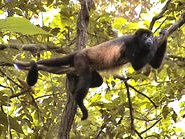
The incredible contact roars of Mantled Howler Monkeys (Alouatta palliata) are a frequent wake-up call to visitors to the New World tropics.  They were studied in a Nicaraguan shade coffee plantation, which had a diverse (60+ species) canopy which insured that preferred foods were available to the monkeys year-round. The monkeys did not avoid areas of coffee plantations, but stuck to the larger trees. The authors concluded that shade coffee can serve as alternate wildlife habitat and corridors between forest fragments for howling monkeys and possibly other forest mammals.