Starbucks

The sincerest form of flattery

Last year, Counter Culture Coffee launched its Direct Trade program. They also started rolling out their current line of packaging: brown kraft-like valve bags with a sleeve that has nice origin-appropriate art, a map on one side panel showing the source, tasting notes on the other side, and a good description of the farm or co-op on the back. I believe they won an award at a coffee trade show for this labeling.

This year, Starbucks debuted “seasonal coffees.” These coffees are only available for a limited time, and are “harvested in-season when they are at their peak of flavor.”  I’m not sure what Starbucks is really trying to say, since all coffee is harvested “in season.”  Coffee is at its peak flavor when it is fresh — when the green beans have not been sitting around for ages, and when it is freshly roasted. Maybe these seasonal coffees are not as stale as the Starbucks coffee often found on store shelves. But I digress.

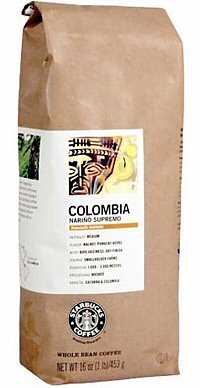
What I really wanted to point out was that the packaging for the new Starbucks seasonal coffee line looks very familiar. A brown (non-valve) bag, with a printed wrap-around-look label with art on the front and tasting notes and a map on the side… You get the picture. If not, here you go:

Coffee review: Starbucks Organic Shade Grown Mexico

Plainspoken Coffee. A Coffee Review for Ordinary People by Ordinary People, #41.

Starbucks Organic Shade Grown Mexicois produced by around 900 small farmers on 3200 ha of land in the southern Mexican state of Chiapas [1]. Many of the farms are near or adjacent to the El Triunfo Biosphere Reserve, which contains the northernmost cloud forests in the world and is considered as one of the greatest biodiversity sites of North America. El Triunfo totals 119,000 ha, of which 93,458 ha corresponds to a buffer zone and the rest to the core areas. Core areas are primary forest owned by the government. The buffer zone consists of privately owned lands, about 60% of which are forested. The remainder is agricultural, with shade coffee being the dominant crop; up to 70% is rustic shade.

Originally this coffee was to be a temporary offering, but proved so popular that it is on the permanent Starbucks menu.

Background

This coffee-sourcing is part of a partnership with Conservation International (CI) which began in 1998. Originally, this was to be a three-year program with CI providing technical assistance to producers encouraging them to continue eco-friendly growing practices, and Starbucks as a dependable buyer. This partnership has continued with some new wrinkles, including the development of Starbucks C.A.F.E. practices.

This project has not been without controversy. One main gripe has been that the contracts with Starbucks paid above-market prices, but the beans went through the large exporter and processor Agroindustrias de Mexico (AMSA), which took a cut of the price. This doesn’t seem like an unusual arrangement and perhaps the only practical one with between a large buyer and dozens of cooperatives. At some point Starbucks did try to deal directly with producers, but the cooperatives were unable to arrange shipment.

Some of the co-ops withdrew from participation. Various reasons have been given. According to CI’s report to USAID [1], when the world price of coffee rose above the price already agreed to in the contracts, producers reneged and sold to other buyers (a not too-uncommon occurrence). Some felt that, after a long struggle for autonomy, that they were once again beholden to middlemen [2]. CI apparently negotiated many of the initial contracts, and some producers later regretted signing when they found out Starbucks was the end buyer (was that not in the contracts?). There were also objections to quality demands being imposed on them.

Nonetheless, the arrangement with Starbucks did and has increased income for many of the farmers. One co-op mentioned as a participant in a New York Times article was identified by a Fair Trade advocate as being organizationally weak, not well suited to judging the quality of their own beans, and unable to seek out other buyers. If that’s the case, this co-op may not be qualified for Fair Trade certification, and therefore Starbucks might be the best option for them, at least at this time.

While there is a lack of publicly available objective information on the outcomes of the Chiapas coffee project, from what I have read it has had an overall positive net impact. Encouraging and promoting organic and shade-grown coffee is a major goal of El Triunfo conservation efforts. At least for some period of time, cooperatives that withdrew from the CI/Starbucks program had a hard time finding buyers, especially those that would pay high prices and invest in their communities. If Starbucks is purchasing an average of 1.7 million pounds of coffee from this area every year, this is likely a good thing, especially if these producers do not have other options for selling their beans.

Finally, we need to bear in mind that this is a certified organic coffee, but it does not have shade certification by Smithsonian or Rainforest Alliance. As mentioned above, however, the coffee grown in this area, especially in the El Triunfo buffer zone, is traditionally grown in the shade, often diverse shade.

Let’s move on to the coffee
Starbucks Organic Shade Grown Mexico is billed as a medium roast. For a company known to over-do the roasting, I was surprised to see that “medium” was actually “medium.” I think good Mexican coffees are delicate and sweet and should be roasted light, but I suppose medium was a good compromise to cater to the tastes of Starbucks customers. I was also surprised to see that in a French press, this coffee was fresh enough to have a decent bloom.

This coffee was what we expected from a Mexican coffee: pleasant, approachable, smooth, and well-balanced. It was fairly sweet with hints of chocolate; a couple people thought that rather than milk chocolate it was a more bittersweet dark chocolate, perhaps due to the roast. One person tasted cinnamon. Overall, comments were quite positive. A few people with known anti-Starbucks sentiments were grudgingly impressed. This is a decent coffee that most people should find more than acceptable. When the votes were tallied, it came away with a solid 3 motmots.

Because of its size, Starbucks falls victim to its own success. Providing a consistent product at such large volumes inevitably means lower quality, buying through exporters (and thus lower prices for producers) and an inability to truly police the growing methods of thousands of farmers. Still, I can think of few other offerings by any of the big roasters that are as positive for the environment as the Starbucks Organic Shade Grown Mexico. It sure beats Kraft’s 30% Rainforest Alliance certified (and 70% mystery-sourced) Yuban, and tastes better to boot.

[1] Conservation International and Starbucks Coffee Company. 2007. The Conservation Coffee Alliance.  USAID Contract # 596-A-00-04-00039-00, Annual and Final Report 2004-2007.

[2] Gonzalez, A. A. and R. Nigh. 2004. Smallholder participation and certification of organic farm products in Mexico. Journal of Rural Studies 21:449-460.
Book review: Starbucked

I’ve just finished Starbucked: A Double Tall Tale of Caffeine, Commerce, and Culture by Taylor Clark, just released by Little Brown. It’s an entertaining, well-written and researched “biography” of the genesis and rise of Starbucks, and the concurrent/coincident specialty coffee scene in the U.S. Anyone interested in Starbucks (love, hate, or neutral) or the genius of retail marketing will really get into this book. Those intrigued with American culture will also find ponderable material here, and it will be valuable for readers who want to understand the post-1970s history of coffee in the U.S. (for the most thorough overall history of coffee, you can do no better than Mark Pendergrast’s Uncommon Grounds).

Clark leaves few stones unturned, especially when discussing the evolution of the Starbucks marketing strategy. The one thing that was barely discussed was sustainability. The closest is an entire chapter on Fair Trade which correctly points out that low-quality robusta coffee is the enemy of struggling coffee farmers, whose

“…fortunes rise and fall on the world’s demand for good coffee beans, and no one has done more to generate an insatiable global thirst for high-quality coffee than Starbucks.”

We can quibble about the quality of Starbucks beans, but the distinction here is between the quality of the big grocery store brands versus Starbucks. While exploding the myth that Starbucks harms independent coffee houses, Clark makes a point I have made here several times: that Starbucks has drawn out people who never strayed from Folgers, and these converts go on to explore other coffee venues.  And with any sort of luck, these converts don’t turn back to grocery store brands. Clark also echoes one of my mantras:

Helping lift farmers from poverty, then, isn’t so much a matter of hectoring companies like Starbucks (even if the company isn’t the human rights champion it claims to be) as it is of making sure people never drink the cheap and exploitive coffee offered by conglomerates like the Big Four.

Not only lifting farmers from poverty, but also preserving biodiversity.

Starbucked will help readers understand why we owe Starbucks quite a bit of credit for transforming coffee culture and triggering a chain of events that is helping consumers realize their own transformative power via the choices they make for their daily cup.

Starbucks Black Apron Costa Rica

Plainspoken Coffee. A Coffee Review for Ordinary People by Ordinary People, #29.

Starbucks Black Apron Exclusive: Organic Lomas Al Rio (Costa Rica).

This review is a tad out of the ordinary for two reasons. First, I don’t buy coffee from Costa Rica. For the most part, they have gone in for sun coffee and chemicals and the Costa Rican marketing model makes it very difficult to identify where and how a particular bean was grown. You can read all the details in my post on coffee growing in Costa Rica. Second, I don’t buy coffee from Starbucks. Not because I dislike the company, but I just find most of their coffee overroasted, not very fresh, and in the case of the Black Apron line, outrageously overpriced ($14/half pound). Nonetheless, the back stories of the Black Apron coffees have been so interesting (e.g., Gemadro, Terranova) that I always see what’s new and what I can find out about it.

The latest Black Apron Exclusive is Organic Lomas Al Rio. Lomas Al Rio is not an estate, farm, or co-op, but a coffee mill in the Central Valley. This area is known for its sun coffee. To its credit, Starbucks makes no claim that this is shade coffee, and clearly states Lomas Al Rio is a mill. This source is not new to Starbucks, which has been purchasing Lomas Al Rio coffee since 1998; it is an intregal part of its Cafe Estima blend.

The Lomas Al Rio mill receives coffee from well over a hundred small and medium farms. It doesn’t process exclusively organic coffee, in no small part because so little organic coffee is produced in Costa Rica (less than 1% of the crop). Many farms in Costa Rica that were once organic have given up on it and gone back to using chemicals (non-organic nitrogen fertilizers in particular). The reason often given is that quality can’t be sustained organically. This is inaccurate in general, but in the case of large areas of sun coffee, it may be true. Sun coffee monocultures strip the soil of nutrients, and pests are more prevalent without the predators (birds, lizards, other insects) found in more forested coffee farms. The long route to high quality organic coffee in Costa Rica would probably involve re-planting a lot of native shade trees. Obviously, it’s easier to just start using non-organic means instead.

Around 2002, Lomas Al Rio was Costa Rica’s first Smithsonian Bird-Friendly certified coffee. Alas, it is no more, having let certification lapse.

No doubt this coffee is Catuai and/or Caturra, as these sun-tolerant varieties are very dominant in Costa Rica. If the “use by” date on the packaging is 6 months out from roasting, we sampled this coffee at two months old, rather long in the tooth. It produced a weak bloom, so I’d guess the we’re pretty close on the age. As I mentioned, most Starbucks coffees are roasted too dark for my taste. This wasn’t too bad, a medium-brown with a sheen, but no spots of oil. But I was dismayed at the pieces and shards in the bag, and the tell-tale missing divots on many beans, a sign that the coffee was roasted too fast. This is a sign of carelessness, but may only affect a given batch. At $14 a box, I was not about to buy another to see how common this error might be. So my expectations were not high. I was very happily surprised.

This coffee had great balance, with a medium body, a pleasant, soft mouthfeel, and a nice finish. It was wonderfully sweet when hot, and it had a distinct flavor than none of us (amateurs) could identify. Marzipan popped into my head — some sort of carmelized sugary almond flavor. Another taster also felt strongly about an almond note. This intriguing mystery flavor meant we tried it repeatedly with different people. Just about everybody liked it, and nobody came any closer to really nailing the sweet taste. Once the coffee really got cool, it took on a sort of odd flavor. But, what do you know, it got a solid 3.25 motmots.

Coffee Review tasted Lomas Al Rio from two different roasters in 1998 and 2002.