Starbucks

Green Mountain and Starbucks make top 100 list

The CRO (Corporate Responsibility Officer, formerly Business Ethics magazine) has just published its eighth annual 100 Best Corporate Citizens, considered the third most influential corporate ranking.  Companies are rated on their performance in eight categories:  shareholders, community, governance, diversity, employees, environment, human rights, and product.

Coming in at #1, for the second year in a row, is Green Mountain Coffee RoastersThe Mermaid also made the top 10, placing ninth; Starbucks has made this list all eight years. Whole Foods Market (owner of Allegro Coffee) was at #54. Missing from the list were any of the big four corporate coffee pushers.

Nestlé and Starbucks respond to illegal coffee report

In an article in an Indonesian newspaper, Nestlé and Starbucks both responded to the report that they had been purchasing robusta coffee beans illegally grown in a Sumatran national park in Lampung province.

Nestlé
A spokesman for Nestlé Indonesia made this statement:

“Nestlé never willingly purchases coffee from dubious sources. However, the company admits the difficulty of determining the precise origin of a coffee bag which has passed through different hands before it reaches the Nestlé buyer.”

The emphasis is mine, which precisely sums up why I continuously recommend not buying supermarket coffees.  If the companies themselves don’t know where their coffee comes from or how it is farmed, how can we know it is farmed sustainably?  Or believe them?

Nestlé also said that the coffee they purchase from Lampung (around 12,000 tons a year) goes to make instant coffee. So brands to avoid = Nescafé and Taster’s Choice.


Starbucks

A spokesperson for Starbucks’ Indonesian partner denied that the company purchased coffee from Lampung (the southern province in question), or any robusta beans from Sumatra at all.

Starbucks is listed in the report on page 50, in an appendix on recipients of tainted coffee.  The list was compiled from records of the Cooperative Industry and Trade Service of Lampung province. It’s possible these records could be forged or falsified, I suppose. There is nothing as yet on the Starbucks web site concerning this issue.

By the way, buyers of Lampung beans should know better.  It was in 2003 that published reports [1,2] revealed that 70% of Lampung’s beans came from inside or adjacent to Bukit Barisan Selatan National Park and that endangered animals were threatened from the illegal cultivation.

[1] O’Brien, T. G. and M. F. Kinnaird.  2003.  Caffeine and conservation.  Science 300:587.

[2] Kinnaird, M.F., E.W. Sanderson, T. G. O’Brien, H.T. Wibisono, and G. Woolmer. 2003. Deforestation trends in a tropical landscape and implications for endangered large mammals. Conservation Biology 17:245-257.

Hat tip to bccy.

Starbucks Ethiopia Gemadro Estate: Corporate greenwashing?

The new Black Apron edition coffee from Starbucks, Ethiopia Gemadro Estate, showed up in our local stores within the last few weeks. Despite our generally low opinion of the taste of many Starbucks coffees, C&C is happy to review them if they can be determined to be sustainable and environmentally friendly.  From the description on the web site, the Gemadro Estate selection seemed like a good candidate.  But as always, we research each source carefully, and in this case we found that the reality of this coffee is not exactly what Starbucks has indicated.

From the Starbucks description:

“In this nation of more than more than 300,000 small, family-run coffee farms, the expansive Gemadro Estate stands as an exception. With its pure water supply, near pristine growing environment and dedication to conservation-based farming methods, this 2,300-hectare farm on the banks of the Gemadro River is setting new standards for progressive, sustainable coffee farming.

At the Gemadro estate, high altitude coffee plants flourish in the protective shade of towering 50-foot ferns. With just 1,100 hectares under cultivation, the remaining estate is devoted to a natural, primary forest that supports the local ecosystem.”

According to my research, this is not exactly the case.

  • The plantation was started in 1998, and the Estate web site confirms the Starbucks information: “Between 1998-2001, a total of 1010 ha of the 2295 ha of its holding was planted with coffee. The remaining land is left for preserving the existing natural vegetation.”  Information indicates the site was written in late 2001 or early 2002. Last month an article in the Ethiopian Herald reported a spokesman said the Gemadro project “had developed coffee on 1,000 hectares of land, adding, the project has began activities to develop additional coffee on 1,500 hectares of land.” (Emphasis added.)
  • This results in damage to the ecosystem. A report on coffee growing in the region of the Gemadro farm (1) described how the expansion of coffee and tea plantations requires opening up of forests, thinning of large trees, and clearing of the understory vegetation.  This in turn exacerbates soil erosion and reduces habitat for wildlife. There is an Important Bird Area in this zone, the Bonga Forest, and the central Ethiopian Highlands are considered a biodiversity hotspot.Additionally, these forests are genetic repositories of wild strains of coffee. Another report (2) states that wild coffee strains are being endangered because montane forests are being cleared or thinned for coffee farms (with the Gemadro Estate parent company being specifically mentioned) and this type of intensively managed “forest” coffee replaces wild coffee with nursery-raised plantsNursery-raised coffee is what is planted at Gemadro.
  • Gemadro Estate is owned by the Ethio-Coffee and Tea Plantation and Marketing, PLC, a division of MIDROC Ethiopia, a MIDROC International Group company. MIDROC is a conglomerate that owns gold mines, hotels, construction and real estate companies, multiple oil companies, cement factories, and other interests that are not generally recognized as being environmentally friendly.
  • MIDROC is owned by Ethiopian-born Saudi Sheik Mohammed Hussien Al-Amoudi. I’ve seen some unflattering profiles of him, but even if he’s the cleanest-living guy in the world, his net worth of $6.9 billion doesn’t inspire me to line his pockets with his latest venture.

Gemadro Estate employs 250 regular and 650 seasonal workers, according to an article in African Business. Al-Amoudi’s companies are Ethiopia’s largest employers, and he is well known for his philanthropy.  Aside from the fact that good deeds don’t always come from wholesome organizations, you can benefit more Ethiopian small-holders and the environment by purchasing coffees that are organic, forest grown, and Fair Trade.

Consider the well-known and widely available Oromia Co-op, with over 23,000 members.  A number of other co-ops are listed at the  Sidama Coffee Farmers Cooperative Union site, which indicates which are organic and Fair Trade.  Novo Coffee has a great selection of Ethiopian coffees, including wild Kaffa forest coffee, and we will be reviewing some of their great alternatives soon.

I don’t hate Starbucks.  They have introduced the public to something akin to specialty coffee, and raised awareness to regular consumers that there is something beyond grocery store slop.  But whereas they have offered some Fair Trade or organic products, this Black Apron selection sounds like a corporate conglomerate sell-out, and calling it sustainable, or saying that it is preserving habitat, is misleading.

UPDATE: See this post for a follow up investigative report.

1. Vlek, P.L.G., ed. 2005. Forest conversion – soil degradation – farmers’ perception nexus: Implications for sustainable land use in the southwest of Ethiopia. Ecology and Development Series No. 26, Cuvillier Verlag GÁttingen, 169 pp.

2. Richerzhagen, C. and D. Virchow.  2002. Sustainable Utilization of Crop Genetic Diversity through Property Rights Mechanisms? The Case of Coffee Genetic Resources in Ethiopia. BioEcon Workshop, 24 pp. (PDF)

Coffee Review: Starbucks Black Apron: Sulawesi Kopi Kampung

Plainspoken Coffee. A Coffee Review for Ordinary People by Ordinary People, #1.

The new C&C tasting panel decided to cut our teeth (so to speak) on Starbucks’ newest Black Apron offering: Sulawesi Kopi Kampung. We chose this for our first test run mainly because The Star[bucks]ling got some on employee comp.

The coffee: Sourced from northern Toraja, in central Sulawesi, an area of lush forest where coffee (often typica) is usually grown under shade.  It is a semi-washed bean.

The beans: It looked like a full city roast, perhaps a bit beyond, as nearly all beans showed some oils.  Sweet Maria’s suggests this may be too dark a roast for a Sulawesi, not surprising from Starbucks.  We opened the bag and took a sniff.  We all agreed it had a distinctive smell. BirdBarista thought they smelled spicy or earthy.  ConLeche immediately said smoky, “like burning leaves.”  Nighthawk also detected a smoky smell, but none of us thought it unpleasant.

In a french press: First, we tried a french press.  The consensus was that this was a very distinctive coffee, with a lot of character.  It had good body, and we thought it was “intriguing,” as we tried to come up with good descriptors.  The flavors of coffees frequently develop as it cools, and it only took a few minutes before our generally favorable impressions began to change.  Star[bucks]ling and BirdBarista began to detect rubber notes.  Really.  The mouthfeel went from lingering and smooth to lingering and “hairy.”  BirdBarista: ”I definitely taste tires.”  Sweet Maria’s described semi-washed beans from Toraja as ”deep and brooding.”  This seemed apt.

Brewed: We may have steeped it too long or made it too strong in the french press, because we really didn’t care for it at all prepared that way. This is a mistake any average joe could make making a cup of joe, so we consider this part of the review valid.  However, the next two days we tried the Kopi Kampung as ordinary drip coffee in the office coffeemaker through an unbleached paper filter.

The results were much better.  It was much “friendlier,” while still retaining a unique character.  The Risky Kingbird liked it.  Nighthawk was quite enthusiastic.  He described it as “pungent and vigorous,” and said it really ”jumps at your palate.”  ConLeche found it hearty, but he said milk neutralized the character.  Once again, as it cooled, we found bitter notes emerging, but overall in the pot it was a much more approachable coffee.  Both Star[bucks]ling and another Starbucks barista, CoalTit (Charbucks, coal, get it?) found it quickly became flat on the palate, the spicy and smoky notes becoming more pronounced.

The verdict was that this was an okay and very distinctive coffee, but perhaps not an every day coffee (good thing, at $13 for a half-pound).  Star[bucks]ling said, ”I wouldn’t want to wake to it.”  It just develops a weird taste after a short period of time.  Surprisingly, we let it sit in the pot for 30 minutes, and it didn’t taste any more bitter after cooking all that time.

When to drink this coffee (field oriented): Mid-afternoon, during a long stakeout watching bird behavior at the nest, when you need to be jarred alert and distracted from your cramped thighs and mosquito bites.

And we’re rating this 2.5 motmots. UPDATE: Coffee Review has posted their comments.
Starbucks responsible coffees

Under the Starbucks category, you can read more about the company’s struggles with committing to Fair Trade and environmentally-responsible coffees.  In particular, Green LA Girl has two posts (here and here) regarding the Starbucks point-based CAFE Practices as they compare to Fair Trade. (Update: an in-depth overview of the latest version of CAFE Practices and their environmental standards here.)

Many people go to Starbucks and want to know — or should know — about which coffees are their most responsible. Here is a run-down on their current offerings.

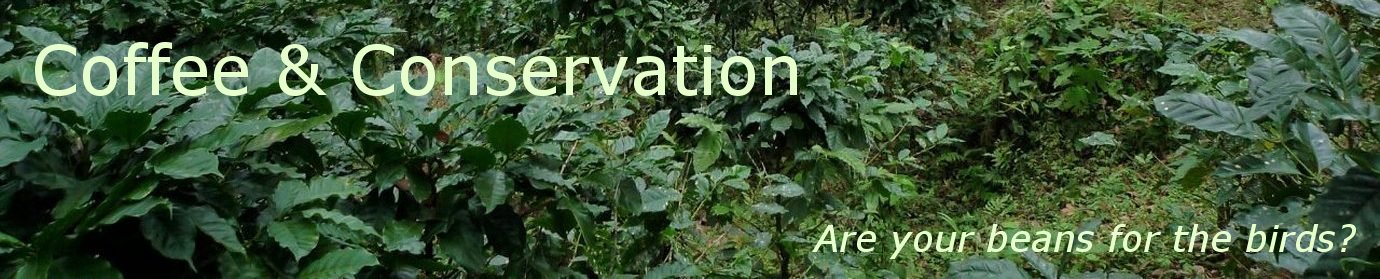
  • Organic Shade Grown Mexico.  Medium roast, origin Chiapas, Mexico.  Grown near the El Triunfo Biosphere Reserve, a park threatened in part by coffee plantations. This is one of the coffees produced in partnership with Conservation International, their “Conservation Coffee.”  Although the description on the Starbucks web page says “traditional shade-growing,” as noted in the post about the partnership, it does not appear that these coffees are grown with any specific or enforced rules regarding degree of shade management or level of organic practices.  Therefore, it does not seem that this coffee is comparable to coffees that are certified organic or bird-friendly. (Update: review and background of this coffee here.)
  • Shade grown Mexican decaf. Medium roast, origin Chiapas, Mexico. Description makes it sound like the same coffee as above, yet it is not labeled organic.
  • Serena Organic. Medium roast, origin Latin America and east Africa. No indication what organization, if any, certifies this as organic.  Coffee Review review.
  • Cafe Estima. Bold roast, origin not specified.  Their featured “Good Coffee, Doing Good” blend.

Starbucks has a line of Black Apron limited edition coffees. They give $15,000 to the farmers of each Black Apron coffee for community projects.  These beans are pricey, and $3 of each half pound must go into producing the fancy laser-cut box.  I just tried the Rwanda Blue Bourbon Black Apron, which is just about at the end of its run, and liked it quite a bit.  But then, I’m a fan of Rwandan coffees.

On the one hand, I give Starbucks some credit for attempting to buy and market responsible coffees; the fact they do it is what counts for me, I don’t care whether they are dragged into it kicking and screaming.  On the other hand, I personally am not a Starbucks fan and think a lot of their coffee is over-roasted.  Click on the Starbucks category for more on the company’s coffees and policies.

Starbucks and Conservation International

Starbucks entered into a partnership with Conservation International in 1998, an alliance also supported by USAID (unfortunately known to finance many projects promoting sun coffee).  Here is a short history of some of the results of that partnership:

In late 1999, Starbucks introduced a shade-grown coffee grown in Chiapas, Mexico that was part of their partnership with Conservation International (CI), which “promotes practices such as water and soil conservation, crop diversification, and chemical fertilizer and pesticide reduction.”  In addition to buying the beans, Starbucks also “provides financial support to the project and offers technical advice to farmers to raise the quality of their coffee.”

In 2001, Starbucks announced new purchasing guidelines it had developed with CI, which award points to suppliers based on sustainability categories. Suppliers with higher points receive a preference from Starbucks.  Starbucks will also pay a premium of up to  ten cents a pound to suppliers who meet sustainability guidelines.  At the time, Starbucks was reportedly paying an average of $1.20 a pound for coffee, which is still below the typical $1.26 per pound Fair Trade minimum.

It is worth mentioning that these sustainability categories are not strictly environmental, but are also based on quality, social conditions, and economic benefits to the communities.  They do mention shade and chemical reduction, but do not impose any enforceable guidelines for shade management or organic farming methods.

In 2003, Starbucks launched a Colombian coffee that was the result of their partnership with CI and the Colombian Coffee Federation, with stated goal “to promote coffee production methods that protect biodiversity and, at the same time, allow coffee farmers to improve their livelihood.” Starbucks also provides substantial financial support to other CI coffee field projects.

The measures Starbucks is taking on environmentally-friendly coffee are not comprehensive.  The CI guidelines are a start, but lack the strong certification for organic or shade-grown farming practices that are needed to truly protect biodiversity. Their efforts are appreciated, and if customers demand it, perhaps they will continue to improve their commitment both to Fair Trade and the environment.