
Research on coffee growing

Research: Ants on Colombian coffee farms

Armbrecht, I., I. Perfecto, and E. Silverman. 2006. Limitation of nesting resources for ants in Colombian forests and coffee plantations.  Ecological Entomology 31:403-410.

Ants are popular research subjects in coffee farms because they are abundant and important components of tropical forest ecosystems (summaries of other research here). This study looked at ants that nest in leaf litter and those that nest in twigs to see if these nest sites are limited in different coffee farm types — sun, monogeneric shade, polygeneric shade, and in forest.

The response of the ants to the type of coffee farm depended a great deal on the species, elevation, and predatory ant assembleges.  Major findings include that there were more species of litter-nesting ants in the shade systems than in sun coffee, and there were more ant colonies in the monogeneric system (one species of shade tree) than in the polygeneric (multiple species of shade trees) or sun systems.  This was an intriguing finding, I thought, and the authors thought that in part it might be due to the fact that the polygeneric shade farms were also organic, and used coffee pulp as a mulch — generally placed right where the ant plots used in the study were located.  Caffeine in the pulp could have depressed the number of ants in these plots (the number of species was very high, however).

The farms were in the Apia municipality, and the sun farms were La Felisa, La Maria, and La Estrella.  This is not the same La Estrella farm that placed in the 2006 Cup of Excellence program (that one is in Huila “state” while Apia is in Risaralda).  La Clarita, one of the polygeneric farms in the study, is Rainforest Alliance certified.
Research: Biodiversity in wild coffee farms in Ethiopia

Senbeta, F. and M. Denich. 2006. Effects of wild coffee management on species diversity in the Afromontane rainforests of Ethiopia. Forest Ecology and Management 232:68-74.

Traditional coffee management in Ethiopia ranges from harvesting cherries in relatively undisturbed forest, to reducing tree and shrub density in semi-forest systems. This study looked at plant species diversity in these two systems in the southeast (Bale Zone of Oromia) and southwest highlands (Bench-Maji Zone) of Ethiopia.

In the forest system, coffee plants made up less than 25% of the plant density versus greater than 88% in the same size class in the semi-forest system.  Continuous management of coffee in the semi-forest system suppresses tree regeneration, reduces tree density, and eventually leads to the disappearance of forest plant species.

This management is leading to a tall tree canopy with no intermediate layer, effecting not only diversity of plants but the structural diversity needed for other wildlife.  In some plots, not even young coffee trees were allowed to regenerate, which means coffee production will end up being affected.  Another way the production of coffee may suffer is that the lack of native forest plants species may also result in a decline of bees and other pollinators. Other studies have shown that coffee fruit set is strongly influenced by the abundance of pollinating insects.

The authors note that “Traditional wild coffee management methods are not based on systematic analysis, and hence opinions among the farmers vary on how to manage the forest.” With a higher demand and stronger market for Ethiopian coffee, farmers
in these areas tend to focus on seed production rather than
preservation of the natural regeneration of coffee trees.  The authors recommend a strategy that will strike a balance between plant diversity (and hence pollinator diversity, which contributes to coffee production, as well as other biodiversity) and coffee production.

They conclude that biodiversity conservation spots are crucial to maintain and enhance biodiversity, including acting as repositories for plant and animal diversity, and genetic resources of wild coffee populations — which are under increasing threat from deforestation — which can prove invaluable in developing new strains.

I consider this an important paper, as most of the emphasis on coffee and biodiversity has been on farming methods in the New World, while African coffees are usually considered “wild” and grown in an un-manipulated manner.  As the Ethiopian and African coffee industries gain momentum, we will have to see how management methods develop, and no longer take for granted that the coffees we purchase from these regions are always sustainable.

Note: If you are not reading this at the blog Coffee & Conversation, the content has been stolen without permission. Please report to coffeehabitat AT gmail DOT com.

Research: Bat diversity in different types of shade coffee

Garcia Estrada, C., A. Damon, C. Sanchez Hernandez, L. Soto Pinto, and G. Ibarra Nunez.  2006.  Bat diversity in montane rainforest and shaded coffee under different management practices in southeastern Chiapas, Mexico.  Biological Conservation 132:351-361.

Southeastern Chiapas is Mexico's primary coffee-producing region.  Very little of the original montane rainforest remains.  Originally, coffee was grown under polyshade, or trees of various species found in the original forest.  Incentives have resulted in many farms using Inga trees for shade; these are native, hardy, fast-growing, deep-rooted, and fix nitrogen (however, production is not increased with Inga, there tend to be more weeds and soil erosion, so replacing forest with Inga doesn't offer many advantages).

This study looked at the diversity of bat species in shade coffee farms that use polyshade; or monoshade (Inga or Inga and bananas) with high, low, or no chemical inputs.  While unaltered montane rainforest had the highest number of species (37), all the others had 23-27 species.  Species composition was different, though, with more fruit and nectar eating bats found in farms with high chemical inputs, which had fewer insect-eating bats.  Application of pesticides decreases insect diversity for these species, especially insect families important to rare bat species. 

Research: Shade coffee farms as habitat for monkeys

Williams-GuillÁ©n, K., C. McCann, J.C. MartÁ­nez SÁ¡nchez, and F. Koontz.  2006. Resource availability and habitat use by mantled howling monkeys in a Nicaraguan coffee plantation: can agroforests serve as core habitat for a forest mammal? Animal Conservation 9: 331-338.

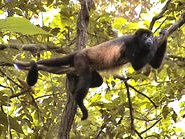
The incredible contact roars of Mantled Howler Monkeys (Alouatta palliata) are a frequent wake-up call to visitors to the New World tropics.  They were studied in a Nicaraguan shade coffee plantation, which had a diverse (60+ species) canopy which insured that preferred foods were available to the monkeys year-round. The monkeys did not avoid areas of coffee plantations, but stuck to the larger trees. The authors concluded that shade coffee can serve as alternate wildlife habitat and corridors between forest fragments for howling monkeys and possibly other forest mammals.