
Research on coffee growing

Research: The value of wild coffee

Hein, L. and F. Gratweiler. 2006.  The economic value of coffee (Coffea arabica) genetic resources. Ecological Economics 60:76-185.

This fascinating paper is not about the sort of ecological research I usually summarize here, but absolutely keeps with the theme of preserving biodiversity, as well as the recent Ethiopian thread that has come up here lately.

First, the authors introduce the importance of ancestral/wild genetic resources in agricultural crops, since careful breeding can impart in existing cultivars genes that can increase yields, confer disease resistance, and improve quality.  Wild coffee, and therefore its genetic resources, are only found where the species originated, in the highland forests of Ethiopia.  The paper highlights two urgent facts:

  • These forests are disappearing at an alarming rate, a rate at which, if it continues, will eliminate the forests in fewer than ten years.
  • Unlike many other plant seeds, coffee seeds are sensitive to cold and maintain their germination potential for only a couple of months.  Therefore, wild varieties are not candidates for seed banks. They must be preserved growing in the wild.

Although the benefits of preserving genetic resources is widely acknowledged, putting a monetary figure on these resources is difficult. The authors of this paper examined the potential economic benefits of preserving the genetic resources of coffee by looking at several characteristics that are known to occur in wild Ethiopian coffees: resistance to three major coffee pests/diseases, a variety with a lower caffeine content, and a higher yield variety.

They concluded that the economic value of Ethiopian coffee genetic resources is between US$420 million up to $1.45 billion (the variation reflects uncertainty in the coffee markets over the period of time it would take to incorporate wild genes into cultivars).  This does not take into account other beneficial characteristics that might be found in wild coffees, such as heat resistance that will be needed in the face of global climate change.

Current inventories of the genetic diversity in Ethiopian forests are inadequate to determine how much forest needs to be preserved in order to maintain the coffee gene pool, conclude the authors.  Certainly, we do not need to be replacing native forest and wild coffee with large plantations of nursery-grown plants. This paper provides significant economic evidence that preserving Ethiopian forests, and their wild coffee resources, are nearly priceless.
Coffee growing and climate change

Coffee (Coffea sp.) requires quite specific growing conditions.  It grows in subtropical regions that have distinct wet and dry seasons.  Although plants can live and produce fruit for decades, drought or heat in summer can diminish production and quality.  And while coffee requires a dry period in the spring, heavy rains in this season can disrupt flowering.

This sensitivity to climatic variables means that global climate change is likely to have profound impacts on coffee growing and production.  An upcoming article in the journal Climatic Change (1) modeled what could happen to coffee production in Veracruz, Mexico if observed trends in climate change continue and coffee prices remain steady.  The report concludes that coffee production will not be economically viable in Veracruz by 2020 due to lowered yields and many current areas becoming unsuitable for coffee growing.

Although there is some work being done on breeding coffee varieties that are more heat-resistant, it will do little to prevent losses due to the climatic instability brought on by global warming (droughts and floods, unusual cold spells) or the pests whose ranges will also change as temperatures rise.

Farmers will be left with few choices.  Areas at higher latitudes (which although too cool now to grow coffee will become warmer) could be used. However, most small holders do not have the money or credit to buy property, even if it is available to purchase; most land is already under ownership that is passed down in families.  If land upslope is turned into coffee farms, it means some conversion and clearing of existing forest, and the old coffee farms will be converted to other crops, none of which is likely to be as environmentally friendly as shade coffee.  This means a loss of biodiversity, and the deforestation of new and old coffee farms will exacerbate and accelerate warming trends, since trees help sequester carbon and buffer temperature changes.

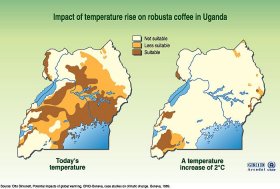
We all have a great deal at stake as the planet warms. Unfortunately, the poor in developing countries, such as coffee growing nations, often bear a large burden.  Even growers of more heat-tolerant lowland robusta coffee, where it is indigenous, stand to lose their livelihoods, as this graphic illustrates.

The authors of the Veracruz report recommend supporting farmers to move into specialty coffee to help to provide some financial security. Purchasing shade coffee and providing incentive for farmers to plant trees rather than cut them down will also help.  As the Fresh Cup article notes,

In the past several decades, roughly half of the world’s coffee plantations have cut down their trees, or cut down forest to plant unshaded coffee. This decreases the ability of vegetation to counteract global warming by absorbing carbon dioxide, and it also raises local temperature.

All the more reason to stay away from corporate technified sun coffee, and enjoy the superior taste of environmentally-friendly coffee.  I’ll be following the research on climate change and coffee, and report further news and suggestions.

(1) Gay, C., F. Estrada, C. Conde, H. Eakin, and l. Villers. 2006. Potential impacts of climate change on agriculture: case study of coffee production in Veracruz, Mexico.  Climate Change 79:259-288.

Abstracts on presentations at the NAOC

Here are some very brief summaries of research that had to do with coffee growing that were presented at North American Ornithological Conference. I also put together a page with full abstracts, and author contacts.

  • Cerulean Warbler (Dendroica cerulea) foraging behavior in the western Andes of Colombia. This species (which I’ve written about before) was common in shade coffee plantations, and only fed in the shade canopy.
  • Population ecology of Cerulean Warblers on breeding and wintering grounds. This study concluded that shade coffee farms in the Venezuelan Andes were critical wintering habitat for this species, with density in the farms higher than in the surrounding forest.
  • Coffee certification as an economic incentive for bird conservation. Discusses the shade coffee farms of central Veracruz, Mexico, many shaded by cloud forest tree species.
  • Certification and birds: the importance of shade coffee plantations for species diversity in the Cuetzalan region, Puebla, Mexico. 182 species were recorded in this area, and while not as rich as primary forest, shade coffee still maintains a high diversity of birds.
  • Traditional coffee plantations: suitable habitat in the anthropogenic matrix for Neotropical resident and migratory birds. A study that complements the previous Puebla study, quantifying the different types of birds found in shade coffee.
  • Neotropical insectivorous birds as pest control of the coffee berry borer (Hypothenemus hampei) on Jamaican Blue Mountain coffee farms.  More on Matt Johnson’s work in Jamaica.
  • Birds, shade grown coffee, and community outreach in Ecuador. Self explanatory.
  • Sensitive bird species in shade coffee plantations. In southern Mexico, shade coffee with high levels of structural diversity (many layers of shade trees) may be good for conservation purposes; however, shade coffee may only be important for forest species which are sensitive to deforestation and disturbance when close to intact forest.

Research: American Redstarts in Jamaica

Johnson, M.D., T.W. Sherry, R. T. Holmes, and P.P. Marra.  2006.  Assessing habitat quality for a migratory songbird wintering in natural and agricultural habitats. Conservation Biology 20:1433-1444.

This study examined American Redstarts (Setophaga ruticilla) in natural and agricultural habitats in Jamaica.  Redstarts are beautiful warblers that nest in North America and winter in the tropics (see map).

Four natural habitats were compared with two agricultural habitats: citrus groves and shade coffee plantations, which were shaded primarily by Inga vera, with understories of varying densities.

Measures of habitat quality for redstarts on the coffee farms was generally intermediate between the best and worst natural habitats.  Two measures, body mass and overwinter survival, were very similar in shade coffee and the best natural habitat. Body mass is especially important.  It indicates that enough food is available, and maintaining body mass is critical for later survival, even after departure from the wintering grounds.  This study estimated that a loss of 0.1 grams (a very tiny amount!) over the winter corresponded with a 6.8% reduction in annual survival probability.

The authors provide two caveats: First, this study focuses on a single species in a single region.  And importantly, there is no similar data to compare the quality of present coffee farms with the habitat from which they were carved. Although shade coffee farms can provide habitat for some species, they do not possess the complete suite of species or ecosystem functions as the original habitat.

The paper named the three shade coffee farms/areas that were used in the study.  None were in the eastern Blue Mountain region. One was in the western growing region, in James Hill, Westmoreland Parish.  Two were in the central highlands in Manchester Parish, Coleyville Farm and Baronhall Farms.  Most coffee is pooled and single estates are hard to find, but Baronhall (formerly Broomhall Estate) is apparently an exception.  I have been able to find various roasters offering this coffee.  Here is a review of Jamaica High Mountain, Baronhall Estate at Coffee Review.