Research on coffee growing

Research: Leaf-cutting ants do not harvest coffee leaves in shade farms

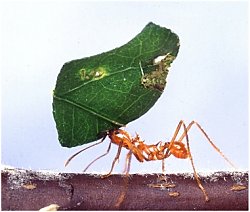
Varon, E. H., S. D. Eigenbrode, N. A. Bosque-Perez, and L. Hilje. 2007. Effect of farm diversity on harvesting of coffee leaves by the leaf-cutting ant Atta cephalotes. Agriculture and Forest Entomology 9:47-55. Leaf-cutting ants, which are common in the tropics, cut pieces of live leaves and carry them to underground burrows where they are used to raise a fungus, which is the food of the ants.

The types of leaves these ants harvested were studied on Costa Rican coffee farms which varied in the diversity of tree species present.  In sun coffee monocultures, the proportion of coffee leaves harvested was highest, at 40% of total biomass.  It was under 1% in farms with complex shade, and the ants preferred shade tree species over coffee when given the choice in trials.

Leaf-cutting ants can consume 12 to 17% of leaf production in an area,and can defoliate coffee plants if there are not preferred alternatives. Damage to coffee plants by these ants is minimized by the availability of a diversity of shade trees.

Photo of Atta cephalotes by Scott Bauer. USDA Agricultural Research Service.

Endangered coffee

I previously discussed the important species and varieties of coffee. An understanding of these varieties can be of great help to consumers looking for sustainable coffee, as different types are typically grown under shade or sun conditions.  The species and varieties of coffee familiar to consumers, however, are just a tiny part of the coffee family tree.

Rather astonishingly, no comprehensive monograph on the taxonomic status of coffee has been published since the 1940s.  That was recently remedied by a lengthy paper published in the Botanical Journal of the Linnean Society.* It details 103 species in the genus Coffea: 41 species in Africa, 59 in Madagascar, and three in the Mascarene Islands; no naturally-occurring Coffea species are found outside of these three areas, and no species is shared between the three areas.

While most of the paper is of interest only to botanists, one aspect is quite striking.  Over 70% of coffee species can be categorized as threatened using World Conservation Union (IUCN) Red List definitions:

  • 14 species (13.6%) are Critically Endangered,
  • 35 species (33.9%) are Endangered, and
  • 23 species (24.2%) are Vulnerable.
  • An additional 13 species (13.7%) are Near Threatened.

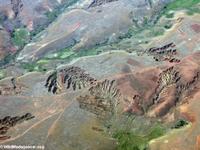
The majority of the most threatened species are from Madagascar, an island with a high level of endemism and deforestation. The authors note there is virtually no in situ preservation of coffee genetic resources, and there are difficulties in conserving coffee genes ex situ because of its general lack of suitability for placement in seed banks (see also my post on The value of wild coffee). Habitat loss is the single most important threat to rare coffee species. The photo shows dramatic erosion on deforested areas in western Madagascar, courtesy of Rhett Butler’s excellent Wild Madagascar web site, where you can read more about this country’s environmental issues.

*Davis, A. P., Govaerts, R., Bridson, D. M., and Stoffelen, P.  2006. An annotated taxonomic conspectus of the genus Coffea (Rubiaceae). Botanical Journal of the Linnean Society. 152:465-512.

Research: Biodiversity and profitability in coffee agrosystems

Gordon, C., R. Manson, J. Sundberg, and A. Cruz-Angon.  2006. Biodiversity, profitability, and vegetation structure in a Mexican coffee agrosystem. Agriculture Ecosystems & Environment 118:256-266.

This study looked at coffee grown in various types of shade in central Mexico, and any correlation between biodiversity (in birds and mammals) and profits. The conversion of plantations to sun coffee is generally believed to increase yield (and therefore profits), while the preservation of shade and forest tree species is thought to be costly in terms of decreased yield.  However, the additional costs of chemical inputs and labor in sun coffee may offset any increases in yield.  This study sought to examine this purported trade-off.

They found no support for a trade-off between biodiversity and profitability. Biodiverse, large shade plantations were highly profitable under all price scenarios, even profit calculations did not include any price premiums, such as those received if a farm is certified organic.  The authors concluded that farms and the environment both stand to gain…

“…by dispelling the notion that high-input, low biodiversity and sun and specialized shade coffee cultivation systems are the most economically sensible ways to grow coffee.”

Sites that were shade monoculture (or “specialized shade”) — with a low diversity and density of shade trees — were indistinguishable from sun coffee in terms of abundance and diversity of forest birds.  This emphasizes the point that not all shade coffees preserve biodiversity. These farms have shade trees, could market their coffee as “shade grown,” and may appear to non-biologists as having a lot of birds (which tend to be common, open-area generalists like grassquits and sparrows), but really do not preserve the diversity of species that were present before the native forest was cut down.

Many farmers have the erroneous belief that epiphytes parasitize shade trees, and they remove them. Biodiversity and profitability could immediately increase if farmers stopped this practice (called “destencho”). See this post on the value of epiphytes in coffee farms. Compared to intact forest, even the shaded farms lacked a number of bird and mammal species, in particular those that utilize the understory and ground level.  These are the layers most managed and disturbed in coffee farms.  Diverse shade coffee farms are best at preserving species that live in the upper layers and canopy.
Research: Nesting birds in shade coffee

Gleffe, J.D., J. A. Collazo, M. J. Groom, and L. Miranda-Castro.  2006.  Avian reproduction and the conservation value of shaded coffee plantations.  Ornitologia Neotropical 17: 271-282.

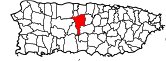
Most of the research on birds and coffee farms focuses on migrant birds which breed in North America and winter in the tropics.  This is the first study to examine the nesting success of resident birds in shade coffee plantations compared to secondary forest.  The study took place in north-central Puerto Rico, and the shade coffee farms were in the Ciales area (map).

The majority of bird nests (72%) were found in shade coffee, and 26 species were recorded in coffee, versus 22 in secondary forest. Six species were found only in coffee, two only in forest.

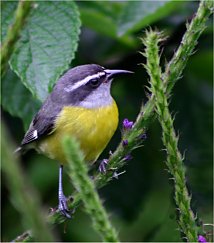
Thirty-two different plant species were used as nest sites in coffee, with the two most common plants used for nesting Inga vera and Andira inermis.  Coffee trees themselves were host to 26% of the nests, many of which were of the Bananaquit (Coereba flaveola), shown here at right. However, it was the canopy trees that were the most important and harbored most of the bird species in both the coffee and forest habitats. The stunning Puerto Rican Woodpecker (Melanerpes portoricensis), an endemic species, is one example of a bird that needs mature canopy trees for nesting. These canopy trees, of course, would not be present in sun coffee plantations, and the authors emphasize that it is the value of shade coffee plantations for preserving birds depends on the shade canopy layer, not the coffee itself.

The study also looked at reproductive success, and discovered that it was similar between coffee and forest, an important finding.  The authors suggest restoration of native shade canopy in existing and new coffee farms to conserve avian diversity in Puerto Rico.  This is especially important because Puerto Rico is experiencing both deforestation due to urban sprawl and development, and the majority of coffee grown there (59%) is sun coffee, with more being converted.  Consumers should choose their Puerto Rican coffee very carefully.  One source I found from the area where the study took place was Finca Cialitos (web site in Spanish, store in English).