Corporate coffee

When birders* drink Folger’s

An editorial recently appeared in the scientific journal Conservation Biology. It was titled “When swordfish conservation biologists eat swordfish.” As the title implies, it’s a riff on the hypocrisy of avowed conservationists when their own lifestyles are inconsistent with the messages they voice. It struck a big chord with me, so I am going to borrow on its theme and major points.

One of my biggest frustrations is the resistance among many birders to change their coffee buying habits. Most birders I’ve talked to are aware that shade grown coffee preserves habitat and is very important to birds, and that mass produced coffee and grocery store brands are bad for the environment. But the next thing I often hear is some excuse why they still drink unsustainable coffee: they can’t find shade coffee, it’s too expensive, they don’t understand or trust certifications, they don’t like the shade/organic coffee they’ve tried, or…no excuse at all. Just a shrug and an admission of guilt.

Not only is it time for us — birders — to acknowledge that our consumption is often in conflict with our professed beliefs and passions, it’s time to do something about it.

In an ideal world, corporate conscience or government regulations would see to it that our environment is protected and that habitats are not destroyed needlessly. But in reality corporations and elected officials both respond to the values and actions of public consensus.

For coffee, certifications (such as Fair Trade, organic, or Bird-Friendly) help fill a regulatory vacuum. But since they are voluntary and not legally required, they are market-driven. Market forces will favor the standards that are easiest to meet. Participation by producers and distributors is reliant upon them gaining higher prices, better market access, or positive social benefits. Lack of consumer demand for the certified coffees undermines all of these motivations.

Chestnut-sided Warblers used to winter here, once upon a time.

Lack of demand has also contributed to the scarcity of certified coffees in the market. Consumers need to grow this market segment. Seeking out sources of sustainably-grown coffee, even if it lacks a certification seal, sends a message to producers. But it means doing a lot of homework. So no matter how you look at it, it is our responsibility to become informed, and we are left to make hard choices regarding our coffee buying habits ourselves.

Of all people, aren’t we as birders the ones who should be setting the example for others? Certainly we are far more informed about the habits, natural history, and declines in many migratory birds than the general public. If we can’t translate our love for birds into action in our daily lives, who are we to criticize the “drill, baby, drill” mentality of others?

To not make the effort to drink coffee that sustains the habitats not only of the creatures that bring us joy, but also of an enormous chunk of the biodiversity that sustains our planet, is not being a particularly responsible world citizen. It also indicates a belief that the actions of individuals do not matter.

The ConBio editorial ended with a quote from Mahatma Gandhi that I will repeat here:

“You must be the change you want to see in the world.”

I want to see a world filled with birds and tropical biodiversity. I want to support that, even with the small but powerful gesture of the coffee I choose to drink.

(A follow-up to this post is here.)

~*~

*You may substitute “nature lovers”, “conservationists”, “environmentalists”, or other green type and still get the picture.

Photo of Doka Coffee Estate in Costa Rica by Josh Yellin via Flickr under a Creative Commons license.

Bearzi, G. 2009. When swordfish conservation biologists eat swordfish. Conservation Biology 23:1-2.

Fight poverty: Quit drinking corporate coffee

If you are one of the 160 million coffee drinkers in the U.S., you can make a decisive, positive impact on poverty by refusing to buy coffee from, at least, Nestlè, JM Smucker, and Kraft Heinz. They sell over 30% of the retail volume of coffee in North America. Their brands include Folgers, Maxwell House, Nescafe, Gevalia, and others.

Here is how your grocery store coffee perpetuates poverty

  • Over 25 million people are directly dependent on coffee growing for a living, with another 100 million indirectly involved, including seasonal or temporary workers.
  • The majority of the coffee in the world is grown in 50 developing nations by producers that each farm less than 5 hectares of land [1].
  • Under good conditions, it costs a farmer around 30 cents (for the cheapest robusta in Vietnam) to 80 cents (for ordinary arabica from Central America; both are included in grocery store coffee) to produce a pound of coffee [2,3,4,5].
  • In 2007, even if farmers received the full market price for their coffee (and typically they do not), their profits amounted to 20 to 50 cents a pound [6,7].
  • Another way to look at it, is that only 5 to 10% of the retail price of a pound of coffee goes to the farmer [8,9,10], and the average retail price for a pound of ground coffee is well under $4.00 a pound.
  • Remember, this is a crop grown on a small plot of land harvested once a year that is probably the main source of income for an entire family.

The big multinational coffee companies perpetuate low coffee prices. Under the free market system, these four main buyers pit 25 million sellers against each other, creating a race to the bottom. They have funded and encouraged the expansion of the low-cost, low quality robusta coffee, and have spent millions of dollars developing technologies to make this bitter variety palatable. They use increasing amounts of this coffee in grocery store blends, further fueling deforestation and dragging down prices. A Wall Street journal article quoted officials from both Nestlè and Kraft as saying that they believe increasing consumer demand for coffee is the best way to help farmers, rather than paying above-market prices for their beans.

This situation is beginning to worsen, as production costs for coffee farmers around the world are rising due to the skyrocketing costs of petroleum-based fertilizers, and the global credit crunch.

The International Coffee Organization notes that low bean prices fueling corporate profits cause “entire rural communities to disappear…forcing desperate peasants into everything from crime and illicit crops to illegal migration.” [3]

Why should you care about the incomes of coffee farmers?

When coffee ceases to be profitable, the coffee fields — which for a large number of small holders are a mix of coffee, food and timber trees, and native shade trees — are cleared. They may be replaced with barren cattle pasture, subsistence crops, or some other crop less eco-friendly than coffee.

There is a direct link between environmental degradation and poverty. There is also a substantial overlap between coffee growing areas and biodiversity hotspots. Deforestation in these areas has severe consequences for loss of biodiversity. Tropical forests, even agroforestry systems, sequester many tons of carbon and help buffer against climate change.

Often the only alternative cash crop is drugs. In Latin America, the crop of choice is coca, the raw material for cocaine.

Efforts to eradicate coca in the coffee-growing nations of Colombia, Peru, and Bolivia are funded by your tax dollar, to the tune of $5 billion so far. This effort has been unsuccessful, and coca production continues to rise. All of the cocaine destined for the U.S. is grown in the Andes, with 90% from these three countries. The cost of drug abuse to society impacts every single one of us.

As coffee prices fall, such as during the coffee crisis in the 1990s, some farmers simply abandoned their land. Some were forced to sell their assets, such as cattle. They took their children out of school. Child malnutrition climbed. Communities wrenched apart by the coffee crisis have not fully recovered. Many farmers that stayed in coffee continue to be in debt.

This was and is a humanitarian crisis. Thousands of impoverished coffee farmers made their way north, with many crossing the border into the U.S. to seek employment.

Can switching the coffee I drink really help?

The U.S. is one of the world’s largest coffee consumers. We can make a difference. Quit supporting the poverty and environmental destruction that cheap coffee from these large multinationals perpetuates.

Good coffee for which a fair price is paid is not too expensive for most Americans. In fact, 45% of Folgers and Maxwell House purchasers have incomes greater than $50,000 a year. Even coffee that costs $15 a pound works out to well under a dollar a cup, tastes great, helps preserve biodiversity, and provides a decent living for coffee farmers.

Drink sustainable coffee!


[1] Fitter, R. and R. Kaplinsky. 2001. Can an agricultural ‘commodity’ be de-commodified, and if so, who is to gain? Institute of Development Study Discussion Paper 380, Brighton, Sussex, England.
[2] Jaffee, D. 2007. Brewing Justice: Fair Trade Coffee, Sustainability, and Survival. University of California Press.
[3] Fritsch, P. 2002. An oversupply of coffee beans deepens Latin America’s woes. Wall Street Journal.
[4] Marsh, A. 2007. Diversification by smallholder farmers: Viet Nam Robusta Coffee. Agricultural Management, Marketing, and Finance Working Document No. 19. FAO, United Nations, Rome.
[5] Anon. 2003. Guatemala Coffee Producers Cautiously Optimistic On Price Bounce, Volcafe Newsletter, Jan. 17023, 2003.
[6] International Coffee Organization. 2008. Coffee  Market Report, September 2008.
[7] Johnston, L. A. 2007. Using a value chain approach to empowering the rural poor in Kenya,Tanzania, and Mozambique.  TechnoServe presentation to Making Markets Work for the Poor, Stellenbosch, South Africa.
[8] Talbot, J. M. 1997. Where does your coffee dollar go?: The division of income and surplus along the coffee commodity chain. Studies in Comparative International Development 32: 56-91.
[9] Talbot, J. M. 2004. Grounds for Agreement: The Political Economy of the Coffee Commodity Chain. Rowman & Littlefield, Lanham, MD.
[10] FAO. 2006. Governance, Coordination, and Distribution along Commodity Value Chains. An FAO Commodities and Trade Division workshop, April 4 and 5, 2006, Rome.

Coffee beans by Rogiro, coffee cup by Chris Campbell.

Folger’s finds another way to make poor beans taste "better"

Folger’s (owned by Procter & Gamble*) is introducing a new roasting method that they say is “the biggest innovation since the launch of decaf” according to an article in the New York Times. The article says

P.& G. has overhauled its main roasting plant in east New Orleans — which employs more than 400 people — to include a step it calls ”predry” or ”preroast.” Each bean is fully dried before roasting, ensuring a more evenly cooked bean, which makes it less bitter…Jim Trout, innovation leader for research and development, at P.& G., said: ”It’s like thawing a turkey before you cook it. If you don’t, the outside will be burnt and the inside will still be raw. This way it cooks evenly all the way through.”

P&G makes it sound as if they’ve come up with some necessary innovation that will improve the taste of coffee. The truth is, it’s only necessary for corporations like P&G, Kraft, Nestlé, or Sara Lee that deal is millions of tons of coffee to utilize multiple post-harvest steps to make their product drinkable.

Green coffee beans do contain water. The drying process, which takes place shortly after harvest at the farm or mill, brings this down to 11 to 12  percent (further drying makes the beans brittle and the flavor bland). Skilled coffee roasters take the unique characteristics of a particular crop into account (including water content) in order to transform the raw, tasteless bean into a the flavorful roasted product that will highlight the best features of the crop in the cup. They also roast in small batches, from 7 to 25 or perhaps 50 pounds, in order to best control the roasting process and the delicate transformations taking place.

I repeated the word “crop” to remind us all that coffee is an agricultural product, not a bolt or a fan blade. Coffee beans vary from year to year, region to region, farm to farm, and even tree to tree depending on microclimate variables.

That’s the first problem big companies like P&G face. They get tons of beans from multiple sources. Some are wetter than others, and some are drier. They roast them in 300-pound batches. If they are to get any consistency, they have to start off with a uniform product — something closer to a bolt than to an agricultural product. Pre-drying/pre-roasting would indeed even out the beans so that they can “cook evenly all the way through.”

Actually, pre-drying is not a new procedure for P&G. In 1989, P&G used it to make beans more porous in order to impregnate them with compounds that would enhance the flavor while simultaneously treating them with enzymes to extract bitter compounds (found in cheap robusta beans). The following year, P&G applied for a patent using pre-roasting for creating dark roasts. They come right out and state in the application that

Low grade coffee beans with many defects will burn and scorch more readily than wholesome beans, causing non-uniform roasted bean colors and tastes … It is an object of the present invention to dark roast poor quality beans with less tipping and burning when compared to present dark roast processing.

Pre-drying and fast roasting also results in roasted beans that are less dense. In 1991, P&G worked out the method, incorporating pre-drying, that produced reduced density (lighter by weight) high yield (same number of cups from fewer beans) coffee. P&G’s “new” roasting method saves P&G lots of money in shipping costs.

According to the data provided by P&G to the Enquirer, what was once a 13 oz. can will now weigh 11.3 oz. but still  produce 90 cups of coffee. Tens of thousands of lighter cans of coffee will add up to significant cost savings in shipping with today’s high fuel prices. If the consumer pays the same price for each can of coffee, it will generate even more profit.

Technically, it’s true that this method improves the taste of Folger’s coffee — because they use low-quality beans to begin with, as is stated in each of their patent applications. In their application “Process for making reduced density coffee,” P&G notes that robustas are the preferred bean (it also states that even moldy beans “show a slight improvement”!).

Do not support these technological “advances” that allow the big multinationals to continue to purchase, and encourage the farming of, low-quality cheap coffee beans. It pushes farmers into poverty and destroys the environment.

*JM Smucker purchased the Folger’s brand earlier this year, and the deal is expected to be completed within a few months.

Walmart’s deceptive coffee claim

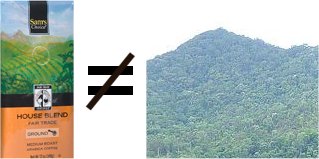
Walmart claims that if every Walmart shopper bought a bag of Sam’s Choice Rainforest Alliance (RA) certified coffee, it would preserve 135,000 acres of land.

And that’s complete bull.

In researching another article, I came across Walmart’s “Sustainability Substantiation” page. It lists a number of their “earthy-friendly” products, and the supposed impact if every Walmart shopper bought one of that particular item.

The claim for Sam’s Choice Rainforest Alliance (RA) certified coffee is that if every Walmart shopper bought a bag, it would preserve 135,000 acres of land. Here’s how they calculated it:

200,000,000 = the number of Wal-Mart shoppers
0.000675 = acres of land every 12oz bag of Rainforest Alliance certified coffee helps preserve
135,000 = acres of land that 200,000,000 12oz bags of Rainforest Alliance certified coffee helps preserve

The math is correct, but the premise is completely wrong. I don’t know where they got the figure that each bag of coffee “preserves” a fraction of an acre of land, but it really doesn’t matter. The fact is that buying RA certified coffee doesn’t preserve anything. RA doesn’t take a portion of each sale and go out and purchase land and create nature preserves, and coffee farmers don’t take their small extra profit from the sales of certified beans and go purchase land to “preserve” (if anything along these lines, they’d plant more coffee, perhaps clearing land to do so). The land is already “saved,” no matter how many bags of coffee from these farms is purchased.

Further, the majority of the land (or “tropical forest”) this coffee purports to preserve (or “help preserve,” “protect,” or “save” — different terms and calculations are used on the page as well as the web page of the coffee itself), is not pristine forest or forest at all, it’s COFFEE! Some farms do include land set aside for conservation, but the bulk of certified land is planted in coffee under varying degrees of shade. As I write about here all the time, it’s better than sun coffee, but not as good as forest for biodiversity.

The ridiculousness of this claim is illustrated by playing along with Walmart’s math. What if every Walmart shopper bought one bag of Sam’s Choice RA certified coffee once a week for a year, a reasonable level of consumption? That’s 10,400,000,000 bags of coffee, resulting in 7,020,000 acres of land “preserved.”  (Let’s ignore the fact that RA certifies only a million acres of farmland worldwide — including all other crops they certify). The entire country of Brazil, the source of Sam’s Choice coffee, has about 2.3 million hectares (5,681,000 acres) planted in coffee. Look! In less than a year, Walmart shoppers can “preserve” the entire coffee production area of Brazil, the world’s largest producer of coffee!

You get the point.

Don’t get me wrong. I’m not knocking the purchase of Rainforest Alliance certified coffee, from Walmart or anyplace else. I encourage it!  And arguably Walmart can expose more people to the concept of and issues around sustainable coffee than any other retailer in the world, which is terrific. I appreciate this effort at education, but abhor the obvious implication that each purchase contributes to the creation or true preservation of actual forested land. It’s misleading to consumers and does nothing to help those of us who know better to trust Walmart’s sustainability efforts.

Buying Sam’s Choice RA certified coffee doesn’t “save” or “preserve” land. It can encourage, through higher sales and more profit for the producing farms, other farms to become certified. This should result in improved environmental conditions on these farms, such as the addition of shade trees or upgraded water treatment methods — if the farms needed to make improvements to become certified, versus obtaining certification for existing sound practices.  This is a good thing. Why can’t they just say so?