Corporate coffee

Deforestation from commodity coffee drags on

The New York Times Magazine published a well-written account about the ongoing illegal coffee growing in Sumatra’s Bukit Barisan Selatan National Park. The article focuses on the Wildlife Conservation Society’s investigations into continued forest clearing in the park by small farmers who sell their coffee at rock-bottom prices to middlemen, who then sell to large coffee companies. The article notes this probe began around 2015. However, the World Wildlife Fund put out a detailed report on this issue in 2007, and a paper in a well-respected peer-reviewed journal in 2009 outlined that this problem had already existed for 30 years. Below I list all the posts in which I summarized or wrote about the illegal coffee growing (and purchasing) in this region.

The Times piece nicely laid out the complexities of the situation and the plight of the exploited farmers. The Wildlife Conservation Society concluded the certifications and traceability were not working because the supply chain was so complicated that the auditing was “too expensive for exporters specializing in cheap, bad coffee.” Nor was expelling or punishing farmers the solution, so WCS launched a program to help farmers improve their yields and livelihoods, even at the borders or within the park with the goal of reducing additional deforestation and eventually reforesting plots.

I’m not going to delve into the pros and cons of this approach, other than to say that I don’t think conservation organizations need to be in the business of agricultural extension services when the giant corporations raking in billions of dollars of profits at the expense of farmers and the environment could and should easily be funding and executing these efforts in totality*. Once again, the responsibility for ensuring environmental ethics and sustainability is fobbed off on a third party. There is no mention in the article on the importance of the “demand” side of the equation, although the author provides this brilliant and not-so-subtle hint:

The reality is that such beans are sold into the anonymity of a commodity market designed to make uniform products for placeless destinations. The point of this coffee was to forget that it had ever come from anywhere at all.

A company can decide to sacrifice profit for ethical responsibility, but only to the degree that shareholders allow them to. And it is the people who buy the products that influence the bottom line which pushes the shareholders to make a company change policies. The article, while illuminating, leaves the average reader feeling rather helpless, or at least with the impression that some organization out there is working to solve the problem.

The average reader is you, and there is something you can do to move the needle in this complex situation. It’s simple and elegant: Remember that your coffee does come from somewhere, and make the choice not to buy and support cheap, anonymized, corporate coffee.

My posts — tons of background:

*And indeed some of them are partnering with WCS to tackle this problem, such as Olam International and JDE. If you believe that corporate giants are sincere or effective in their efforts, consider Nestlé’s “zero deforestation” claim. Despite the fact that Nestlé purchases more coffee than three of the five raw products included in the plan (soy, meat, or palm oil), it was not a commodity Nestlé chose to include in this plan.

Nestlé 2015 sustainability report: What you need to know

Update, April 2024: Shared value is a joke for coffee farmers in Chiapas, Mexico. Promises and assistance by Nestlé have fallen so short of covering costs for these farmers they burned sacks of coffee in the streets.

Nestlé has released their 2015 Creating Shared Value report. The Swiss multinational is one of the largest food companies in the world and produces one of the most correspondingly voluminous CSR reports. I delved into the 2013 report in some detail, and you can refer to that post for context. Here, I will just highlight the most salient reports regarding coffee.

  • Nestlé continues to purchase about 10% of the world’s coffee production. In 2014, those purchases totalled 842,000 metric tons, in 2015 it was 849,000 tons. I track these figures in the table at Corporate coffee: How much is eco-certified?.
  • Of those 849,000 tons, only 56% is traceable back to a farm or plantation (p.115). The company defines that traceability as 4C Verified — compliant with the most rudimentary, baseline standards in the industry. Or to put it another way, over 373,000* tons is NOT traceable to source and may not even meet the most basic standards of ethical human and environmental decency.
  • More astonishing, Nestlé sources about a quarter of their coffee (225,600 tons) directly from 760,000 farmers (p. 100) via their Farmer Connect program (p.117) of which 85% is 4C compliant. That means 15% of their direct-sourced coffee — from known producers they are working with — is not even 4C Verified.
  • 85% of the approximately 55,000 tons of coffee used for Nespresso’s permanent Grand Cru coffee pod selections is sourced under their Nespresso AAA Sustainable Quality program (p. 119), about the same percentage as the past 3 years. This is their proprietary program based on Rainforest Alliance standards. Read more here.
  • There is no mention of the volume of organic or other eco-certified coffee purchases. Nestlé doesn’t place value in third-party certification for coffee (see statement below).

nestle-no-cert-clip

At 351 pages, there is much more material in the report, which you can download at their website.
_______________

*56% of 849,000 tons = 475,440, although later (p. 118) in the report they say that 482,054 tons represents 56%. The latter would mean they purchased 860,811 tons of coffee, so I used the former figures, as they are given several times in the report.

McDonald’s sustainability update

mcdonalds-logoI have reported previously on McDonald’s efforts to improve coffee supply chain sustainability, part of a larger effort in overall sustainability. In my post “McDonald’s makes a substantial commitment to coffee sustainability”  I provided an overview of 2013 levels of certified coffee and farmer capacity-building partnerships. I also compared the efforts of this company which derives a relatively small portion of income from coffee to that of JM Smucker (owner of Folgers, among other brands) which makes most of its profit from coffee. I gave a brief recap and update later that year.

In their 2014 Good Business corporate responsibility report, McDonald’s declared an “aspirational” goal (versus a commitment, I suppose) of sourcing 100% of their coffee from third-party verified sustainable sources. As of 2014,

  • 32% of their global coffee (22% in the US) is from sustainable sources, including Rainforest Alliance, UTZ, or Fairtrade certified farms. This is through their network of suppliers, as they do not purchase coffee directly. That is an increase from 2012, when those figures were 25% global, 15% US.
  • 100% of caffeinated coffee is Europe is Rainforest Alliance, UTZ, or Fairtrade certified.
  • 100% of coffee in McDonald’s restaurants in Brazil, Australia, and New Zealand is Rainforest Alliance certified.
  • 100% of espresso in the US and Canada is Rainforest Alliance certified.
  • Their grocery store Espresso Roast McCafe at Home brand is 100% Rainforest Alliance certified. The bagged McCafe coffees in grocery stores are roasted by KraftHeinz.  Kraft went through a series of spin-offs and mergers, and retained some coffee operations and brands, including Maxwell House, Gevalia, and Tassimo.

These are significant efforts for a fast food chain and, as noted in my previous posts, more impressive than some coffee companies. Because McDonald’s buys through suppliers that also serve other companies, pushing the suppliers to source more certified coffees should also have positive spillover effects in the larger market.


Slave labor in your cup

danwatch-logoThe British newspaper The Guardian published an article this week, “Nestlé admits slave labour risk on Brazil coffee plantations.”The subtitle sums it up: “Nestlé and Jacobs Douwe Egberts say beans from Brazilian plantations using slave labour may have ended up in their coffee.” The article is based on an extensive investigation by the Danish independent media and research center Danwatch.  Nestlé admitted it had obtained coffee from farms found to have poor labor conditions resembling slavery. Jacobs Douwe Egberts (JDE) conceded “it was possible” they did, too.

Labor practices are outside the wheelhouse of C&C coverage; you can read the entire Danwatch report here.  But I want to point out here that this is not the first time these companies have been caught buying coffee grown under illegal or unethical conditions. It’s why I advocate for not buying supermarket coffee from large corporations and why I am so skeptical of their “sustainability” claims.

The companies

Most people are familiar with the mega-giant transnational food and beverage company Nestlé. They own the coffee brands Nescafé, Nespresso, and Taster’s Choice, as well as other international brands.

The name Jacobs Douwe Egberts (JDE) is probably unfamiliar to most people outside of Europe, and the company has a rather convoluted pedigree. It was created in 2015 after a merger between Mondelez International (which had previously taken over most of the coffee brands of Kraft Foods) and European coffee giant D.E Master Blenders 1753 (which itself was spun off from the coffee business of Sara Lee Corp.). Coffee brands include Maxwell House, Gevalia, Kenco, Tassimo, and Senseo, plus many international brands.

The privately held JAB Holding Company owns the majority share in JDE.  It also has majority stakes in Peet’s Coffee and Tea, Caribou Coffee, Keurig Green Mountain, Einstein Noah, and (via Peet’s) Intelligentsia and Stumptown.

Nestlé and JDE together control approximately 18% of global coffee production, and over 40% of global retail market share.

Caught before

In 2007, a World Wildlife Fund report revealed that coffee illegally grown in Sumatra was being purchased by Nestlé and Kraft (most of Kraft’s coffee business is now controlled by Jacobs Douwe Egberts, see above) and other large coffee buyers. Land was being cleared in a national park to grow coffee, threatening habitat for endangered elephants, rhinos, and other wildlife.

At the time, Nestlé admitted the difficulty of determining the precise origin of their coffee. Nearly a year later, in an ABC News follow-up story, Nestlé made the cavalier comment “It might come – we have no way of  knowing – from illegal sources. Law enforcement is not our task.”

Indeed, the enormous amount of coffee purchased by Nestlé, JDE/Kraft, and Smucker’s (Folgers) follows a complex supply chain that would require effort and investment to ensure it does not originate under dubious conditions. It isn’t as if these companies can’t afford it. They make hundreds of millions (in Nestlé’s case, tens of billions) in profits annually.

You can read more about Nestlé’s various sustainability claims, and my take on them, from this page. As for JDE, the fact that the majority owner (JAB) is privately held will only reduce transparency regarding their supply chain, including that of many of their acquisitions. JAB is engaged in a quest to dominate the global coffee scene. I can’t see how this race, a competition with its main rival Nestlé, can advance the cause of coffee grown in a manner that is sustainable to farmers or the environment.

Epilogue regarding other buyers

Starbucks was also implicated in receiving illegally-grown Sumatran coffee in 2007. Prior to 2007, only about half of Starbucks’ coffee was sourced under their CAFÉ Practices guidelines, which identifies their suppliers and requires various criteria and transparency, verified by a third party. Now greater than 96% is sourced through this program. In the current Brazilian case, Starbucks told Danwatch that while they had done business with cooperatives and/or middlemen connected with the guilty farms, they knew each of their farm sources and did not obtain coffee from the farms in question.

McDonald’s and Dunkin Donuts were also mentioned in the Danwatch report because they use the Canadian distributor Mother Parkers, which in turn purchased coffee from a Brazilian firm that may have gotten coffee from one of the implicated farms. McDonald’s responded that their communication with suppliers indicated conditions described by Danwatch were not present in their supply chain. I’ll add that McDonald’s has been making considerable efforts in cleaning up their coffee supply chain. They have a goal of sourcing 100% of their coffee from verified sustainable sources by 2020, and are about a third of the way there. I’ll be writing a post about their progress in these efforts.

Dunkin Donuts response was more vague: “Dunkin Brands will continue to communicate and enforce our code of conduct standards throughout our coffee supply chain. Any material breach of this Code that does not have an immediate corrective action plan would result in termination of the supplier’s approval status.” They gave this same answer to multiple questions from Danwatch.

UPDATE: For in-depth perspective on slave labor in coffee, please see Michael Sheridan’s always deeply insightful posts:

Smucker’s 2015 sustainability report

JM Smucker Company, one of the largest coffee buyers in the world, has issued their 2015 corporate responsibility report. Smucker’s is the owner of Folger’s, Millstone, Café Bustelo, Café Pilon, and Dunkin Donuts retail brands; coffee represents the largest portion of the company’s sales and a 2015 profit of $549 million. This is their fifth CRR, and is as tiresome and uninformative regarding efforts to source sustainably-grown coffee as the four previous versions. Here are the previous posts:

The reports tend to lack relevant, quantitative data. Thus, an update in the 2015 report on their goal to have 10% of their retail coffee purchases be third-party certified (primarily UTZ Certified) by 2016 was a welcome tidbit. Smucker’s stated that in fiscal year 2015, they had reached 8%, up 2% from 2014. As I’ve previously noted, we don’t know the total amount of coffee the company purchases. The last figures available from 2013  estimate it at 300,000 tons. Nor do we know what proportion of total purchases consists of retail purchases.

In last year’s report, Smucker’s announced a show of their commitment to certified, sustainable coffee with their introduction of an UTZ Certifed brand, Life is Good. It has already been discontinued, although that fact was not included in this year’s report.

Once again, large sections of the green coffee sustainability portion of the report are copied wholesale, with little or no rewording, from previous years.

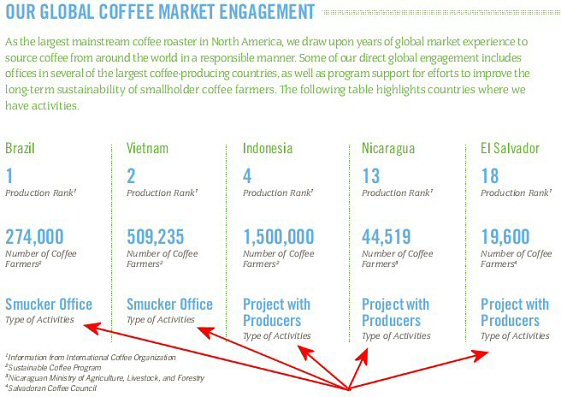
My favorite part of the report was the table on page 44, intended to highlight company activities in some coffee-sourcing countries. There were a few generic facts about coffee production, but the table said nothing about the company’s “direct global engagement.” Each spot in the table where that information was apparently supposed to appear was filled in with the words Type of Activities.

smucker-2015-chart

I think this is the equivalent of the “Hello World! This is your first post” placeholder.

What does it say when a company can’t be bothered to properly complete a report, or competently proofread it? This kind of indifference combined with the perennial lack of originality in the Smucker CRRs is insulting to stakeholders. It demonstrates a shortfall of sincerity in the company’s desire to inform the public about their coffee sustainability efforts in a transparent, thorough, and meaningful way.

Nespresso AAA quality program guidelines

Updated in April 2016

In 2009, Nespresso, the premium capsule coffee unit of the giant Swiss multinational food corporation Nestlé, announced a sustainability initiative they called Ecolaboration. I covered the goals in this post.

One major focus has been Nespresso’s AAA Sustainable Quality Program (“AAA program” for short). The goal in 2009 was to source 80% of Nespresso’s coffee from this program by 2013. They reached that goal, and in 2015 they were at 85%, with a goal of 100% by 2020. It is important to note that parent company Nestlé buys around 850,000 tons of green coffee annually, of which only about 0.2% is eco-certified (via Fair trade/organic).  Nespresso, which has a separate supply chain, sourced 55,000 tons of coffee through the AAA program in 2013, which represented 84% of their purchases. Thus, Nespresso buys about 65,500 tons of coffee, a small fraction of the total purchased by the company.

The AAA program’s three “A’s” are Quality, Productivity, and Sustainability. Once a farm meets the quality requirements (about 50 criteria) and is accepted into the AAA program, they enter a process to evaluate their social and environmental sustainability efforts. This aspect of the program was developed in partnership with Rainforest Alliance. For many years, the criteria or guidelines were not available to the public.  The Generic Tool for the Assessment of Sustainable Quality (TASQ) is now available online. What follows is an overview of the requirements for producers to be included in the AAA program under this TASQ, with an emphasis on the environment. Many of the statistics providing context for the guidelines come from Nespresso’s Ecolaboration Full-term Report, 2009-2013, published September 2014 (PDF), or the Coffee Barometer 2014 (PDF).

Criteria and scoring

The TASQ is based on the 2010 Sustainable Agriculture Network (SAN) standards used for Rainforest Alliance farm certification.  Nespresso has divvied up and tweaked the 10 principals and 99 criteria in the 2010 SAN standard into 42 principals and 296 criteria. Of those, 36 are classified as “critical” (12% of total). They include prohibitions on such things as hunting endangered species, paying below the minimum wage, or not documenting coffee transactions, and are considered “internationally accepted minimum standards for sustainability.”

If a farm does not meet all the critical criteria, they are designated as Under-performing but allowed time to resolve the shortcomings. Once a farm meets all the critical criteria, they are then considered compliant and at the Basic performance level. Thus, there is a low bar (especially regarding environmental standards) for inclusion in the program.

There are three more performance levels in the AAA program, reached by complying with increasing percentages of criteria on top of the critical ones: Emerging (at least 33% of non-critical), High Performing (66%) and Certified (80% or greater and at least 50% per principal).

“Certified” here does not mean that a farm automatically receives Rainforest Alliance (or any other) certification. If a farm chooses to apply for RA certification, Nespresso pays for the first year of certification audits. This is encouraged because at the farm level, only 30% of each harvest from participating farmers meets Nespresso’s quality requirements. Nespresso maintains that due to overall quality improvements and/or certification, farmers are able to sell the rejected portion of their crop at a higher price to other buyers.

As of 2015, according to the company Creating Shared Value Report, there are 75,000 farmers in the AAA program, but Nespresso does not disclose the percentages of farms at each performance level. The progress report stated that as of 2013, overall compliance of participating farms with the AAA standards reached 79.8%.  I took this to mean that 79.8% of farms in the program were in compliance (i.e., at least at the Basic level). It could mean that on average farms were compliant with 79.8% of criteria, but I’m not sure why it would not have been worded that way. Also unclear was whether “overall compliance” included quality criteria, or just TASQ criteria. No further similar reports have been published as of early 2016.

On a positive note, the report also noted that 30% of Nespresso coffee was Rainforest Alliance certified1.

The level of documentation required for various criteria varies depending on the size of the farm — 10 ha or less or greater than 10 ha. Nespresso doesn’t indicate how many of their producers are smallholders.

Inspections are done by Nespresso agronomists, and verified by SAN partner auditors. These include Rainforest Alliance’s own auditing division in many of the countries where Nespresso sources coffee2.

Ecological criteria

Nespresso states that 30% of their criteria fall under the umbrella of the environment. These include topics such as waste disposal and soil preservation.

More narrowly, there are 5 principals covering ecosystem management and wildlife conservation: Protection of Natural Areas, Reforestation, Shade Management, Conservation of Biodiversity, and Susceptible Species Protection. There are 37 criteria in these principals (12.5% of total).

The four shade criteria are fairly general, e.g., one is “There is a shade planting program with records.” One is very similar to the shade guideline from the 2010 SAN standard — this is the one that has been proposed to be watered down in the upcoming revision of the SAN standards. Overall, the ecological criteria tend to be quite generic and many are not quantifiable. Further examples include “Farms provide support to the conservation of nearby protected areas and conform to the management plans of those areas” and “Wild animals bred in the farms are supervised by a competent professional.”

Of the 37 ecological criteria, 7 are critical (none of the shade criteria nor any of the reforestation criteria), which represents 19% of the 36 overall critical criteria, and 2% of all criteria. Some of the critical criteria also seem open to interpretation, such as “The ecosystems conservation program takes into account natural ecosystems restoration and the reforestation of on-farm areas that are not appropriate for agriculture.” However, there are supporting documents to the TASQ that are not available publicly that may clarify some of these criteria.

Bottom line

  • Nespresso is sourcing a small fraction of the total coffee purchased by parent company Nestlé under guidelines that are similar to those used by Rainforest Alliance or UTZ.
  • The bar for inclusion in this program is much lower than other true certifications, with producers being allowed in the program (at least temporarily) even if they do not meet all critical criteria representing baseline sustainability standards.
  • A small percentage of the criteria are related to the ecology of farms, many are generic and without quantifiable goals.
  • Nespresso does not disclose a breakdown of the percentage of farms at each performance level.

Future plans

The next iteration of Ecolaboration is dubbed The Positive Cup by Nespresso. Their new coffee sourcing goal is to source 100% of its permanent Grand Cru range through the AAA program by 2020. There are now there are 45 Grand Cru coffees of which 19 are in the permanent range. These numbers seem to change as limited editions come and go; we don’t know if the new goal will translate to an amount that is more or less than the 80% of Nespresso’s total tonnage it is currently sourcing under the program.

You can read more about the various aspects of sustainability efforts at Nespresso, including those beyond coffee sourcing, at their web site.

_______________

1It is not known how many of these producers obtained Rainforest Alliance certification as a result of going through the AAA program, or if they already had it. Many producers carry multiple certifications or affiliations. For example, according to their Mid-term Report Coffee Target 2011, about 25% of Nespresso’s coffee came from Colombia. The same year, Starbucks published a report on over 200 of their farmers in Colombia (PDF). Forty-two percent of them were also Nespresso suppliers, but nearly all were already in Starbucks CAFE Practices program (with its more stringent environmental requirements) first.

These overlaps make it difficult to assess any single program without accounting for producers that participate in multiple schemes because the credit for improvements might be due to the pre-existing affiliation.

2This arrangement is a little cozy. As noted in Table 15.7 of the chapter cited below, the Nespresso AAA standards are defined by RA, RA controls the accreditation process, and RA auditors controls compliance standards (certification). These authors do not consider Rainforest Alliance certification itself as third party accredited.

Soto, G., and J.-F. Le Coq. 2011. Certification process in the coffee value chain. Chapter 15 in Ecosystem Services from Agriculture and Agroforestry: Measurement and Payment. Rapidel, B., et al., eds. London, Earthscan.
Corporate money and pseudo-certifications

Destroying consumer trust and undermining the value of certifications

In return for financial support that represents a tiny fraction of profits, large corporations are receiving “endorsements” in the form of product badges promoting health benefits or sustainability efforts — despite the fact that many of these corporations have rotten sustainability records. This includes purveyors of corporate coffee, including Nestlé and JM Smuckers (Folgers).

It isn’t apparent from the badges or labels what they truly represent, nor in some cases is it even possible to figure out from viewing the websites of the organizations, corporations, or sponsors.

“Made by Sustainability Leaders” badges on Walmart products, backed by The Sustainability Consortium (TSC)

The Sustainability Consortium was originally established with funds from Walmart, and is “dedicated to improving the sustainability of consumer products” through “implementation of credible, transparent and scalable tools” that are “accessible for all producers, retailers, and users.” However, the only publicly-available documents are the “sustainability insights” for various products and sectors. These brief, very general overviews aren’t particularly insightful (e.g., for coffee, “clearing land for agriculture can lead to deforestation.”). The “toolkits” containing Key Performance Indicators, presumably the guidelines or criteria for sustainability assessment, are only available to members; annual memberships cost between $5000-$100,000. Thus, consumers do not know how corporations are evaluating sustainability. The FAQs, however, indicate that companies are using a self-administered survey and state that “TSC does not verify Key Performance Indicator responses.”

walmart-leaders-badgeNow Walmart is putting a “Made by Sustainability Leaders” badge on many products. While this gives the appearance that these are products are good for the environment, the badge really represents any product made by a company determined to be a sustainability leader based on the (self-administered, unverified) TSC survey. Not only do we not know the TSC criteria, the badge does not pertain to the actual sustainabilty of the individual product, and none of this is apparent to the consumer.

Are these corporations truly “sustainability leaders”? One probably needn’t go much further than noting paper products by Georgia Pacific are badged by Walmart. Georgia Pacific is a TSC member that is owned by the Koch brothers, and its products are boycott targets.  Other Walmart suppliers that are not TSC members (e.g., Nestlé) can also display the badge; Walmart uses the toolkits developed by TSC to rank its suppliers and hand out badges.

Other TSC members include JM Smuckers, Monsanto, Dow Chemical, Dupont, and BASF. Following Walmart’s lead, other retailers or the corporations themselves could label their own products with some similar sort of badge or claim. I can’t get behind a mystery badge that puts money in the pockets of companies that are often so egregiously anti-environment.

For more details, read this excellent article by The Grist about this greenwashing initiative.

The Academy of Nutrition and Dietetics (AND) has allowed Kraft to put it’s “Kids Eat Right” badge on their pasteurized prepared cheese product.  This seems dubious on the face of it, and more so when you learn Kraft is a major sponsor of AND. The New York Times has a report on this initiative, noting that other nutrition scientists are so uncomfortable with the Academy’s funding by big food corporate sponsorships that they have formed their own group, Dietitians for Professional Integrity, that calls for better transparency and ethical sponsorship. There are more resources on their website regarding the conflict of interest generated by corporate sponsorships.

What this has to do with coffee

The proliferation of different types of certifications, labels, endorsements, badges, etc. is confusing to a public that is already suspicious about them. We can debate the legitimacy and ethics of TSC, AND, and similar organizations all day, it really doesn’t matter. What does matter is that the basis for the badges, endorsements, and labels must be honest, transparent, and easily accessible and understood by the public.

Same goes for genuine certifications. People need to be able to understand what (and who) is behind the certification. When they do not, it leaves consumers to be duped into purchasing products that are not sustainably produced, or so distrustful of certifications or other claims that they disregard them all and just buy what is cheap and convenient. Either way, it’s a win for the profits of these companies (which in turn increases their power and influence) and a loss for the environment.

More corporate coffee consolidation

Two of the giants in the corporate coffee world want to merge in an attempt to rival the world’s current biggest coffee buyer, Nestlé I’ve been waiting for the merger to go through to write about this deal, but it is being investigated by European anti-trust regulators, so I’ll go ahead and provide some background now.

The proposed merger is between the #2 and #3 coffee companies in the world: Mondelēz International and D.E. Master Blenders 1753.

mondelez-logoMondelēz International was the name given to the Kraft Foods division that spun off from the company’s grocery segment in 2012. Coffee brands include Gevalia, Tassimo, and Kenco. (Kraft Food Group and Kraft Foodservice control Maxwell House, Yuban, General Foods International and the Gevalia and Tassimo brands in North America. Although I’ve not read that Kraft brands are part of this deal, Maxwell House is shown as an included coffee brand in this fact sheet put out by Mondelēz.)

master-blenders-logoD.E. Master Blenders 1753 is owned by JAB Holding Company (Joh. A. Benckiser) — the private firm that recently purchased Caribou Coffee and Peet’s Coffee.  Their main coffee brand, though, is Douwe Egberts (once owned by Sara Lee Corporation). There are other coffee brands owned by D.E. Master Blenders, mainly European; the most familiar to Americans is probably Senseo.

A merger between these two companies was agreed upon in mid-2014. If approved, the new company will be called Jacobs Douwe Egberts. Mondelēz will own 49% of the new company, and JAB will have controlling interest at 51%.

Mondelēz International purchases about 500,000 tons of coffee annually. D.E. Master Blenders purchases 300,000 tons, according to Coffee Barometer 2014 (PDF). Combined, their purchases equal Nestlé’s 860,000 tons. Thus, if the merger proceeds, Nestlé and the new Jacobs Douwe Egberts will be purchasing around 20% of the entire world production of coffee.

In my table describing Corporate Coffee: How much is eco-certified, you can see how little of this coffee is falls under any of the meaningful eco-certifications (Smithsonian Bird-Friendly, Rainforest Alliance, or organic). A mere 57,000 tons — 3.3% — of the coffee purchased by Nestlé, Mondelēz International, and D.E. Master Blenders* falls under these three certifications!

I can fall back on my usual advice: avoid inexpensive, mass-produced, commodity traded, grocery store coffee. The largest coffee companies in the world control this category, and do little, if anything, to make sure the coffee they buy is produced under conditions that protect farmland, natural habitat, biodiversity, or the farmers that grow it.


*I’ve not historically included D.E. Master Blenders in my table as I have concentrated on North American brands, but I will do so if the merger goes through. D.E. Master Blenders mainly purchases UTZ Certified coffee, which does not have strong, specific, or meaningful ecological criteria; Coffee Barometer 2014 indicates the company has plans to procure more organic and Rainforest Alliance certified coffee in the future. Even adding in UTZ and Nestlé’s own self-certified, mystery Nespresso AAA Sustainable Quality program purchases, the total only amounts to 202,000 tons, or 12% of what these three companies buy each year.

4C-certified coffee: miniscule amount under minimum standards

In order to provide context and perspective, I update a table on this site to reflect the amount of coffee out there that is produced and/or sold under some sort of eco-sustainability standard. The amount of coffee produced under these standards (Bird-Friendly, Rainforest Alliance, organic, plus Starbucks CAFE Practices and UTZ Certified) has grown substantially over the last decade.

One standard/certification scheme I leave off is 4C certification. This is the “entry level” set of standards often used by large commodity coffee companies.  To the unsuspecting consumer: this certification really only verifies that the coffee was produced under conditions weren’t illegal (violating basic human rights, environmental laws, and business ethics). Overall, 4C standards are very basic.  You can read all about what 4C certification is and isn’t right here.

It’s a (needed) starting point, but frankly hardly something to brag about or (worse) convey to consumers as being a meaningful sustainability certification. Nonetheless, the growth in 4C certified coffee is driven by big players like NestlÁ© and MondelÁ©z International. Mondelez, for instance, is using 4C certified coffee to reach it’s 2015 goal to  “sustainably source” all its coffee for western Europe.

Last year, Daily Coffee News reported that the amount of 4C certified coffee tripled, to 7.5 million bags in 2012-2013 (at 60 kg a bag, that’s 450,000 metric tons).

That sounds like a lot, until you look at 2013 world coffee production: nearly 147 million bags (or 8.8 million metric tons).

Bottom line: 5.1% of world coffee production is sold as 4C certified, the weakest, lowest-bar standard available. On the bright side (?) the amount of 4C certified coffee produced is 2.28 million metric tons, or about 26% of world production. I’m not sure what it says about large coffee buyers that the supply of “sustainably” grown 4C coffee so widely outstrips demand, with less than 20% of 4C coffee being sold as such.

The 4C Code of Conduct is in the process of being reviewed and revised. We’ll see what that brings.


2014 JM Smucker’s Corporate Responsibility Report

groundhog

Groundhog Day would be an appropriate release time for Smucker’s sustainability reports.

JM Smucker’s, owner of Folgers, Millstone, Café Bustelo, Café Pilon, and Dunkin Donuts retail coffee, has released its 2014 Corporate Responsibility Report, its fourth after being dragged unwillingly into developing a coffee sustainabilty plan by shareholders.

Once again, there isn’t much to say about the report’s coffee sustainability section. The coffee sections from the last two years have been nearly identical, much of it word-for-word — take a look at my posts on the 2013 and 2012 reports. This year, they have at least done some rephrasing, but follow the same theme as previous reports — restating their goal for certified coffee purchases to reach 10% of its total retail purchases by 2016, and highlighting organizations that they support: TechnoServe, the Hanns R. Neumann Stiftung Foundation, and World Coffee Research.

The most notable difference this year is that they have finally stated their progress towards the 10% certified goal: in 2014 they indicate that 6% of the coffee they purchased was certified. Caveats: First, we don’t know the total amount of coffee the company purchases; the last figures available from 2008 and 2010 put it at an average of 265,000 tons. Second, the company is careful to specify the goal is 10% of retail purchases. Not sure how this is defined, or what proportion of total purchases this represents.

So in a strict sense, this report does indicate some progress in the company sourcing third-party certified coffee. However, we can’t really quantify it, and the certification they are using is primarily UTZ Certified, which doesn’t have strong ecological criteria.

One also has to wonder what happens when the 10% certified purchases goal is reached. The company states it believes this will represent the “highest level of certified purchasing by any mainstream coffee roaster in North America.”  This may or may not be true, depending on their definitions, but I can certainly argue that buying a higher volume of UTZ Certified coffee (at best less than 30,000 tons using a generous estimate) does not have the ecological impact of, for example, Starbucks sourcing 180,000 tons of coffee under its CAFE Practices standards, which have stronger environmental criteria than UTZ.

I don’t give a huge amount of weight to their “partnerships” with organizations that help coffee growers. It’s not that these organizations don’t do substantial important work (they do), it’s mostly because the company’s level of support and involvement is difficult to evaluate. Their support to TechnoServe is apparently financial. In the past it has been a very small fraction of Smucker’s profits; no details have appeared in recent TechnoServe annual reports. There is an entire page in the Smucker’s 2014 report about the company’s “on the ground” partnership with the Neumann Foundation in Sumatra — yet curiously nothing about this project (or Smucker’s) appears on the Foundation’s web site.  The relationship with World Coffee Research also appears to be monetary, but again, no details on the level of support. For a company that in 2014 made $642 million in profit on over $2 billion in net sales in their U.S. retail coffee division alone, I’m not sure we can give Smucker’s much credit for meaningful sustainability efforts from these apparently modest contributions.

Overall, this report is a slight improvement over the past 2 years, but this powerhouse coffee buyer has a long way to go to improve transparency and prove their commitment to purchasing sustainable coffee.

Illustration adapted from photos by Cornelia Kopp/AlicePopkorn and Ken Fager/kenfagerdotcom at Flickr under Creative Commons Licenses.

Nestlé 2013 sustainability report: the kitchen sink

nestle-sinkSome corporate sustainability reports are underwhelming. The JM Smucker Co. (owner of Folgers, among other brands) is a great example. Not much to it, and whole swaths are repeated word-for-word from year to year.

Food mega-giant Nestlé, on the other hand, produces phone-book sized sustainability reports. Granted, Nestlé is a larger company with more products. Still, their 2013 Creating Shared Value report is a whopping 404 pages, overwhelming in its scope. Any reader would get lost in its facts, figures, and examples. Let’s call it the everything-including-the-kitchen-sink approach.

I know I’m cynical, but as I grudgingly sat down to read over Nestlé’s latest report, I couldn’t help but wonder if this was an intentional effort to swamp people with data or just impress them with size, all to obscure a so-so sustainability record.  I will restrict my critique here to just what pertains to coffee.

There are two things to note about Nestlé’s coffee business. First, there are at least two coffee supply chains in the company. Nespresso is responsible for its own supply chain, separate from the rest of Nestlé’s green coffee purchasing1. The rest goes to Nestlé’s other brands, primarily instant under the Nescafé label.

Second, on page 150, Nestlé states it buys 10% of the world’s coffee production; thus, in 2013 Nestlé bought 870,000 tons of green coffee2. It’s unclear if this includes Nespresso, but since the figure right in line with previous estimates of Nestlé purchases, we will assume that it does.

How Nestlé’s defines sustainable coffee

In their Responsible Sourcing Guideline (PDF), Nestlé defines responsibly sourced green coffee as that which is verified against the 4C Code of Conduct or standards such as their own Nespresso AAA Sustainable Quality Program.

What does this mean? 4C compliant coffee is not certified, but indicates meeting a basic, entry-level standard. There are no meaningful, quantifiable eco-criteria, and the 4C Code addresses only the most egregious, illegal, unsustainable practices in the industry. The Nespresso AAA program uses criteria that are based on the Sustainable Agriculture Network (SAN) standards used for Rainforest Alliance certification, but which criteria and how they are scored or evaluated is not publicly disclosed. [Update 2015: here is a post on the environmental and social requirements for producers in the AAA program. Note the low bar for entrance into the program.]

So how much of Nestlé’s coffee is “responsibly sourced”?

The majority of Nestlé’s coffee goes to their non-Nespresso brands. Of this, the company states (page 152) that 71,493 tons, or 8.2% of their annual purchases, was 4C compliant, reaching just the most basic level of “sustainability” standards.

Meanwhile, 84% of their Nespresso purchases were made under their AAA program. Nestlé considers volume data proprietary, but in 2010 Nespresso stated3 it purchased 49,020 tons of coffee (5.6% of Nestlé’s total purchases). Nespresso has experienced considerable growth. If we guess that it purchased 60,000 tons, then 84% of that would be 50,400 tons under their AAA program, or 5.7% of Nestlé’s annual purchases. It’s probably safe to say that around 6-7% of Nestlé’s total purchases were sourced under the Nespresso AAA program.

So, less than 135,000 tons is sourced under some sort of standard, leaving nearly three-quarters of a million tons of coffee not meeting any sort of basic sustainability requirements at all!

Even less than meets the eye?

On page 125, Nestlé states a goal to source 90,000 tons of coffee that complies with the Sustainable Agriculture Standard by 2020.  That sounds like a volume that would be around 10% of Nestlé’s annual purchases. However, a footnote explains that this is an “aggregate figure from 2010 to 2020”. In other words, 90,000 tons over 10 years, or 1% of Nestlé’s total green coffee purchases.

A similar footnote is not given for their goal of sourcing 180,000 tons of 4C-compliant coffee by 2015, but later in the report when these figures are provided, the language seems to indicate that this is also a cumulative amount. For instance, on page 152, the report says (my emphasis added) “By 2015, we aim to source 180,000 tonnes…” and “By the end of 2013, we had sourced 148,198 tonnes…” On page 157, it says “…we will have bought 180,000 tonnes…by 2015…” If this were an annual amount, wouldn’t the wording be, for example, “In 2013, we sourced…”?

Other tidbits:

  • They tout that an independent study found that Colombian farms in their Nespresso AAA program had “52% better environmental conditions” than non-AAA farms. Examining the actual report (link here) shows that this figure included farms with Rainforest Alliance certification. It did not say how many of the farms had the certification, or how the conditions on these certified farms drove up the environmental index.
  • The percentage of their suppliers that comply with the company’s supplier code has declined from 96% in 2011, to 74% in 2013.

In a similar vein, the company’s strategy for biodiversity impacts of coffee states: “Biodiversity issues are managed primarily through the use of the 4C Coffee Code, the Nespresso AAA Sustainability Quality Program and the Nescafé Plan, which, in partnership with Rainforest Action Network, has developed better farming practices.”

In a nutshell

Remember, Nestlé has no interest in investing in or marketing third-party certified coffee, so it’s worth repeating we get from Nestlé:

  • around 50,000 tons of coffee sourced under their Nespresso AAA guidelines, with a low bar for inclusion
  • plus 71,493 tons sourced under the dubiously-meaningful 4C code of conduct,
  • leaving more than 740,000 tons of coffee sourced from farms following no sustainability standards, or at least none known or being disclosed to the public.

Footnotes:

1Alvarez, G., C. Pilbeam, and R. Wilding. 2010.Nestlé Nespresso AAA sustainable quality program: an investigation into the governance dynamics in a multi-stakeholder supply chain network. Supply Chain Management 15(2):165 – 182. DOI: 10.1108/13598541011028769

2Data converted from world production statistics, International Coffee Organization. 

3Nestlé Nespresso Ecolaboration Progress Report, June 2011.

Update on JM Smucker’s coffee sustainability

rusty-folgersIn 2011, I profiled JM Smucker’s (lack of) approach to coffee sustainability issues. Since the company acquired Folger’s and some other brands, coffee has become the company’s biggest profit-maker. For two years, major investors pressed the company to develop and report on a coffee sustainability plan.

Last year, Smucker’s began to outline small steps toward a green coffee sustainability vision. In their 2012 Corporate Sustainability Report, they offered,

  • A goal for certified coffee purchases to reach 10% of its total retail purchases by 2016. This would be primarily UTZ Certified coffees, which don’t have strong ecological criteria (it’s the most popular certification for the big commodity coffee buyers), but will greatly improve transparency.
  • Partnerships with organizations that offer smallholder support: TechnoServe, the Hanns R. Neumann Stiftung Foundation, and World Coffee Research.

You can read my whole recap and analysis of the 2012 report here. As for the current 2013 Corporate Sustainability Report (PDF), it’s pretty much a rehash of the points above.

There are no further data on what progress they are making on reaching their 10% goal, e.g., how much certified coffee they are currently buying.

Regarding their partnerships, there is also no new information. The report does go into some detail discussing the goals and achievements of the organizations they support. While the company makes no claims about their specific role in these good deeds, I find this overall approach misleading.

Let’s put it this way:  I do some volunteer work and make an annual donation to a local environmental non-profit. While my contribution may be valuable to the whole, I would be called a fraud if I tried to pad my rÁ©sumÁ© with this organization’s accomplishments.

Two new items are largely symbolic, in my opinion. First is their $50,000 a year membership in The Sustainability Consortium, originally established with funds from WalMart. Many very large corporations are now touting their association with TSC, who states that their mission is “to design and implement credible, transparent and scalable science-based measurement and reporting systems accessible for all producers, retailers, and users of consumer products.” Indeed, transparency is mentioned a lot on their website. For instance, they state that consumers desire “…product transparency” and are confused about “…what constitutes a sustainable product” — and that these were major motivations behind the formation of the organization. Alas, when I try to access the Key Performance Indicators and Category Sustainability Profile for coffee, I find it requires member login. I confirmed with TSC that these data are not available to the public. TSC could very well be doing fantastic work but although their website is extensive, I could not find or access any specific material to help me as a consumer determine whether member coffee companies are taking meaningful steps to improve their supply chain sustainability.

(For more background on TSC, see a couple of Joel Makower’s great pieces at GreenBiz, Inside Walmart’s Sustainability Consortium, and Driving the Sustainability Consortium’s ambitious agenda.)

Finally, Smucker’s is producing “Life is Good” branded coffee, which is is UTZ Certified.  You may know Life is Good for their t-shirts and stickers, etc., whose raison d’Áªtre is to spread the power of optimism, with 10% of its net profits going to their own foundation for children.  At $6.99 to $7.99 per 11-ounce bag, the coffee won’t fill the foundation’s coffers (or those of the farmers it was sourced from). While promoted as a premium coffee, it’s safe to be suspicious of the quality of a brand that sells banana bread-flavored and s’more flavored varieties.

I also believe in the power of optimism, but I am not optimistic that JM Smucker will ever be a significant purchaser/purveyor of truly ecologically-sustainable coffee.

Coffee can photo by Travis S. under a Creative Commons license.

McDonald’s promotes coffee sustainability efforts

McD-RA-promoMcDonald’s is launching a campaign aimed to educate the public about their efforts in sourcing coffee sustainably, which I wrote about in March. To recap, the corporation’s North American operations is investing over $6 million to provide education and training to more than 13,000 Guatemalan coffee farmers to increase their capacity for sustainable coffee production.

As I noted in the previous post, the investment in technical assistance to farmers builds on the commitment to purchase increasing amounts of certified coffee, primarily from farms certified by Rainforest Alliance. Currently, all coffee at McDonald’s locations in the U.K., Australia, and New Zealand, and all coffee for espresso-based drinks in the U.S. and Canada, is sourced from Rainforest Alliance-certified farms. All coffee, except for decaf, in Europe is also Rainforest Alliance, Fair Trade, or UTZ certified. In 2011, certified purchases amounted to about 10,400 metric tons. In 2012, 25% of their global coffee purchases were certified; in the U.S. the figure was 14.8% (actual volume figures are not available).

While $6 million is not much money for a multi-billion corporation, keep in mind that coffee is not McDonald’s primary business, and that they only really entered the premium coffee market segment in 2006. They do not source coffee directly, but rely on a suite of suppliers. And, as previously pointed out, even the small amount of certified coffee McDonald’s purchased for North American (around 3800 tons) was more than coffee giants JM Smuckers (1500 tons) and Nestlé’s (2000 tons) total certified global purchases combined! And McDonald’s 14.8% certified U.S. purchases also dwarf Smucker’s 0.5% (and Smucker’s goal is only 10% by 2016). Whereas Smuckers has been dragged reluctantly into modest sustainability efforts, and Nestlé has rejected third-party certifications, McDonald’s has chosen to go with Rainforest Alliance, Fair Trade, and  UTZ Certified because they felt the certification criteria of those organizations were best aligned with the company’s vision.

mcd-coffee-sustainability-shot

Although millions of Americans guzzle coffee every day, not very many are aware of where the daily fix comes from, how it is grown, and the issues that impact coffee farmers and the environment (hence this blog!). McDonald’s wants to familiarize with the public with these issues and how specifically the company is approaching enhancing sustainability in their coffee supply chain. Their connection with Rainforest Alliance will be featured in their ads, in stores, and other promotional assets. Many people that are “into” coffee and drink specialty coffee know about coffee certifications and Rainforest Alliance. I’d venture an educated guess that most people who usually get their coffee away from home at fast-food restaurants have no notion about certifications or coffee sustainability. The ubiquity, popularity, and marketing power of McDonald’s can go a very long way in introducing these issues to the general public.

The next step is increasing the amount of certified coffee they purchase for drip coffee in North America; I hope the majority will be Rainforest Alliance.  McDonald’s has brought their suppliers (S&D Coffee & Tea, Gavina Gourmet Coffee, Farmer Brothers, and Mother Parkers) to the table to address this goal and provide the company with a sequenced plan. These are four of the largest coffee suppliers in North America — providing well over 100,000 tons of coffee annually for foodservice, private label, convenience stores, and their own brands. Currently S&D, the largest of the four, has the best sustainable-coffee commitment, offering a number of certified coffees, including their own line of Bird-Friendly certified coffee [NOTE: S&D was purchased by another company in 2020]. Farmer Brothers has just released its first, baseline sustainability report, where it states it now buys 9% “sustainable” coffee (which amounts to about 3500 tons). Gavina and Mother Parkers don’t provide much detail on similar offerings. This presents a golden opportunity for the Golden Arches. The ability of McDonald’s to influence the purchasing of their suppliers means this initiative has great potential to increase demand for certified, sustainably-grown coffees. Perhaps most importantly, I think that a significant increase in the volume of coffee destined for drip in North America, combined with the visibility and marketing power of McDonald’s, has the potential to really propel coffee sustainability issues into the mainstream.

You can see more at the coffee sustainability section of their website. More detail is promised in McDonald’s next corporate sustainability report, due out next spring. I’ll be reporting on it.

McDonald’s makes substantial commitment to coffee sustainability

mccafeMcDonald’s Corp. recently announced that their North American operations is investing $6.5 million over  4.5 years to provide technical assistance to Guatemalan coffee farmers to increase their capacity for sustainable coffee production. McDonald’s is partnering with the non-profit TechnoServe (which coordinates many coffee-related projects) and SCAN (Sustainable Commodity Assistance Network), a global consortium of 20 organizations that provide an array of support for sustainable agriculture practices. This is another component in the sustainability efforts of the Golden Arches, a number of which are directly related to coffee. These include:

  • All coffee in the U.K. is from Rainforest Alliance-certified farms (since 2007).
  • All coffee in the rest of their 39 European markets is from Rainforest Alliance-certified or UTZ Certified farms (since 2007).
  • All coffee in Australia and New Zealand is from Rainforest Alliance-certified farms (since 2008-2009).
  • All coffee for espresso-based drinks in the U.S. is sourced from Rainforest Alliance-certified farms (as of March 2013).
  • All coffee for espresso-based drinks in Canada must be certified by a third party, and is currently 100% Rainforest Alliance.

To get an idea of why I find this so significant, we need put all of this in perspective by comparing it to the largest coffee buyer in the U.S., J.M. Smucker Company.

McDonald’s is a fast food restaurant. They do not directly source or roast coffee (it comes through suppliers). Coffee is not their core business, but makes up just 6% of U.S. sales for the company1. Smucker’s is a food manufacturer that owns the coffee brands Folgers, Millstone, Dunkin Donuts bagged coffee, Café Pilon, and Café Bustelo. Coffee makes up 44% of their U.S. sales.

McDonald’s certified coffee purchases in 2011 — Rainforest Alliance, UTZ, and Fair Trade — were about 10,400 metric tons, with three-quarters of it being Rainforest Alliance-certified. Although the McDonald’s restaurants in the U.S. lag behind European markets in offering certified coffee, the company expects to buy around 3800 tons for the domestic market.  Not a lot, but more than Smuckers (1500 tons) and Nestlé (2000 tons) total certified global purchases combined!

The most recent McDonald’s pledge amounts to $1.4 million a year to provide sustainability support to coffee farmers. That’s 0.06% of it’s annual coffee sales of about $2.1 billion on U.S. systemwide sales of just over $35 billion. That doesn’t sound like much until you realize that Smucker has opted to support TechnoServe at $150,000 annually2, or 0.006% of its annual U.S. retail coffee sales of $2.3 billion.  And, as I like to remind everyone, JM Smucker has a dismal environmental sustainability record, and less than 0.5% of the coffee it buys each year carries any type of certification whatsoever.

mcd-love-1

You can let McDonald’s know (on Facebook, for example) that you appreciate their efforts and would like to see more eco-certified coffee in the U.S.

1Figures provided to me by McDonald’s and are the most recent available; total global coffee purchase information not available at this time. The Nestle and Smucker figures are based on the most recently available data — both of those companies are very guarded about releasing any information to the public. In contrast, McDonald’s was helpful and forthcoming about giving me this data, and also has extensive information at their web site.

2This figure is based on statements made by Smucker’s regarding a continuation of support provided to TechnoServe by Proctor & Gamble, which sold its coffee brands to Smucker. The last time donors were listed in TechnoServe’s annual reports was 2009, and Smucker was listed as a donor in the $100,000 to $499,999 level. I wrote to TechnoServe to verify the amount of support they received from Smucker, but did not receive a reply. I’m sure if Smucker had upped the ante, they’d brag about it, because their 2013 Corporate Responsibility Report touted this relationship…by highlighting the work TechnoServe had done with 170,000 coffee farmers, making it sound as if Smucker should receive lots of credit. TechnoServe receives $3.1 million in corporate and foundation support alone.

Nestlé: Saying no to coffee certifications

Nestlé is the world’s largest food company, with 2011 sales of $94 billion. Some of the most popular of their many coffee brands are Nescafé , Nespresso, and Taster’s Choice. The company buys upwards of 850,000 tons of coffee annually, of which less than 1% is eco-certified.

Nestlé’s most recent corporate responsibility report, Creating Shared Value 2011 (PDF), makes some specific statements about what this big multinational company thinks about sustainability certification.

The company presents its overall position in a section titled Third-party certifications and Responsible Sourcing: “Certification is not an end point in itself, and only one of several ways of Creating Shared Value, promoting sustainable rural development and progressing other development goals in an effective and holistic way.”

In the section specifially devoted to coffee, there is a sub-section titled Marketing certified coffee to consumers. Here’s what it says:

Currently, there are no plans to market certified coffee to consumers (ie, coffee carrying a certification seal on the label). We believe that our own Responsible Sourcing Platform, which combines in-house codes and guidelines, capacity-building teams for key commodities and suppliers, NGO and industry partnerships and third-party certifications, offers a more targeted approach than certification alone.”

Unfortunately for consumers, Nestlé offers few details on their “Responsible Sourcing Platform” so that we can judge whether we think their coffee is really grown in a sustainable manner. They do mention that the “Nestlé Supplier Code is an integral part of any green coffee contract.” This document is publicly available (PDF). It’s easy reading. In fact, it’s only 6 pages, three of which are the covers and title page.  Here are the sections on Sustainability and Environment, in their entirety:

  • Sustainability Nestlé supports and encourages operating practices, farming practices and agricultural production systems that are sustainable. This is an integral part of Nestlé’s supply strategy and supplier development. Nestlé expects the Supplier to Nestlé to continuously strive towards improving the efficiency and sustainability of its operations, which will include water conservation programs.
  • Environment The Supplier must operate with care for the environment and ensure compliance with all applicable laws and regulations in the country where products or services are manufactured or delivered.

That’s it. Nothing specific, no standards, guidelines, or benchmarks. In contrast, the basic farm standard of Rainforest Alliance runs 49 pages. Starbucks CAFE Practices has 7 pages of criteria just devoted to environmental leadership for its coffee suppliers.

Nestlé states that “For coffee, biodiversity issues are managed primarily through the use of the 4C Coffee Code and the Nespresso Sustainable Quality AAA programme for coffee sourcing.” Please read this post to learn how 4C compliance merely indicates marginal standards of human and environmental decency. As for the AAA Sustainable Quality program, see this post for an overview of the environmental and social requirements for producers in the Nespresso AAA Sustainable Quality Program, with its low bar for inclusion.

Maybe there’s more to their sourcing guidelines, and they include fabulous safeguards for the environment. I assume if that were the case they’d be making sure we know every last detail, and their coffee would easily qualify for various certifications that consumers would recognize and understand. But Nestlé has made it clear they are not interested in these certifications, and that their way is better. Whatever that is; we’re supposed to take their word for it.