Blends/Multiple

New orchid species named for coffee company

puro-orchid-1A new species of orchid, Teagueia puroana, was discovered in central Ecuador in the eastern Andes, and named for the Puro Coffee company.

I was once active in orchid growing and writing for the American Orchid Society, so when I read about an orchid discovered with a coffee connection, I was naturally interested. This orchid was discovered in 2002 in the Cerro Candelaria Reserve, a nearly 3000-ha area protected through a partnership between FundaciÁ³n EcoMinga and the World Land Trust.  Since 2005 when the brand was launched, Puro Coffee, the Fairtrade coffee brand of Belgium-based Miko Coffee, has contributed 2% of the retail price from each bag of coffee sold to the World Land Trust for the protection of rainforest. To date, this funding has helped purchase over 3200 ha in Ecuador, Brazil, Colombia, Borneo, and Guatemala. In honor of this support, the new orchid species was named Teagueia puroana. The official description of this new species was published in 2011 along with another new Teagueia species in the journal Lankesteriana.

Teagueia is a genus in the orchid subtribe Pleurothallidinae, a group of mostly miniature New World orchids usually found at high elevations. Despite their small size and specific, fussy cultural demands, Pleurothallids are popular with orchid aficionados for their fragile and delicate beauty. Until recently, only six species of Teagueia were known. Now over two dozen species have been discovered (along with new representatives of other orchid genera) all in the same Rio Pastaza watershed, many on Cerro Candelaria. The effort to map the distribution of orchids in this region was spearheaded by botanist Lou Jost.

After the discovery of the Teagueia on Cerro Candelaria, Jost and some of his colleagues founded FundaciÁ³n EcoMinga, and obtained funding through the World Land Trust to establish the preserve. So far, Cerro Candelaria is the only place T. puroana has been found. It lives on the stunted trees in the alpine grasslands known as pÁ¡ramo at 3700 meters. While some of the new Teagueia are abundant as creeping ephiphytes on low vegetation and mosses on different nearby mountains, T. puroana is very rare, with only a few plants located despite much searching.

While this is the first orchid I have heard of named for a coffee brand, orchids are often important components of shade coffee farms, and shade coffee farms can be important refugia for orchids.

puro-miko-logosMore on the coffee

Miko Coffee, part of the Miko Group, was founded as a grocery business in 1801, with coffee roasting becoming its main business around 1900 (plastic food packaging is the other main activity of the Miko Group). Miko coffee primarily focuses on the  “out of the house” market, providing beans, equipment, and related products for food service, restaurant, and office coffee in over 20 countries, mostly in Europe and Asia. Retail coffee is a relatively small portion of their business, and Puro Coffee is their Fairtrade and FT/organic/ethically-sourced brand.

Puro offers three different blends. The current compositions are given below, but they sometimes change. Puro provides updates on their web site, so you know what you are getting.

  • Puro Organic, certified organic and Fairtrade. Currently sourced from Peru (CEPICAFE) and Honduras (COSAGUAL and COCAFCAL).
  • Puro Noble, certified organic and Fairtrade; 80% arabica, 20% robusta. Currently sourced from Peru (CEPROAP), Honduras (COAGRICSAL and COPROCAEL), Guatemala (FEDECOCAQUA), and Congo (CDI Bwamanda). Also available in decaf.
  • Puro Fuerte, certified Fairtrade; 50% arabica, 50% robusta. Same sources as Noble.

We tried all three coffees, provided to us by Puro. Our expectations were not sky-high, as we most often drink single origins and find the more generic blends nice but not as interesting (especially to the more jaded panel members).  We were pleasantly surprised.

3.5motmotThe Organic blend was everybody’s favorite. Two adjectives were mentioned by nearly all reviewers: “smooth” and “milk chocolate.” Soft and creamy also came up. Personally, I usually don’t like Peruvian coffees too much, because the catimor variety is commonly grown there and I find I seem to be able to taste the chemical flavor of the robusta heritage. CEPICAFE, however, grows 95% typica, and the sweetness came through. When prepared in a Clever Coffee Dripper, we additionally found an initial hit of cinnamon and spice which we also enjoyed. Overall, this coffee earned 3.5 motmots.

3newmotWe approached the Noble with some trepidation due to its robusta content. We were all surprised we could not detect any hint of rubbery, chemical flavor familiar to us from other robusta offerings we’ve tried, and least when the coffee was fresh and hot. The flavor deteriorated a little bit as it cooled. Overall, we found it very similar to the Organic blend, just not as bright. This lack of some liveliness and the flavor change when cool dipped the score to 3 motmots.

2newmot75Upping the robusta content to 50% was clearly the tipping point for us, as nobody was really enthusiastic about the Fuerte blend. I’m really not sure exactly what was going on here, as some of the flavors our more experienced tasters were finding seemed beyond the usual bold, rubbery type of flavor that is a more normal characteristic of robustas. In a French press in particular, it seemed dirty and oddly astringent, with a most peculiar flavor/aroma that reminded me of rubbing alcohol. Not sure what might have caused this. Medicinal flavors can come from over-fermented beans; perhaps this batch may have had some bad beans in it, as it seemed at odds with what must be a really well-processed robusta from the CDI Bwanmanda group in Congo. Some grocery-store-coffee drinkers we dragged into this panel didn’t really detect these flavors; perhaps it might also be more suitable for an espresso prep than a drip. This blend ended up with 2 motmots.

Right now, Puro Coffee does not have a U.S. distributor, but a new web site for online purchases is being rolled out in multiple languages: Puro at Home. Their U.S. brand home page has an almost overwhelming amount of information. The Puro blog is an especially good source of information on their rainforest and habitat projects (e.g., cool moths and beetles in Brazil, giant monkey-eating eagles in Ecuador). There is also an entire page with links to the many short videos they’ve created on their coffee, rainforest projects, social initiatives, partnerships, and worldwide clients.

I have found that some coffee companies that support a cause as strongly as Puro Coffee does the World Land Trust tend to focus more on the cause than the coffee. Puro is certainly an exception to this: very committed to the cause of conserving rainforest and sustainably-grown coffee, and very satisfying coffee as well.

Jost, L., and Shepard, A. 2011. Two new species of Teagueia (Orchidaceae: Pleurothallidinae) from east-central Ecuador. Lankesteriana 11(1): 9-14.
Photo courtesy of Puro Coffee. All rights reserved.

Coffee review: Arbor Day blend

Plainspoken Coffee. A Coffee Review for Ordinary People by Ordinary People, #41.

Introduction
The Arbor Day Foundation‘s mission is to “inspire people to plant, nurture, and celebrate trees.”  The first tree-planting holiday, dubbed Arbor Day, took place in Nebraska in 1872. The last Friday in April — today — is National Arbor Day in the United States, celebrated with various tree planting activities.

One of the Arbor Day Foundation’s projects is Rain Forest Rescue, which has supported development of a conservation plan and land purchases in forested areas of Mexico, Belize, and Guatemala. Related to that effort, the organization sells Arbor Day Specialty coffee. In addition to bags ranging from ten ounces to five pounds, various samplers and gift boxes and a coffee club of two bags of coffee a month are also available.

Coffees
The regular offerings are the Arbor Day blend (medium roast), an Italian dark roast, and two flavored varieties (hazelnut and a cinnamon hazelnut). The medium roast Arbor Day blend is also available in decaf through the coffee club. There is currently a limited edition Colombian from Mesa de los Santos which I won’t go into here; I wrote about this Smithsonian Bird-Friendly and Rainforest Alliance certified origin in a previous post.

Aside from the limited edition coffee, there is no further information about the the origins of the Arbor Day selections on the web site. However, I was told that Arbor Day sources from Fair Trade co-ops in Mexico depending on availability: ISMAM and Nubes de Oro.

ISMAM (Indigenas de la Sierra Madre de Motozintla) is a cooperative with nearly 2,000 members of Mayan heritage, growing coffee on 9,700 ha of land, mostly on plots of less than 5 ha. It is based in Tapachula, Chiapas, near the Guatemalan border, and all members have received organic certification. Coffee is grown between 800 and 1600 meters (other sources I’ve seen give the altitude at 1,100 meters; the lowest elevations are robusta coffee, not included in this blend), and is the arabica varieties typica and bourbon.

ISMAM-grown coffee is touted as shade grown. One larger ISMAM farm, the 200 ha Finca Belen, is  Smithsonian Bird-Friendly certified. It’s a farm where Smithsonian researchers have done a number of studies on shade coffee and biodiversity. It’s not possible to determine how much, if any, of the Arbor Day coffee comes from this particular farm. Shade management across 2,000 farms will certainly vary.

Nubes de Oro is also a Chiapas cooperative, located near the El Triunfo Biosphere reserve (see this Starbucks review for more info) and headquartered in Mapastepec. There are over 400 members. As with ISMAM, Nubes de Oro grows typica and bourbon, and the altitude ranges from 900 to 1300 meters. This cooperative is also listed as Smithsonian Bird-Friendly certified, although the certification may involve only some of the members.

The Arbor Day coffees are roasted by The Roasterie in Kansas City — a really good specialty roaster, not some big anonymous commercial roaster, which I think is great.

Review
We reviewed the Arbor Day Blend in both regular and decaf. When I received the coffee, the Fair Trade certified label was prominently displayed, but I had to search for the organic seal. Curious.  Anyway, as advertised this was a medium roast, with most beans showing a sheen of oil, and some with blobs of oil.  There was no roast date on the package (which was not a valve bag), but when hot water hit the freshly ground coffee it did have a decent bloom.

In the French press, this coffee was pleasant, but did not have the acidity we may have expected from a Mexican coffee, especially from Chiapas. Some chocolate notes were there, but more people commented on flavors tending toward nutty or earthy. Several people thought it was sharp, slightly bitter, or better with milk.

Brewed, this harshness was gone for the most part, but it was still not as lively as we would have liked. To be fair, this is in all likelihood, given the season, the end of last year’s crop and therefore would be more apt to be a little dull. One taster said that it didn’t knock his socks off (actually, I think he said “my socks stayed on when I tried it.”). But, he said that didn’t mean it was bad — just a decent cup of coffee. It was just what you’d expect from this origin, balanced, not really complex, a good everyday cup.

I don’t drink much decaf, so I wasn’t sure what to expect from the decaf version. I thought it was better than the regular — a little smoother, without the sharp notes, even in the French press. It had no “off” taste, but was a little weaker than the regular, even when we experimented with grind and brew times. Had I been served this, I would not have known it was decaf.  Overall, these coffees scored 2.75 motmots.

For those seeking decently-sourced, organic, Fair Trade, and generally shade grown coffee — especially by subscription — I’d say to certainly give the Arbor Day coffees a try. In particular I think the average American coffee drinker, who is used to darker roasts or coffee shop coffees, would be pretty pleased with this.

And on this Arbor Day, consider planting some trees. If you order from the Arbor Day Foundation, you will be directed to select trees that will grow in your region. I implore you to make sure to select species that are native to your area. Arbor Day sells a lot of species that are not native to North America, including a few that are considered invasive in some regions. Using native species is really important to keep ecosystems functioning normally — and it will help the same migratory birds than benefit from your choice of shade grown coffee!

Coffee review: BuyWell International Fair Trade Organic coffees

Plainspoken Coffee. A Coffee Review for Ordinary People by Ordinary People, #40.

BuyWell is a relative new-comer to the sustainable coffee arena, established in Colorado Springs in fall 2007. They focus exclusively on certified organic, Fair Trade coffees. BuyWell purchases Green-e certified renewable energy certificates from 3Degrees
to offset 100% of the electricity used for their entire operation. Further, they support a number of coffee-related charities such as Coffee Kids, Cafe Femenino, and Roots and Wings International.

Roots and Wings was a new one for me — a secular organization working to provide university scholarships in southwest Guatemala. I was impressed with this program; please visit their web site for more on what they do and how you can make a direct donation. You can also do it through coffee purchases: BuyWell donates $3 per bag of coffee sold online when customers type ”RootsAndWings” in the coupon/promotion code.

We tried out several of their coffees.

Nicaragua Picaflor — These beans come from the 100-plus-member Cooperativa 5 de junio, in the the Las Sabanas region of Madriz department (a.k.a., Segovias coffee-growing area), in northern Nicaragua. The coop is part of a larger farmers association,  Aldea Global (AssociaciÁ³n Aldea Global Jinotega), which practices sustainable agriculture and has other Fair Trade products.

In 2006, Cooperativa 5 de junio scored an 84.46 in the Cup of Excellence competition. They grow mostly Caturra and Maracatu at 1200 to 1400 m in “extensive shade.” (Maracatu is a Caturra x Maragogype hybrid.)

The Picaflor is billed as a light roast. I was really pleased to see that “light” meant “light” for BuyWell. A gentle roast is often best for these more delicate Central American beans. A nearly unanimous flavor reported by tasters was “caramel”. There was also some citrus when piping hot, leaning towards orange for one taster. It had a silky mouthfeel, and was my personal favorite of the three coffees. 3.25 motmots.

Guatemala Fuego — These beans are sourced from the NahualÁ¡ cooperative (Cooperativa de Servicios Varios Nahuala) in the Quetzaltenango region of southwest Guatemala near the city of Pasac. Ninety percent of the 126 members are organic, and they also produce organic bananas and honey. The members have been working on a riparian reforestation project as well. The coffee varieties Catuai, Bourbon, and Caturra are grown at 1200 to 1500 m.

This was a medium roast — not too dark for a Central. It had an interesting aroma, which reminded me of American Robins (I know this is odd, but remember, I’m a bird bander, and I’ve handled tens of thousands of birds…some do have distinctive odors), sort of organic and leafy. Having made this rather esoteric comment aloud, a coworker actually agreed with me, in a more generic way: “Yeah, like the apartment I shared with Dale and Edgar the Crow. Sometimes we’d take in a starling or two.” Okay, strange descriptions of what are actually nice smells aside, we also had some consensus on taste, with three people volunteering they got a subtle cherry flavor. Nutty was also mentioned more than once. It had a creamy mouthfeel, also described as “round” and “smooth.” 3 motmots.

Sumatra Canopy — The Canopy coffee is from the Gayo Organic Coffee Farmers Association (Persatuan Petani Kopi Gayo Organik, or PPKGO) near Takengon in Aceh province, Sumatra. This is a big co-op, with nearly 2000 members, and all are organic. The farms are located at between 1100 and 1500 m in the buffer zone to Gunung Leuser National Park. Shade grown coffee in Sumatra is especially important because illegal logging threatens remaining forests, including those in protected areas. The demand for timber has been particularly acute since the 2004 tsunami. PPKGO grows a number of varieties of coffee: Bergendal (they typica variety most often grown in Sumatra), Sidikalang (I presume this is another typica cultivar from the named region near Lake Toba), and the hybrids Catimor and Caturra.

This was a medium-dark roast. It’s been awhile since we’ve reviewed a dark roast, and a long while since we’ve done an Indonesian coffee. The origin was instantly recognizable earth (one person specified loam), leather, pepper or spice, and resin. I liked it much more than I expected I would, given that this isn’t my favorite flavor profile. But the roast was handled correctly, so the characteristic Sumatran taste came through without being all about a “rich” or burnt taste. The score of 2.75 motmots in part reflects one taster who just couldn’t come to grips with an Indonesian coffee; she described it as tasting like “those little hard sesame breadsticks.” I’m going to temper that comment by saying that this coffee will please anybody who does like Indonesian coffees, as it’s probably one of the most approachable I’ve had.

Overall, I was pleased with BuyWell’s selections, the information on their web site, and their commitment to sustainability in their business practices. I was also impressed with the way their roaster handled each bean. I think sometimes working with beans from co-ops, which are likely to vary in quality because they come from so many producers, leads some roasters to over-roast to cover up or even out the impact of the lowest-quality beans. I thought BuyWell honored the origin and the bean and did a really nice job.

You can also check out BuyWell’s blog, Screaming Monkey.

Coffee review: Counter Culture Coffee Finca Nueva Armenia

Plainspoken Coffee. A Coffee Review for Ordinary People by Ordinary People, #39.

We did a quick take on Counter Culture’s Finca Nueva Armenia a couple of years ago, as it was used in their Sanctuary shade-grown coffee line. We liked it then, we like it now.

This certified organic selection from the Huehuetenango region in Guatemala is now one of Counter Culture Direct Trade Certified coffees. FNA was founded in the late 1800s. The current owners, the Recinos family, have had it since the 1940s and are now in the fourth generation of coffee farming. The farm went organic in the 1990s — one of the first organic farms in the country.

Coffee grows under multi-tiered shade with 50 species of shade trees recorded on the farm. The farm was very recently qualified for Smithsonian Bird-Friendly status. This is significant, as the farm is quite large — 113 ha. FNA grows mostly bourbon and typica varieties, at 1500 to 1833 m (click on this map for a satellite image).

As a family-owned farm, Finca Neuva Armenia doesn’t qualify for Fair Trade certification, which only covers small farmers that are part of a cooperative. But the Recinos family pays their workers 30% more than surrounding farms during the harvest, including even better rates at the end of the harvest when the per-person picking yield drops, in order to encourage picking for quality as opposed to quantity. And the Counter Culture Direct Trade program pays farmers well above Fair Trade prices.

On the package, this is described as a “classic breakfast coffee. It is certainly that — very well-balanced, light-bodied, the last drop tasting as good as the first without turning bitter in the cup. It was gently sweet, with milk chocolate tones and a short finish. But it is what I like to call a “classic ++”, as there were just these hints of other flavors that made it stand out from the typical classic Central American profile. For several tasters, there was an apple or apricot aspect. One person thought it was “spicy”, but another put his finger tongue on it with “cinnamon”. For me there was also a spicy/savory aroma and flavor, especially when the coffee was prepared as a pour-over or French press, that I really liked. I found myself chasing after that taste in sip after sip. I was never able to describe it more specifically, but sure enjoyed trying! It averaged out at 3.75 motmots; my score is just over 4 motmots.

If you are looking for a really great quality, super-tasting, affordable coffee that is farmed under the most stringent environmental criteriathis is it!

Coffee review: Higher Ground Roasters

Plainspoken Coffee. A Coffee Review for Ordinary People by Ordinary People, #23.

Higher Ground is an Alabama roaster that carries only certified Fair Trade, certified organic, and shade grown coffee. Shade coffees are not labeled certified, although some do come from Smithsonian (SMBC) certified sources; unfortunately the fee to use the seal can sometimes be cost-prohibitive to a small roaster in the same way that the certification fee can be unaffordable for farms and co-ops. Because so few Rainforest Alliance certified coffees are also certified organic and Fair Trade, as well as the company being uncomfortable with some of RA’s certifying practices, these have not been on the offering list.  Instead, Higher Ground partner Alex Varner visits source farms (and knows his birds, by the way!), or relies on his importers to evaluate shade. He is actively working to find ways to improve this system, and is surely one of the most committed-to-sustainability and candid roasters I’ve ever corresponded with.

Higher Ground is a member of a number of environmental/sustainability organizations, including 1% For The Planet. Among other initiatives, they also offset their energy usage by purchasing renewable energy, use 100% recycled materials and biodegradable corn plastics as often as possible, and donate their waste as compost to local organic farms (I presume that means coffee waste!). They partner with a number of non-profit organizations, donating a good chunk of the proceeds from special-label blends for fundraising. I am extremely impressed with this company! (More on Higher Ground: Cup of coffee with a conscience — Birmingham Business Journal.)

We tried three of their coffees.

Bolivia. This medium roast is from the familiar CENAPROC co-op in the Yungas region. This co-op has twice won the Cup of Excellence, and grows on land once used for coca production on the eastern slopes of the Cordillera Occidental. The co-op has fewer than 90 members, and farms are typically about nine hectares.

Remember that our most highly-rated coffee was Bolivian, the beautiful Cup of Excellence winner Calama Marka, from Paradise Roasters. We’ve yet to find a coffee that really holds a candle to that, but it seems most Bolivians we try are real winners, as was this one.  It had awesome chocolate tones not only in the French press, but even when brewed in our crappy office pot. The first sips were quite bright, then it settles into a mellow medium-bodied cup, with a lingering sweet candy-like aftertaste.  Can coffee be yummy? This is. 3.5 motmots (one person scored it 4.5!).

Mexico. A light roast, hailing from the ISMAM (Indigenas de la Sierra Madre de Motozintla) co-op in Chiapas, made up of over 1200 Mayan farmers. Average coffee plot size is less than four hectares.  Fair Trade and organic certification has made a huge difference in the lives of farmers in Chiapas, an acutely impoverished region.  The higher prices paid for their beans has paid for schools and other community projects, not to mention boosted personal income. Benefits to the environment include improved soil conditions, as well as protecting the forest, because traditionally coffee in Chiapas is grown under native trees.

Mexican coffees are usually pleasant and enjoyable, and this was typically simple and smooth, with mild caramel and vanilla undertones. While not complex, a couple of us found it evocative, bringing to mind a bright, fresh spring morning filled with soft bird song.  In fact, this is our new gig — to match a bird song to the coffees we review. My immediate response to this was House Wren — but not the energetic full song, but the gentle murmurings of a contended wren rummaging through the fresh spring shrubbery. A perfect breakfast coffee, 3 motmots.

Peru. This was a dark roast from the CACVRA co-op (Cooperativa Agraria Cafetalera Valle Rio Apurimac), grown in the Apurimac River valley. The Apurimac is one of the headwaters of the Amazon, and this is considered the southern zone of coffee growing in Peru. This coffee comes from the co-op’s higher elevation farms, at 1300 to 1800 meters, from mostly small holders (less than five hectares), grown under mixed shade which includes various fruit trees.  I’ve cautioned that even organic Peruvian coffee may lean toward shade monoculture, but farmers in the Apurimac Valley are said to use an average of nine shade tree species on their farms. When Varner visited, he found some farms growing coffee under fruit and cacao trees in typical mixed family plots and others growing under various native tree species.

This coffee illustrated to me my complete transformation from a dark roast lover to a light roast fanatic. A year ago, I would have been crazy about this.  Today, I enjoyed it but my tastes have changed so much that I know I didn’t appreciate it fully. However, the folks who are into darker roasts were enthusiastic. The final tally: 2.75 motmots, higher from dark roast fans.

Higher Ground exemplifies the situation with sustainable coffee today. They are trying to minimize their own impact on the environment; striving to work with a hodgepodge of seals and lack of seals and searching for ways to improve transparency in this system; fostering relationships and understanding at the source; and providing great coffee.

Coffee review: Coffee Labs Doghouse Blend

Plainspoken Coffee. A Coffee Review for Ordinary People by Ordinary People, #22.

Coffee Labs Roasters Doghouse Blend, Peru and El Salvador.

Coffee Labs Roasters is a cafe/roaster located in Tarrytown, NY (northwest of White Plains). Owners Mike Love and  Alicia Kelligrew are devoted to sustainable coffee. Dogs, too — they are welcome in the cafe, featured in their logo and name, and honored in their Doghouse Blend, which we review here.

This coffee is certified by both Rainforest Alliance and Smithsonian (SMBC Bird Friendly), and is certified organic and Fair Trade.

Coffee Labs sources Peruvian coffees from La Florida, which comes from the Cooperativa Agraria Cafetalera La Florida, a co-op of over 1000 members in the central Chanchamayo Valley, Junin department. Peru is the second largest producer of organic coffee (after Mexico). While much of Mexico’s organic coffee is grown in rustic shade or traditional polyculture, Peru grows a lot of its organic coffee in commercial polyculture or shade monoculture (definitions here), a less-desirable situation for biodiversity.  Therefore, knowing that La Florida is certified by Smithsonian as Bird-Friendly is reassuring, as their environmental standards are the strictest in the certifying business (see more info after the jump). Also, Peru produces a lot of inexpensive, mediocre organics often used in blends, but Chanchamayos are often considered the best in the country.

The El Salvador portion is from “Santa Rita,” in Sonsonate department of western El Salvador. I believe this is a farm or group of farms, certified by Rainforest Alliance, in the big Las Lajas cooperative.  You can read a lot more about El Salvador coffees in a previous post outlining coffee growing in the country and its importance to birds.

This is a “black and tan” blend — French roasted Peru, medium-dark with oil; and light roasted El Salvador, tan and dry. This was the correct choice for this blend — a dark roast would have overwhelmed the El Salvador’s more delicate flavor. It was a really pleasant cup — even brewed in our neglected office pot through a paper filter (what we consider to be the most punishing circumstances for a coffee being reviewed). We would describe it as subtle rather than complex, but the careful roast of each variety and the just-so proportions of each seems to have harmoniously balanced the flavors; each brought what it should to the cup. Several people independently noted that the flavor stayed consistently stable as it cooled, and even tasted decent cold. It didn’t acquire any funky flavors the way some dark roasts do when they cool.  The Doghouse Blend ended up with 3 motmots.

Coffee Labs does not have online ordering yet, but you can order the Doghouse Blend by email (coffeelabsroasters@mac.com) or phone (914-332-1479) for $12.50/lb. They have quite a variety of organic, Fair Trade, and SMBC Bird-Friendly coffees. Coffee is shipped within 48 hours of roasting.  It’s also available at several Whole Foods Markets near their Tarrytown location, with plans to distribute to the entire Northeast region in the future.

A little further information on Peru:

It’s important to be careful when purchasing Peruvian coffee. Here is an excellent example. At one time there was great bird diversity of rustic shade coffee in Villa Rica, central Peru (in Pasco department, north of Junin), and a Smithsonian survey in 1998 found Cerulean Warblers on these farms. A survey for Cerulean Warblers in these same farms in 2006 found none. Survey leader Gunnar Engblom noted,

“We hardly found any such habitat [rustic shade]. Most that was there 6-8 years ago has been replaced with fast growing Inga and Albizia as shade trees species that carry no epiphytes and less leaf cover. [There is a] strong indication that the coffee boom of shade-grown coffee does not promote the more bird friendly ”song bird coffee” plantations (rustic), but rather promotes more monocultures with Inga and Albizia. It seems that both yield and quality is higher in such conditions and that the market (ultimately the consumers) does not know how to separate between terms such as organic, song bird coffee, shade-grown coffee, etc. We interviewed people at the farms and it is clear that many of those area considered rustic has converted to being mono-cultures today. Maybe this is also the case with other areas north of Villa Rica.”

You can read his full report (PDF) here.

The Smithsonian Bird-Friendly certification requires a minimum shade cover of 40%, and the overstory should include at least ten different species of shade trees, with no more than 70% of the trees being Inga species, which means more habitat remains appropriate for birds.

Coffee review: Millstone’s organic line

Plainspoken Coffee. A Coffee Review for Ordinary People by Ordinary People, #18.

I introduced the Millstone (Procter & Gamble) organic line of coffees in a previous post. This is a review of four of the five of the coffees in the line (I did not receive a sample of the Organic Mountain Moonlight blend).  There are four certified organic/certified Fair Trade coffees, and one Rainforest Alliance (RA) certified coffee.

The product brochure indicates these are grown in Central and South America, although they would not divulge any specifics, such as farms or co-ops, growing methods, or even country of origin for two blends.  The information says that this collection is “made from the very best arabica beans” although the product descriptions do not say “100% arabica.” However, these coffees arrived in coated paper bags, taped shut, with handwritten labels, so I don’t know what the actual bag might indicate.

These coffees made their biggest and most lasting impression right after I opened the box. The smell — presumably mostly from the paper-bagged varieties — filled the room in short order.  It wasn’t a pleasant coffee smell, but a very strong chemical/burnt rubber odor. It remained pungent for another 12 hours, as I took it all into work and had to move it out of my office because it smelled up my whole end of the hall. Happily, (but curiously), the odor disappeared by the next day, and even when we opened the packages, the beans mysteriously lacked real coffee odor.

Organic Nicaraguan Mountain Twilight Blend. This is described as “A medium-dark roast with a delightful aroma and smooth, rich taste.” Millstone would not answer a question regarding what co-op(s) in Nicaragua this came from; “blend” indicates more than one country of origin, but this information was not forthcoming.

The beans were quite dark, with a sheen but no spots of oil. The beans didn’t really smell like coffee, but had a dull burnt rubber aroma.  The coffee didn’t taste burnt, but lacked any richness.  One taster thought it tasted like coffee that was too weak made in a dirty pot (although it was made with our standard measurements, two tablespoons of grounds to each six ounces of water, in a french press for our first tasting).  This was just plain, mediocre coffee.  1.25 motmots.

Organic Mayan Black Onyx. “The darkest of our organic roasts with a smooth, bittersweet taste.” Again, no information on source.

These were dark beans indeed.  They smelled vaguely like burnt nuts (some debate on what kind of nuts — the kind that is the fruit of a tree, or the kind that is screwed onto a bolt). It was a surprise to us all that such a strong, dark and assertive-looking brew could taste so flat, insipid and lifeless. It left an odd coating on the tongue. I recall, back in the day, getting drunk, trying to sober up with coffee, then passing out. That stale taste left in my mouth the next morning?  Sorry, that’s what I thought of.  Our mean score barely struggled above 1 motmot.

Kenneth Davids at Coffee Review took a run at this one:

“A rather striking dark-roast coffee in its disconnected extremes of abandoned sweetness and charred bitterness.”

Organic Deep Peruvian Forest Blend. “A dark roast with a light, floral acidity and a clean finish.” No information on region of Peru, or if or what other countries contributed to the blend.

Yes, we kept going (we only tried one a day, to prevent any fatigue or bias). This was surely the strangest and worst of the bunch. Also a dark roast, but again a flat dark brown without surface oils. The beans had absolutely no coffee smell.  One reviewer said if he had been blindfolded, he would not have guessed it was coffee. Brewed, this blend had a truly strange oceanic smell, not coffee-like, but almost briny, a whiff of the sea. The taste was also genuinely odd — one reviewer (who has spent three summers in Alaska) said it reminded him of a hot puddle of seawater sitting on a pair of discarded rubber waders on a crab-fishing boat.  0.5 motmots

Rainforest Reserve. This was the only coffee that came in a sealed foil valve bag. It actually smelled like real coffee, but there was still a harshness to the odor that was faintly disagreeable. It is billed as a medium dark roast, but was identical to Green Mountain’s dark roast Rainforest Blend.

I was absolutely unable to get an answer from Millstone if this RA-certified Rainforest Reserve is the same as their Signature Collection Rainforest Reserve. If so, I found an old press release that notes it it sourced from the Lake Atitlan area in Guatemala. However, the Signature selection is not labeled organic, so I have to assume they are not sourcing from the same farms (remember that RA-certified coffee is not required to be certified organic, unlike Smithsonian Bird Friendly coffee, which is). The advantage Millstone has by not revealing the source of their beans is that they can change what goes into each variety, depending on availability and price.

This coffee was certainly the best of the bunch, which wasn’t saying too much.  It was slightly bitter, with a thin, metallic-tinged flavor that lacked richness. One person in our first group of four tasters did like it, and her score bumped up the average to our final rating of 2.25 motmots.

The only variety of the line not sampled was the Organic Mountain Moonlight.  However, the far-more-talented palate of Doug at Bloggle did review it. He notes “Its flavors tend toward wet earth and wood… and for a cup that tastes subtly of mud, it has surprisingly little body, but it does offer a fairly harsh, stale finish.” Check out the comment regarding why Millstone might be purposely marketing such characterless and uninspiring organic, Fair Trade coffee.

Parting thoughts
The thin body of these coffees, and their unappetizing aroma, were what really made them stand apart.  If we give Millstone the benefit of the doubt and believe that they use all arabica beans, then the lack of body and flavor can only be from poor handling and processing. This is a nice lesson in mass production versus hand-crafting. You can’t process and roast tens of thousands of pounds of beans with the same care and attention as batch-roasting to order.  The wheels just fall off.

Finally, a bit on Millstone and sustainability. I dug up P&G’s 2004 sustainability report (PDF).  It covers the whole company, not just the coffee, but has an index by subject. Under “Environmental Indicators, Biodiversity, Major Impacts on Biodiversity” there is no page reference, but a statement that says

“P&G does not track biodiversity land use as in general we do not operate in these areas.”

Indeed.

Coffee review: Wild Birds Unlimited Birder’s Blend

Plainspoken Coffee. A Coffee Review for Ordinary People by Ordinary People, #14. A review in our conservation organization coffee series.

Wild Birds Unlimited Birder’s Blend. Certified Fair Trade and Certified Organic. Shade grown, as determined by roaster (see the review on other Songbird Coffees for that story) from regions that typically grow in shade (Matagalpa in Nicaragua and (Lake Atitlan in Guatemala).

Wild Birds Unlimited (WBU) is the largest franchise system of retail stores catering to the backyard bird feeding hobbyist in the U.S.  The stores are well-stocked with a lot of very high quality products, and employees, while often not bird experts, are well-trained and knowledgeable about bird feeding and its apparatus. WBU funds the Pathways To Nature grants which fund projects in the National Wildlife Refuge system, and partners with various organizations to support a number of bird conservation initiatives.

One partner is the American Birding Association (ABA), and a portion of the sales of the WBU Birder’s Blend go to the ABA, since this coffee is one in the line of Songbird Coffees, one of which we reviewed here. But since many people may first encounter a Songbird Coffee at a WBU store, we thought we’d review it separately.  It also gives us a chance to try one more in this line of a number of choices.

This was described as a light roast, but it was clearly full city, with all beans shiny with oil and medium-dark brown.  The package had no roast date, but there was a decent amount of bloom in the French press, so the beans were quite fresh.  However, this is unlikely to be the case if purchased at a WBU store, which probably don’t have huge turnover.

The first sip was pleasantly citrusy, very lively and bright. It had a nice sweetness with just a hint of caramel.  I think we were all happily surprised, and we found it better than the Panama blend Songbird Coffee.  Like that coffee, it also did turn a bit bitter as it cooled, and was better in a drip machine, as it lost some of the  brightness and liveliness in a French press. It earned 2.5 motmots, and we think it would turn at least some people on to sustainable coffee, except real cheapos.

An addendum: Curiously, the package uses a portrait of the Common Yellowthroat (Geothlypis trichas), a warbler that nests over much of North America.  It winters in the southern U.S. and much of Latin America from Panama north (although there are a number of resident subspecies in the tropics).  However, it is a species generally found wet areas, including marshes, reed beds, and mangroves — typical lowland habitats –not habitats where coffee is grown.  I found only a couple references to this species being found on coffee plantations (in Jamaica), where they were actually much more common in sun coffee than shade coffee.  It is certainly not a species characteristic of coffee farms.

Coffee review: Audubon coffee

[For reference only…Audubon Coffee Club is now defunct]

Plainspoken Coffee. A Coffee Review for Ordinary People by Ordinary People, #13.  Audubon Premium Shade Grown Coffees. A review in our conservation organization coffee series.

The National Audubon Society promotes a small line of “habitat-friendly certified organic premium shade grown” coffees*, which are available at some supermarkets, and via their Audubon Coffee Club web site. All the coffees are Rainforest Alliance certified. They are distributed by Rogers Family Company, whose other brands include San Francisco Bay Gourmet Coffee, The Organic Coffee Co., Fairwinds Coffee, Cunningham’s Coffee, Pleasant Hill Farms Quality Coffee, and East India Coffee and Tea.  Rogers Family Company only buys beans from “farms that have demonstrated an interest in environmental responsibility” and in fact, owns at least two plantations.

Several kinds of Audubon coffee are offered: a Breakfast Blend, Rainforest Blend, French Roast and Decaf, and can be purchased ground or whole bean at the web site. Nowhere on the web site or package can you determine the country of origin of these coffees, much less a region or farm (although they may be sourced at least in part from the Rogers Family Panamanian farms). Nor do you get a choice of roast.  A roast level is not indicated on the package, but on the web site, away from the individual product pages, it notes that beans are “roasted to their fullest flavor point – a little darker than most coffees.” (Update: the web site is now much more thorough, and the coffees are now certified organic and 100% Rainforest Alliance certified.)

In my local grocery store, Audubon coffee was only available ground, at about $9.50 for 12 oz.  I purchased the Breakfast Blend, featuring the John James Audubon portrait of a Red-shouldered Hawk on the label.  An interesting (odd?) choice of bird, as many populations are not migratory, and those that do winter in the northern tropics are found in lowlands and avoid higher elevations, where most coffee would be grown.

The bottom of my package indicated it was distributed by JBR Gourmet Foods, Inc.  JBR changed its name to Rogers Family Company in late 2005.  I hoped this coffee wasn’t that old!

As luck would have it, there were many people hanging around the day we tried this coffee, so we had a lot of opinions. Most of us were unenthusiastic.  The most frequent comment was that it tasted over-roasted, burnt, and bitter.  Even fresh, it kind of tasted like coffee that had been left cooking in the pot too long.  It was quite acidic, but left a “hairy” feeling on the tongue. For the tasting panel regulars, it was not much beyond diner coffee.

Ergo, regular reviewers gave this coffee a very low score, averaging 1.25 motmots.  Two reviewers who frequently drink grocery store coffee liked it more, and their average score was 2.5 motmots. This was an interesting result, and indicates that this coffee might be a “step up” for ordinary coffee drinkers and convince them to switch to sustainable coffee.  However, I expect that many people would need to be farm more impressed to spend the extra money.  It is probably better fresher, or whole bean, but alas, I picked this up the way many people might — off the shelf of a busy grocery store.

I’d like to try this fresher, and whole bean, via the coffee club, or hear from folks who have tried it this way.

*There is some interesting history to this coffee. According to “Sustainable Coffee at the Crossroads” (Rice and McLean, Consumers Choice Council, 1999), Audubon originally sold the very first coffee using Smithsonian’s Bird-Friendly certification criteria, around 1997. It was originally roasted by Boyd’s Coffee and called Cafe Audubon. Audubon dumped it because they were not happy with the sales and marketing revenue.

Coffee review: Song Bird Coffee

songbird-coffee-new-logoUpdate: As of late 2016, this line of coffee was re-launched and is now certified Bird-Friendly (and therefore also organic) as well as  Fairtrade certified. It is still roasted by Thanksgiving Coffee Company. There are currently four varieties/roast levels.

Plainspoken Coffee. A Coffee Review for Ordinary People by Ordinary People, #12. A review in our conservation organization coffee series.

American Birding Association Song Bird Coffee

The American Birding Association is a nearly 40-year-old group that caters specifically to recreational birders. In recent years, the ABA has focused more on bird conservation. One aspect of that initiative was the promotion of Song Bird Coffee, roasted and sold by Thanksgiving Coffee Company. Fifteen cents of each package sold goes to ABA education and conservation projects, and another fifteen cents is returned to the growers [as of 2016, this has been changed to a percentage of each sale].

Song Bird Coffee is sold in 7 varieties, including decaf and flavored; each package depicts a different North American breeding bird species that winters in Latin American coffee-growing regions. Most coffees are certified organic, many are Fair Trade. They are all advertised as shade-grown, although none of them are certified by Rainforest Alliance or Smithsonian even though the descriptions list “shade grown” under “Certifications.”  The web site says,

Thanksgiving Coffee uses verified shade grown coffee. This means that its CEO, Paul Katzeff, or the importer has personally inspected the farm to insure that the plants are properly grown in the shade.

Well, you all know what I think about that. Song Bird Coffees are only labeled to country of origin, but the web site provides further information. All the Song Bird Coffees I investigated do appear to be sourced from areas that typically do grow under shade. However, they are not labeled as Smithsonian Bird-Friendly, which is the only true shade certification. This is a little unsettling, especially since they are targeted at consumers who may just be entering the sustainable coffee market.

We tried the Panama Blend, in large part because it was sourced from Finca Hartmann, a farm whose coffee we have already reviewed.  This was billed as a medium roast, and the beans were on the dark side of medium brown, with a sheen of oil.  Our impression from other Thanksgiving Coffee varieties is that they tend to roast a little on the dark side, which probably helps make these so acceptable to American consumers.

We found this coffee to be substantially similar to the other Finca Hartmanns: a classic cup, soft and smooth, with no remarkable qualities.  It did not cool very gracefully, becoming a little bitter, but less so when brewed in a drip machine, which is likely how most people will drink it.  In fact, when brewed in a drip through a paper filter, it was at its smoothest and most muted.  Although none of us were blown away by it, we think people would find this a nice step up from grocery store coffee, and it could certainly win some converts. It earned 2.25 motmots.

A couple of other Song Bird Coffees have been reviewed at Coffee Review, and received higher kudos, they are noted in this list of the other varieties of Song Bird Coffee, with source information. Many birders know them by their bird labels, which are given in parentheses, along with a link to information about the bird.

*If I had to pick one of these as the most biodiversity-friendly, it would be the Guatemalan. If I wanted to avoid one, it would be the Costa Rican. Real shade coffee is uncommon in Costa Rica; about 30% of Costa Rican production is sun coffee, and about 50% more is in shade monoculture…they allow very minimal shade to be labeled “shade coffee.”  I was unable to determine a precise source for this coffee, although the importer notes the varieties are bourbon, typica (both those require some shade), cataui, and caturra (both of those used in CR for sun coffee). I’ll be writing more about Costa Rica in the future.

Counter Culture Sanctuary Coffees

Plainspoken Coffee. A Coffee Review for Ordinary People by Ordinary People, #6.

Counter Culture’s Sanctuary Shade Grown Coffees.

Fred Houk, an avid birder and a former member of SCAA’s Environment (Sustainability) Committee, was one of the co-founders of Counter Culture Coffee.  Through his efforts, Counter Culture began marketing their Sanctuary coffees in 1997, making them one of the first shade-grown coffee lines.  Sanctuary coffees are not sold on the Counter Culture web site, but are available at many Whole Foods Markets in the eastern U.S., and in regional southeastern U.S. natural food chains such as Earth Fare, Green Life Grocery, and Weaver Street Market, as well as some independent co-ops and organic shops.  Counter Culture has plans for a future stand-alone Sanctuary web site.

Packages feature a Wood Thrush, currently still common in eastern North America but of high conservation concern because of steady, long-term population declines — down 43% since 1966 — throughout most of its range. Wood Thrushes winter in tropical forests throughout Central America, including shade coffee plantations.

CC’s Mark Overbay sent three Sanctuary coffees to try; all are certified organic.  Links are to CC’s offerings from the same origins.

  • Guatemala Huehuetenango Finca Nueva Armenia — The Huehuetenango coffee region in western Guatemala is rugged and high elevation. Finca Nueva Armenia has at least 50 species of native shade trees, and I understand they are going to apply for SMBC certification soon.This was my favorite, and the first “Huehue” that I’ve tried…I understand why it’s a favorite of experts. We found it had more character than other Central Americans, including a little citrusy zing, at least in the french press, that reminded us of an Ethiopian.  We also detected a fruity flavor, perhaps apricot, as the cup cooled.
  • Mexico Pluma La Trinidad — From the region around Pluma Hidalgo in Oaxaca.  La Trinidad is the coop with over 350 members, and it is Rainforest Alliance certified.A slightly deeper roast than the other two, with some hints of oil on the beans.  This was the most rich and chocolately of the bunch, and held up best as a drip.  Using the Aeropress or Eva Cafe Solo, it also made an excellent Americano. AND, it was great iced!
  • Nicaragua Matagalpa Cafe San Ramon — In my post about Nicaragua and its coffees, I mentioned Counter Culture has a strong relationship with growers in this region through the Sister Communities of San Ramon. The farm, Finca Esperanza Verde, has an ecolodge and a butterfly farm, and like the rest of the area, is a great birdwatching destination.  The Counter Culture involvement is a perfect model of relationship coffee.  This is what we’re looking for in sustainable coffees and righteous roasters, people!A clean and classic cup.  Using press or other immersion method brings out more character in this subtle coffee, especially hints of cocoa.

Any of these coffees would make excellent daily breakfast brews. We give these Sanctuary coffees overall 3.5 motmots.

Counter Culture was Roast Magazine’s 2004 Roaster of the Year, when CCC was wholesale-only.  We’re happy CCC went retail, especially with sustainable coffees such as the Sanctuary line.

Coffee review: Caribou Rainforest Blend

Plainspoken Coffee. A Coffee Review for Ordinary People by Ordinary People, #3.

Today, a more pedestrian coffee, the organic and Fair Trade Rainforest Blend from Caribou Coffee, a Starbucks rival in many northern states.  Caribou not only has better coffee, in my opinion, but clearly has a stronger commitment to sustainability.  As I wrote about before, Caribou is on its way to having half of its beans Rainforest Alliance certified.  It also supports Coffee Kids, Grounds for Health (women’s health in coffee producing counties), the National Breast Cancer Foundation, and helped build a medical clinic in Guatemala.


The coffee:
This blend is certified Fair Trade and organic, and is labeled as shade grown.  The web site states the beans are from Papua New Guinea, Guatemala, Mexico, and Brazil.

The beans: It is given a roast darkness of “6” on a 10-point scale.

Brewed: The first sip brought us all a surprising “zing” that Coal Tit accurately described as “juicy.”  Contrary to logic, this effect was hard to detect when a gold filter was used, but seemed to show up better with an unbleached paper filter after several trials. I find complex coffees really intriguing, but for the most part, on a daily basis I do not want to be mindful of my coffee.  I want it to taste good, but I don’t want to pay attention to it every time I sip it.  The Rainforest blend fit the bill.  Star[bucks]ling found it to be sweet, bright, and crisp.  Really, you can’t say a lot more than that.  But after our previous more flavorful coffee tastings, he went on to try to come up with more subtle tastes. “You don’t get any kind of wood?” he asked.  Uh, no.  But good for you!

Bottom line: We expected this to be a pretty ho-hum, good but without any distinguishing characteristics.  We were wrong and pleasantly surprised.  Pleasant is a good word, not complex or fascinating, but just distinct enough to be interesting, very balanced, clean and mild, a nice everyday coffee.

When to drink this coffee (field oriented): All day long, doing spring migration counts or breeding bird census work, even on warm days.

We’re rating this 3.5 motmots. This average came about from lower scores from people who like more forthright flavors, and high scores from those who reward friendly coffees they can drink all day.

Review: Good Coffee Co.

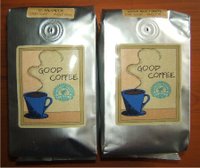
Every month, I like to try out a new shade-grown coffee.  This month, it was from the Good Coffee Company of South Carolina, which sells only Rainforest Alliance certified coffee. Since their coffees are available in 8 oz. packages, I tried two: El Salvador and their Costa Rica/Brazil blend.  I wish more roasters would offer small packages like this for folks to try, especially online vendors.  I don’t like to buy several pounds of coffee if I might not like it, not to mention I can’t drink that much in a week and hate to evaluate stale coffee. But just buying one pound and paying shipping is pretty pricing.  The option of buying several small bags is really appealing to me.

I ordered these beans as dark roasts.  A peek at the beans when they arrived showed a lighter color than what I’m used to seeing in a “dark roast.”  Only a few beans with oils barely showing on the surface, and a flat, milk-chocolate brown color.  The roast description on the Good Coffee site is a close match to this…I should have read it first! I tried the El Salvador first, noted to be of mild acidity and medium body.  I thought it was really nice when prepared as a strong cup in an Aeropress.

The Costa Rica/Brazil blend was described as an “Experimental blend. This product is a blend of our 05-06 crop RA Costa Rican SHB and Brazil NY2 Screen 19 coffees with a dash of RA Guatemalan and Kenya AA for balance.”  The beans were roasted to an identical medium, not dark, roast like the El Salvador, but I actually liked it a little better, and it was especially good in the Aeropress.   Both of these coffees “aged” better than a dark roast, I must admit, whether cooking in the pot or sitting in a thermal mug.  Since I like strong coffees, I actually liked them better a little old.  They also made a fine blend with a darker roast.