New orchid species named for coffee company
 A new species of orchid, Teagueia puroana, was discovered in central Ecuador in the eastern Andes, and named for the Puro Coffee company.
 A new species of orchid, Teagueia puroana, was discovered in central Ecuador in the eastern Andes, and named for the Puro Coffee company.
I was once active in orchid growing and writing for the American Orchid Society, so when I read about an orchid discovered with a coffee connection, I was naturally interested. This orchid was discovered in 2002 in the Cerro Candelaria Reserve, a nearly 3000-ha area protected through a partnership between FundaciÁ³n EcoMinga and the World Land Trust. Since 2005 when the brand was launched, Puro Coffee, the Fairtrade coffee brand of Belgium-based Miko Coffee, has contributed 2% of the retail price from each bag of coffee sold to the World Land Trust for the protection of rainforest. To date, this funding has helped purchase over 3200 ha in Ecuador, Brazil, Colombia, Borneo, and Guatemala. In honor of this support, the new orchid species was named Teagueia puroana. The official description of this new species was published in 2011 along with another new Teagueia species in the journal Lankesteriana.
Teagueia is a genus in the orchid subtribe Pleurothallidinae, a group of mostly miniature New World orchids usually found at high elevations. Despite their small size and specific, fussy cultural demands, Pleurothallids are popular with orchid aficionados for their fragile and delicate beauty. Until recently, only six species of Teagueia were known. Now over two dozen species have been discovered (along with new representatives of other orchid genera) all in the same Rio Pastaza watershed, many on Cerro Candelaria. The effort to map the distribution of orchids in this region was spearheaded by botanist Lou Jost.
After the discovery of the Teagueia on Cerro Candelaria, Jost and some of his colleagues founded FundaciÁ³n EcoMinga, and obtained funding through the World Land Trust to establish the preserve. So far, Cerro Candelaria is the only place T. puroana has been found. It lives on the stunted trees in the alpine grasslands known as pÁ¡ramo at 3700 meters. While some of the new Teagueia are abundant as creeping ephiphytes on low vegetation and mosses on different nearby mountains, T. puroana is very rare, with only a few plants located despite much searching.
While this is the first orchid I have heard of named for a coffee brand, orchids are often important components of shade coffee farms, and shade coffee farms can be important refugia for orchids.
More on the coffee
 More on the coffee
Miko Coffee, part of the Miko Group, was founded as a grocery business in 1801, with coffee roasting becoming its main business around 1900 (plastic food packaging is the other main activity of the Miko Group). Miko coffee primarily focuses on the “out of the house” market, providing beans, equipment, and related products for food service, restaurant, and office coffee in over 20 countries, mostly in Europe and Asia. Retail coffee is a relatively small portion of their business, and Puro Coffee is their Fairtrade and FT/organic/ethically-sourced brand.
Puro offers three different blends. The current compositions are given below, but they sometimes change. Puro provides updates on their web site, so you know what you are getting.
- Puro Organic, certified organic and Fairtrade. Currently sourced from Peru (CEPICAFE) and Honduras (COSAGUAL and COCAFCAL).
- Puro Noble, certified organic and Fairtrade; 80% arabica, 20% robusta. Currently sourced from Peru (CEPROAP), Honduras (COAGRICSAL and COPROCAEL), Guatemala (FEDECOCAQUA), and Congo (CDI Bwamanda). Also available in decaf.
- Puro Fuerte, certified Fairtrade; 50% arabica, 50% robusta. Same sources as Noble.
We tried all three coffees, provided to us by Puro. Our expectations were not sky-high, as we most often drink single origins and find the more generic blends nice but not as interesting (especially to the more jaded panel members). We were pleasantly surprised.
 The Organic blend was everybody’s favorite. Two adjectives were mentioned by nearly all reviewers: “smooth” and “milk chocolate.” Soft and creamy also came up. Personally, I usually don’t like Peruvian coffees too much, because the catimor variety is commonly grown there and I find I seem to be able to taste the chemical flavor of the robusta heritage. CEPICAFE, however, grows 95% typica, and the sweetness came through. When prepared in a Clever Coffee Dripper, we additionally found an initial hit of cinnamon and spice which we also enjoyed. Overall, this coffee earned 3.5 motmots.
 We approached the Noble with some trepidation due to its robusta content. We were all surprised we could not detect any hint of rubbery, chemical flavor familiar to us from other robusta offerings we’ve tried, and least when the coffee was fresh and hot. The flavor deteriorated a little bit as it cooled. Overall, we found it very similar to the Organic blend, just not as bright. This lack of some liveliness and the flavor change when cool dipped the score to 3 motmots.
 Upping the robusta content to 50% was clearly the tipping point for us, as nobody was really enthusiastic about the Fuerte blend. I’m really not sure exactly what was going on here, as some of the flavors our more experienced tasters were finding seemed beyond the usual bold, rubbery type of flavor that is a more normal characteristic of robustas. In a French press in particular, it seemed dirty and oddly astringent, with a most peculiar flavor/aroma that reminded me of rubbing alcohol. Not sure what might have caused this. Medicinal flavors can come from over-fermented beans; perhaps this batch may have had some bad beans in it, as it seemed at odds with what must be a really well-processed robusta from the CDI Bwanmanda group in Congo. Some grocery-store-coffee drinkers we dragged into this panel didn’t really detect these flavors; perhaps it might also be more suitable for an espresso prep than a drip. This blend ended up with 2 motmots.
Right now, Puro Coffee does not have a U.S. distributor, but a new web site for online purchases is being rolled out in multiple languages: Puro at Home. Their U.S. brand home page has an almost overwhelming amount of information. The Puro blog is an especially good source of information on their rainforest and habitat projects (e.g., cool moths and beetles in Brazil, giant monkey-eating eagles in Ecuador). There is also an entire page with links to the many short videos they’ve created on their coffee, rainforest projects, social initiatives, partnerships, and worldwide clients.
I have found that some coffee companies that support a cause as strongly as Puro Coffee does the World Land Trust tend to focus more on the cause than the coffee. Puro is certainly an exception to this: very committed to the cause of conserving rainforest and sustainably-grown coffee, and very satisfying coffee as well.
Jost, L., and Shepard, A. 2011. Two new species of Teagueia (Orchidaceae: Pleurothallidinae) from east-central Ecuador. Lankesteriana 11(1): 9-14.
Photo courtesy of Puro Coffee. All rights reserved.
 When you think of endangered species, I’ll bet you don’t think about
  In 1996, Seattle’s


 Among CAN’s projects is the
  This is a bag of coffee that does not have tasting notes, but instead has a “sustainability facts” label similar to the Nutrition Facts labels found on food products in the U.S. What a great idea! It gives data on the coffee-growing community and its environmental, social, and economic conditions. You can see the environmental section on the label at right: there are 541 shade trees of 14 species per hectare. For comparison,
  As of our review, it’s harvest season in Central America; this bag was no doubt from last crop season. I was in the San Ramon area last March at the end of harvest, and many coffee trees were very afflicted with fungal diseases due to the wet weather in the preceding months. This coffee had no flaws, and I can only imagine that with better growing conditions it could really shine. Certainly I expect that a newer sample would be perkier and demonstrate a little more complexity that this sample. It came in at a solid 3.25 motmots, and obviously supports a program that has done an excellent job at establishing a broad program of assistance that benefits farmers, students, and consumers.
 I was going to include a briefer version of this list in my post on “

 The Peter Asher Bob-o-link Coffee was a blend of dry and pulped natural processes. From the dry aroma to the last sip, this is a coffee loaded with cocoa and chocolate, not normally what I associate with Brazilian coffees. In addition to chocolate, tasters reported (each of the following qualities more than once) caramel, French vanilla, nuts, and butterscotch. I think you’re getting the idea: this coffee was like a candy bar. The only time we picked up the metallic taste was when it was prepared in a
  This is certainly one of the most unusual mainstream coffees (versus novelty coffee such as


 I’ve written about
 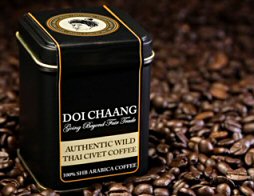 Doi Chaang provided us with a tin of the “spat” wild civet coffee for us to try. Because these are wild civets, the coffee is very limited. This year it is available in 50-gram tins, so we were unable to have a lot of people taste the coffee, so we won’t provide a motmot rating as we usually do. We prepared the civet coffee as a simple pour-over, side by side with their medium roast single estate variety. Later, we also made the medium roast peaberry variety as a drip, and compared notes with another round of the civet as a pourover. We were going to use the peaberry for the side-by-side comparison, but the standard bean version seemed closer in roast level to the civet variety. The latter was, visually, perhaps just a tad lighter.
 KNC is one of the world’s top five macadamia processors. Macadamias are native to Australia, and were introduced into Kenya in the 1940s. In the early 1970s, the Kenyan government tasked KNC to develop the industry. KNC is a Kenyan/Japanese joint venture; the chair is Pius Ngugi, one of Kenya’s most wealthy businessmen. KNC has now expanded into cashews, tea packing, wine production, and arabica coffee. Overall, the company operates seven farms on over 8,000 acres, and is also supplied with raw product by thousands of smallholders.


