Coffee reviews

Review: Bob-o-link Coffee

Plainspoken Coffee. A Coffee Review for Ordinary People by Ordinary People, #48.

The backstory

I first heard about Bob-o-link Coffee on a local birding listserv. My first thought was, “Why would anyone use a grassland bird species to represent coffee?”  The answer is sort of a practical one: the owners have an Illinois home on Bob-o-link Road. And the area where the producing farms are located, the Mogiana Region of SÁ£o Paulo and Minas Gerais, Brazil, is so far south that few North American migrant birds spend the winter there. Bobolinks (Dolichonyx oryzivorus) do travel there: these small songbirds have one of the longest journeys of any North American songbird — each year they make a 20,000 km round trip! They are strictly grassland and agricultural field birds, and never found in forests*. But given their very steep population declines (in part due to pesticide exposure on rice farms in winter), they do make good ambassadors for the problems facing Neotropical migratory birds.

Tenuous link aside, Bob-o-link Coffee comes from a group of small farmers practicing sustainable production techniques, including reforestation, organic methods, protection of water resources, and careful post-harvest quality control. The effort is spearheaded by Fazenda Ambiental Fortaleza (FAF), an organic (though not USDA certified) coffee farm in the region just outside the town of IgaraÁ­. FAF also produces “natural” coffee. Not so much in the sense of a natural (dry) process coffee, but apparently coffee planted by merely scattering beans under a shade canopy and providing no further intervention: no chemicals, no fertilizer (not even organic compost), no pruning. Honey, vegetables, cheese and other products are also produced on the farm. FAF provides support and instruction on organic and sustainable agriculture to local farmers and volunteers from the organization World Wide Opportunities on Organic Farms.

The other farmers that produce Bob-o-link Coffee are located at 900 to 1300 meters, and grow a number of arabica varieties: yellow and red Bourbon, yellow and red catuai, and Mundo Novo, to name a few more common ones. What’s in a bag of Bob-o-link Coffee might vary by crop year, so check with your roaster. Like many Brazilian coffees, this is typically dry processed. Note that this coffee is sometimes labeled as “bird-friendly,” but it is not certified by Smithsonian Bird-Friendly at this time (and the term “Bird-Friendly” is trademarked by Smithsonian; you must see the Bird-Friendly seal on the coffee to assure that is is certified). Bird-Friendly certified coffees must also by certified organic. Not all of the supplying farms are, which is an impediment for BF-certification.

Review(s)

We have tried this coffee in two crop years from three different roasters. Last year, we purchased it from Klatch Roasting; the Bob-o-link Coffee was a regular offering. Recently, Klatch announced that it is discontinuing its relationship with FAF and will no longer carry Bob-o-link Coffee. We also bought it from Portola Handcrafted Coffee Roasters, which has since morphed into Portola Coffee Lab and no longer has online sales. This year, we were contacted by Peter Asher Coffee and Tea Company in Champaign, IL, who sent us a 12-oz bag to try. Peter Asher has been carrying this coffee for two years, the buyers have made trips to FAF. They are so impressed with the mission of FAF that they also support student visits there through the University of Illinois Office of International Programs.

Of course, as an agricultural product, coffee quality and taste can vary widely from year to year, even from the same farm(s).  Further, every roaster will treat beans differently. It’s hard to tell what contributed to the dramatic contrasts we experienced between crop years and roasters with the Bob-o-link Coffee, but here is what we found.

The Portola version was sold as organic, and we found it sweeter than expected, a little spicy, with a pleasant tobacco-essenced finish. However, it was always the first few sips that were most interesting, then the coffee faded a bit and veered into monochromatic territory. In general, folks were ambivalent about the coffee, so we sought it out again. We were even more disappointed in the Klatch batch. Whether prepared as a drip, Chemex, Aeropress, or French press, it had a persistently tinny taste. Personally, I often tend to find a metallic aspect in many Brazilian coffees, but I wasn’t alone in detecting it this time. Knowing this was a coffee with a strong backstory working toward a sustainable “brand,” we decided to wait another year before publishing a review. Indeed, the current crop year roasted by Peter Asher is barely recognizable as the same coffee.

The Peter Asher Bob-o-link Coffee was a blend of dry and pulped natural processes. From the dry aroma to the last sip, this is a coffee loaded with cocoa and chocolate, not normally what I associate with Brazilian coffees. In addition to chocolate, tasters reported (each of the following qualities more than once) caramel, French vanilla, nuts, and butterscotch. I think you’re getting the idea: this coffee was like a candy bar. The only time we picked up the metallic taste was when it was prepared in a Chemex. Brewed, it was pleasantly sweet and smooth, balanced but subdued, and unremarkable. As a pourover, using a Clever Coffee Dripper with a longer-than-usual extraction time (5 minutes), it was fuller and more interesting. But preparation in a French press was when it had the richest chocolate tones along with a medium-bodied but creamy mouthfeel. Please start with one of these manual brewing methods to get the most out of this coffee.

Since the Peter Asher version is the current crop year and the only one of the three roasters which we tried which has the Bob-o-Link Coffee available, it is the one we rated here. At 3.75 motmots, it is one of the higher-rated coffees we have reviewed in some time. Bob-o-Link Coffee is gaining traction in the U.S. and not too hard to find online.  While it would be interesting to see how it fared from other roasters, we found a winner at Peter Asher, and thank them for reaching out to us so we could give it another try!

*The bird list from the supplying farms does not, in fact, include Bobolinks.

Male Bobolink photo by Janet and Phil under a Creative Commons License.

Review: Coffees from India

Plainspoken Coffee. A Coffee Review for Ordinary People by Ordinary People, #47.

In the overview of coffee growing in India, I promised some reviews. The crew here at C&C has, in fact, been busy drinking multiple offerings from India. We hope to do at least two posts, each with several short reviews.

We start off here with reviews of several non-traditional coffees. We purchased these from Muddy Dog Coffee Roasting in Morrisville, NC.

Sethuraman Estates Liberica

This is certainly one of the most unusual mainstream coffees (versus novelty coffee such as Kopi Luwak) currently available. Two species of coffee make up nearly all coffee on the market today: arabica (Coffea arabica) and robusta (C. canephora). Coffea liberica is a species native to west and central Africa, and accounts for only about 1% of world trade. It is a large tree with big, leathery leaves often grown on roadsides or as a windbreak.

Sethuraman Estates is in the Chikmagalur region of Karnataka state, near the town of Magundi and the Bhadra Wildlife Sanctuary. By all accounts, including this excellent one by Muddy Dog owner Jim Pelligrini, there is ample shade and lots of wildlife on the farm. Much of the coffee at Sethuraman is grown organically, and part of the estate is in the process of being certified. Coffee is fertilized with estate-produced worm compost, and other environmentally-friendly practices have been initiated, including the installation of new water-conserving processing equipment.

This coffee is grown at about 900 m, and prepared as a pulped natural. The aroma of the ground coffee as well as the first taste is very fruity — there is the strong suggestion of blueberries, as in a dry process Ethiopian, but there are components of other dark fruit (plum was mentioned by one taster) as well as cherry. A fruit brandy or liqueur flavor was agreed on by multiple tasters, leading a couple of people to say it would be good as an after-dinner coffee.

As the coffee cooled, several drinkers who tended to favor milder coffees were put off by the sour notes that emerged. It wasn’t harsh or sharply sour — in fact, overall the coffee was remarkably smooth. On the other hand, the finish reminded one German taster of sauerbraten — in a good way. “I did not expect to have this kind of experience from coffee!!!” was his remark. I have seen this coffee described elsewhere as “meaty.” This may represent savory or umami aspects of the profile. We (gratefully) did not come up with “animal-like flavors of jackfruit…and mint.”

The first few sips are indeed powerful, and perhaps could be considered challenging to many. We found it was more approachable in a French press than as a drip.

I was a little surprised that such an assertive coffee was liked by so many people. Nobody dismissed it, and most people agreed that while they wouldn’t want to drink it every day, they’d try it again. A few were very enthusiastic. When scores from the larger-than-usual panel were averaged, the final score was 3.25 motmots, very respectable for such an unusual coffee. Please give it a try!

By the way, liberica has a higher caffeine content than arabica (beans at about 1.4% caffeine versus around 1%), but less than robusta (1.7%)[1], although nobody thought it produced any more buzz than usual.

Monsooned Malabar

I think for Americans, Monsooned Malabar is the coffee most associated with India. The name is a legal Geographical Indication, indicating that the coffee comes from a particular region. In this case, Monsooned Malabars are processed coffee beans (usually, maybe always, dry processed) exposed to the annual monsoon winds in warehouses along the Malabar coast of India. This unusual treatment is deemed necessary to replicate the unique taste and character of Indian coffees that were once transported to Europe on sailing vessels and subjected to months of humidity on the journey. As the beans absorb moisture, they swell and turn pale. Again, Jim of Muddy Dog has a great blog post on how the process proceeds in modern times: How Stuff is Made: Monsooned Malabar Coffee.

There are a number of adjectives that invariably pop up in descriptions of Monsooned Malabars: earthy, woody, pungent, wild, funky, low-acid, and heavy or syrupy-bodied. Unadventurous coffee drinkers might balk at a coffee described this way. Usually roasters don’t recommend Monsooned Malabars to people who like sweet, bright coffees. I consider myself solidly in that group, yet I really enjoyed this coffee.

The tasting panel did find some of those flavors in this coffee, but they were nowhere near as odd, unpleasant, or unappealing as this coffee’s reputation had lead us to expect. We found this coffee well-rounded, with pleasing tones of earthiness, leather, and smoke. There was a very agreeable rustic, musty nuance that added character to the overall mellowness of the coffee. Really no hint of fruit, despite the dry processing.

Nobody gave this coffee less than 3 motmots, and the average score was between 3.25 and 3.5 — so we’ll go with 3.5 to encourage people to give it a try. Whereas many Indian coffees are hard to come by, Monsooned Malabars are not terribly hard to find. Some roasters even offer single-estate origin Monsooned Malabars. On the other hand some also have monsooned robustas, and many roasters are just not sourcing very high quality monsooned coffees, or have the skill to roast them correctly. I assume that’s why so many Monsooned Malabars are described as extreme or intense. Choose a roaster carefully. I know our positive experience with this coffee was due in large part to Muddy Dog’s honoring the bean’s interesting profile.

Kaapi Royale Cherry Robusta

This robusta selection is also from Sethuraman Estates, grown lower than the liberica, at 750 m. “Cherry” in regards to Indian coffee means a natural or dry process. Much of the world’s bad supermarket coffee is made up of cheap robusta. However, there are some carefully grown and processed robustas used in espresso blends. Typically, people don’t drink robusta straight, with the exception of the occasional single-origin espresso shot. Since we have so far not branched out into espresso prep reviews, we bravely prepared this sample as a drip and in a French press.

Robusta beans have a distinctive rubber flavor, and a bitterness that comes from the high caffeine content. When prepared in my Technivorm drip coffee maker, these characteristics were a bit more emphatic than they were when prepared as a French press. Because a sourness also developed as the coffee cooled, making this coffee in any typical consumer drip coffee maker would surely accentuate the most formidable aspects, while drowning out the intriguing properties. Thus, we proceeded with several trials in the press.

Although a dry processed coffee, fruit was not the dominant feature. There was no mistaking it was a robusta — the “rubber” was there — but it was tempered by semi-sweet chocolate, wood, and earth. It was not bitter, but very, very smooth. Nobody found this offensive. While everyone agreed this wasn’t something they’d go out and buy a bag of, they liked the idea of a cup now and then, and very much appreciated an opportunity to taste a high quality robusta, rather than the crap in supermarket coffees. It ended up with a respectable 2.75 motmots.

A future review will cover some more traditional, single-estate arabicas from India.

We’d like to thank Jim Pelligrini for putting together a great package of Indian coffees for us to buy and try out. Nor can we neglect to also thank Allen Leibowitz of Zingerman’s Coffee Company for inspiring us to embark on exploring Indian coffees.

[1] Ashihara, H. and A. Crozier. 2001. Caffeine: a well known but little mentioned compound in plant science. Trends in Plant Science 6:407-413.

Review: Doi Chaang Civet coffee, revisited

Plainspoken Coffee. A Coffee Review for Ordinary People by Ordinary People, #46.

I’ve written about Doi Chaang Coffee, a unique Thai/Canadian partnership, before.  This is certified organic, certified Fair Trade (although the partnership goes well beyond), single-origin coffee grown in northern Thailand. There is plenty of background information on the company and the coffee in the review of their medium roast that we did in 2008. I won’t rehash everything here, but just provide the basics:

Doi Chaang coffee is grown on over 2400 ha in the vicinity of the village of Doi Chang (20.325, 99.839) in Chiang Rai province at around 1200 meters. It is 50% Caturra, 35% Catimor, and 15% Catuai. The coffee is grown under the shade of various fruit and nut trees, including macadamia, plum, pear, and peach. Reforestation efforts in the area strive for a 50/50 mix of native tree species and cash crop species (both marketable and consumable crops are necessary to replace the income formerly generated by poppy growing).

In 2009, we reviewed Doi Chaang’s civet-processed coffee. Unlike most other civet coffees (often known as “kopi luwak“), Doi Chaang does not farm or raise civets in captivity (see the third photo here for the tiny cages in which these animals are typically held). All beans are gathered from what is left behind by wild civets in the Doi Chaang coffee-growing areas. Two species of civets are found in the area, the Masked Palm Civet (Paguma larvata) and the Asian Palm Civet (Paradoxurus hermaphroditus). The related Binturong (Arctictis binturong) also occurs there and is known to eat coffee fruit as well.

Generally, civet coffees are made from beans that have passed through the digestive tracts of these animals: they eat the ripe coffee cherries, but do not digest the seeds, which are passed in the waste. For more on this, er, process, read our review of typical kopi luwak coffee, and the review of Doi Chaang’s wild civet coffee. As I mentioned in the latter post, Doi Chaang actually offers two types of wild civet coffee: passed and spat. It’s not unusual for animals to regurgitate large seeds from fruit they have just eaten rather than have all the bulk pass through their systems. Modest chemical changes in the coffee beans apparently do occur when they pass through the entire digestive systems of civets. I’m not sure they’d be exposed to digestive enzymes long enough to make a profound difference if they are just held in the mouth and then spit out. However, it’s conceivable that mammals may first swallow the fruit and shortly thereafter regurgitate the seeds, in which case they will have been exposed, at least for a short time, to some of the digestive processes that apparently give “passed” civet coffee its character.

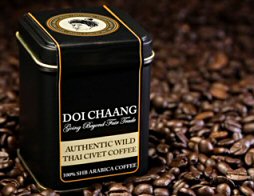
Doi Chaang provided us with a tin of the “spat” wild civet coffee for us to try. Because these are wild civets, the coffee is very limited. This year it is available in 50-gram tins, so we were unable to have a lot of people taste the coffee, so we won’t provide a motmot rating as we usually do.  We prepared the civet coffee as a simple pour-over, side by side with their medium roast single estate variety. Later, we also made the medium roast peaberry variety as a drip, and compared notes with another round of the civet as a pourover. We were going to use the peaberry for the side-by-side comparison, but the standard bean version seemed closer in roast level to the civet variety. The latter was, visually, perhaps just a tad lighter.

Now we don’t consider ourselves as having an extremely sensitive palates — we are ordinary people, after all — and I was frankly skeptical that a “spat” coffee could have gone through any flavor-enhancing changes. So we didn’t expect to be able to tell the difference between the two. We were wrong. The civet coffee was markedly smoother, with an understated milk chocolate sweetness. In our previous review (the “passed” civet coffee), we didn’t detect the Sumatran-like profile of earth and leather that we did in the regular and peaberry varieties (which were muted in that crop year, but much sharper this year). This time, we did get a more Sumatran vibe from the wild civet coffee, although it was restrained and very mellow, especially as the cup cooled. Hands down, we liked this better than either the peaberry or the standard single origin.  Was it due to the extra care and sorting that might go into the preparation of the civet beans? More careful roasting of the precious beans? Can a civet discern some particular property in ripe coffee cherries, thus making these beans share some special characteristic? Or does even brief consumption by the mammal impart a distinct profile? I can’t say. But I will admit, it was markedly different, and clearly more enjoyable.

Here is a recent review of the Doi Chaang wild civet “spat” coffee by CoffeeReview.

Since we first started reviewing Doi Chaang’s coffees, they have become much more widely available in both retail outlets and online.

One of my absolute favorite things about Doi Chaang is a coffee is the nearly overwhelming amount of information the company freely provides about its history, growing, processing, and people. If people could have this kind of background on all the coffee they buy, nobody would be drinking mystery corporate coffee anymore. Here are a couple resources:

  • The Doi Chaang blog.
  • A 30-minute documentary produced by Global TV is available in segments on YouTube. Part 3 is a quickie, and deals with the civet coffee as well as other products being produced by Doi Chaang, including macadamia nuts, honey, and soap. I love hearing brother Wicha talk about poop!

The Doi Chaang story is really remarkable. I especially recommend the documentary. The success of Doi Chaang in North America is nothing compared to how successful its been in changing the lives of the hill tribe that produces it. If you feel an urge to drop some cash on an animal-processed coffee, go for the Doi Chaang version. Not only does it avoid exploiting animals, it generates income for a company doing truly good work.

Review: PT’s Kenya Kia Ora

Plainspoken Coffee. A Coffee Review for Ordinary People by Ordinary People, #45.

In my exploration of coffee growing in Kenya, I discussed how little organic coffee was produced in the county.  At least two factors account for this. First is that there is little governmental support or official policies regarding organic agriculture in the country [1].  Another factor is the prevalence of various diseases and pests, including coffee berry disease (Colletotrichum coffeanum), coffee leaf rust (Hemileia vastatrix), and coffee berry borer (Hypothenemus hampei).  The severity of these problems has been blamed, at times, on the lack of integrated pest and farm management, and has resulted in very heavy use of pesticides and fungicides. In particular, the overuse of copper fungicides has exacerbated pest problems (although some copper solutions are actually permitted under organic standards) and contaminated the environment [2].

According to interviews with coffee-growing small holders in the vicinity of Nyeri [3], farmers have little knowledge of what products are considered eco-friendly, even though they acknowledge more birds and wildlife are present when they do not spray their crops. They also indicated that the mills to which they sell their coffee have strict regulations that include spraying regimes and prohibitions on intercropping with shade trees.  Without institutional support, organic farming may never gain momentum in the country.

Although Kenya currently exports around 50,000 tons of coffee annually, only about 400 tons are organic (2008 figures, [1]). So when I saw that PT’s Coffee Roasting had an organic coffee from Kenya, I knew this was a coffee with a story that I wanted to review.

PT’s Coffee Roasting Co.: Kenya Kia-Ora Organic

Background

There was little to be found online about Kia-Ora Farm. PT’s Jeff Taylor put me in contact with the importer, InterAmerican Coffee. Their information was roughly the same as was being reported on various roaster web sites: the coffee was intercropped with macadamia nut trees at 1600 to 1900 m in Kirinyaga. Not much to go by. The InterAmerican bean bio had one tidbit that helped me track down the source: it was certified organic by one of the handful of agencies working in Kenya, Soil Association Certification Ltd. out of the UK. A dig through documents on their site revealed that Kia-Ora Farm was owned by Kenya Nut Company (KNC).

KNC is one of the world’s top five macadamia processors. Macadamias are native to Australia, and were introduced into Kenya in the 1940s. In the early 1970s, the Kenyan government tasked KNC to develop the industry. KNC is a Kenyan/Japanese joint venture; the chair is Pius Ngugi, one of Kenya’s most wealthy businessmen. KNC has now expanded into cashews, tea packing, wine production, and arabica coffee. Overall, the company operates seven farms on over 8,000 acres, and is also supplied with raw product by thousands of smallholders.

Coffee supplied to KNC is processed in the Thika Coffee Mills (one of the handful of “factories” that handle coffee in the country), a KNC company, for both export and the local market. KNC also roasts and packages its own blends of coffee under its trademark “Out of Africa”.

The specifics about Kia-Ora — size of the farm, organic history — remain elusive.  One roaster indicated the farm grew French Mission (Bourbon) and SL varietals. If anybody has further details, please drop me a line or leave them in the comments.

Coffee review

PT’s treatment of this coffee was a light roast, no oils on the surface of the beans. A lot of people tried this coffee, and some were new to the wine-like Kenyan profile. That can spell trouble for some distinctive coffees, but everybody but one panelist enjoyed it.

Surprising was the malt flavor a couple of people detected on the front end when very hot out of the French press; this was not found in samples brewed on the Technivorm. Either way, the coffee had a resonant, tart, wine-like acidity so often admired in Kenyan coffees. Grapefruit overlain with honey seemed to be a dominant player, but one taster noticed a hint of savory on the palate, reminiscent of tomato (that’s a flavor I’ve seen in coffee descriptions, but never connected with until now; it’s way better than it sounds!).

More than one person thought that the Kia-Ora’s tartness was starting to veer off into sour territory, especially when made at concentrations at or above 1 gr coffee to 15 gr water*.  I like this characteristic acidity, but it was this sharp forwardness that unsettled some panelists that weren’t familiar with it.  Thus, the overall rating worked out to just over 3.5 motmots,  but there were many people who scored it higher (one gave it a 4), and those that preferred a heavier bodied, lower acid coffee dragged down the average. Experimentation with the ratio of coffee to water should help people find their sweet spot (low concentrations stripped it of character, however) and Kenyan coffee aficionados should really enjoy it.

We also tried this coffee provided to us by Strongtree Organic Coffee Roasters (although they didn’t know we’d be reviewing it). They took the roast just a tiny tad farther. This seemed to take the edge of the sour note, and steadied the acidity. Importantly, the coffee consistently maintained all it’s good qualities between the two roasters.

Noble Coffee Roasting‘s Kia-Ora offering is a finalist in the Good Food Awards for coffee.

Parting thoughts

Much, perhaps most, of Kenya’s coffee is grown in the sun using (a lot) of chemicals. The fact that a major company is investing in and exporting high-quality organic coffee (and nuts), probably on a relatively large scale, is encouraging. It was particularly impressive to me after reading about the struggles in both the Kenyan coffee and macadamia sectors.

Some coffee varieties that have fungal-disease resistance are being developed, which would help farmers maintain their yields, and farms, as well as support organic production. However, if these varietals are viable, the question remains — can they produce the same cup quality as heirloom varietals? Historically, that hasn’t been the case, and a lowering of quality may equate to lower prices to farmers, and subsequent abandonment of coffee as a crop, as has happened in the past.

When coffee prices declined in the 1990s, some farmers switched from coffee to macadamia. In fact, KNC has worked to encourage small farmers to grow macadamias to decease overall dependence on coffee and tea. Now, the nut crops are threatened by major fungal outbreaks. Integrated pest management and good cultural techniques can help minimize these outbreaks [4], but should farmers again turn to certain fungicides, organic certification could be jeopardized on coffee farms that also have macadamia.

These struggles have helped fuel a sell-off of agricultural land to developers in Kenya. For instance, the 1,000-ha Tatu City, is slated for a former coffee farm outside the town of Thika, about 40 km north of Nairobi.

With Kia-Ora, KNC has proven that good quality, organic coffee can be a commercial success, even as a specialty coffee export. Let’s hope this achievement is recognized and built upon in the years to come.

[1] Kledal , P. R. , H. F. Oyiera , J. W. Njoroge, and E. Kiarii . 2009. Organic food and farming in Kenya. In: Willer, H. and Kilcher, L. (eds.) The World of Organic Agriculture. Statistics and Emerging Trends 2009, FiBL, IFOAM, ITC.
[2] Nyambo, B. T., D. M. Masaba, and G. J. Hakiza. 1996. Integrated pest management of coffee for small-scale farmers in East Africa: needs and limitations. Integrated Pest Management Reviews 1:125-132.
[3] Lamond, G. 2007. Local knowledge of biodiversity and ecosystem services in smallholder coffee farms in Central Province, Kenya. MSc thesis. University of Wales, Bangor. UK.
[4] Mbaka, J. N., L. S. Wamocho, L. Turoop, and M. M. Waiganjo. 2009. The incident and distribution of Phytophthora cinnamomi Rands on macadamia in Kenya. Jrl. Animal and Plant Sciences 4:289-297.
*As ordinary people, we try not to aim for precision in these reviews, striving to make coffee without adherence to measurements as would most people. But I do try to mix it up a little, and when I’m considering a review coffee on my own, I will often make more careful experiments.