Coffee news and miscellany

Sips: Coffee "CSA", la broca, farmer education, co-ops and cash

I always come across items that might be of interest to readers that deserve more than just a Tweet (@birdbarista) but not quite a whole post. Hence the debut of the "Sips" feature.

  • San Rafael Sustainable Coffee Initiative: Interesting riff on direct trade/CSA model. Provide micro-loans to three farms near San Rafael, Costa Rica, get coffee when the crop is harvested. Coffee isn't certified organic, but no pesticides or herbicides are used. Farm photos and videos on the site look shadier than most in Costa Rica.
  • La broca (coffee berry borer) found in Hawaii: Bad news. It's also turned up in Puerto Rico. More on la broca control here.
  • Project First Taste: Many coffee farmers have never tasted their own coffee, and they can't make quality improvements or business decisions because of it.
  • What do high market prices mean for cooperatives? Understanding how the cooperative system works and is impacted by the C market.


Birds on coffee

I talk about birds in coffee a lot on this site– how birds use and need the resources provided in shade coffee farms is the inspiration for the site. How about birds on coffee…labels and logos?

First up, coffee roasting companies named after birds.

Caffe Ibis – White Ibis

Black Stilt Coffee Lounge

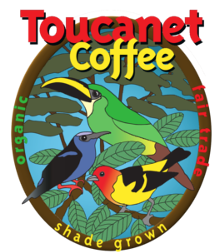
Toucanet Coffee – Three birds: an Emerald Toucanet, Red-legged Honeycreeper, (both tropical species) and Western Tanager (breeds in North America, winters in the tropics).

And here’s a sampling of birds on coffee packaging.

Thanksgiving Coffee Company – Songbird Coffee series in partnership with the American Birding Association. Top = Wilson’s Warbler, Black-throated Green Warbler, and Indigo Bunting; Bottom = Ovenbird, American Redstart, and Baltimore Oriole. All North American breeding birds that winter in the tropics.

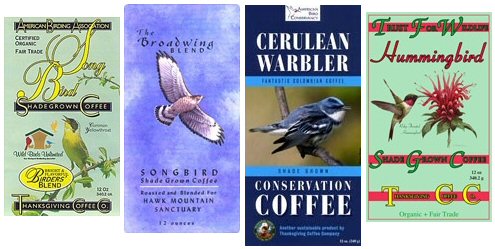
Thanksgiving Coffee Company – More partnership coffees. Common Yellowthroat on Birder’s Blend (Wild Birds Unlimited); Broad-winged Hawk on Broadwing Blend (Hawk Mountain Sanctuary); Cerulean Warbler on Conservation Coffee (American Bird Conservancy); and Ruby-throated Hummingbird on Trust for Wildlife. All North American breeding birds that winter in the tropics.


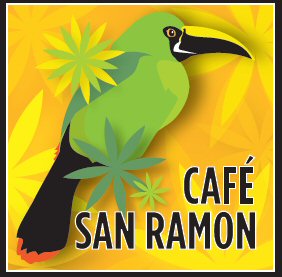
Counter Culture Coffee,Café San Ramon — Emerald Toucanet, a tropical species. I have to say, this is my personal favorite because Counter Culture asked me to help them identify an appropriate species for this product and this was one of the first choices. Plus, I’ve actually seen this species on the very farm that is the main source of this coffee.


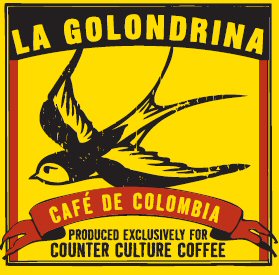
Counter Culture Coffee, La Golondrina – a swallow. There are many swallow species, both resident and migrants to the tropics. According to Counter Culture, a swallow was chosen as in Latin American culture, the swallow is a symbol of communication between people separated by distance and borders.


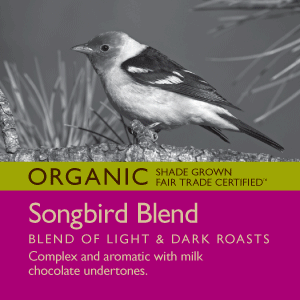
Tony’s Coffee and Teas, Songbird Blend. Another Western Tanager.


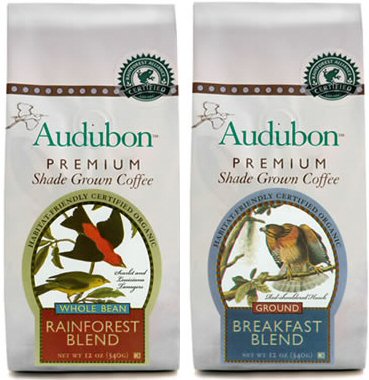
Audubon Coffee, Rainforest Blend and Breakfast Blend. Scarlet Tanager and Broad-winged Hawk. Both North American breeders that winter in the tropics. These are both portions of paintings by John James Audubon.


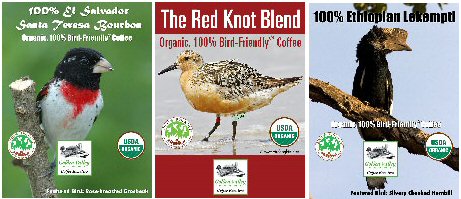
Golden Valley Farms has nearly a dozen Smithsonian Bird-Friendly certified coffees featuring birds on the packaging. Here are just three. The El Salvador Santa Teresa Bourbon has a Rose-breasted Grosbeak, which breeds in North America, winters in the tropics. The Red Knot blend shows a shorebird of the same name, which makes one of the longest migrations of any bird, from the Arctic to Tierra del Fuego. This coffee raises funds for this species, which has experienced dramatic population declines. Finally, their Ethiopian Lekempti has a hornbill on the package, probably a Silvery-cheeked Hornbill. These striking large birds nest in cavities, and they restrict the entrance to their nest holes with mud, droppings, and fruit pulp. The female becomes sealed inside while incubating eggs and tending to young, with the male passing food through a small hole. The female breaks out when the nest hole gets too crowded.

Know some other roasters or coffees with a cool bird as a logo? Let me know in the comments!
Transparency via smartphone apps

One of the great dilemmas in educating consumers about sustainable coffee is how to fit a lot of sometimes complex information on a bag of coffee. The point of purchase is where the rubber hits the road — it’s probably the first and/or last place to inform a potential consumer where the coffee came from and how it was grown, purchased, and processed.

Certification schemes are designed, in part, to help consumers in this regard by assuring them that their coffee (or other product) was produced under some particular condition: all the consumer would need to do is recognize the “seal” of the certifier. Unfortunately, the proliferation of different certifications has led to consumer confusion and “label fatigue.”

Now a new option is coming along, an extension of our electronic age that takes advantage of the near-ubiquity of smart phones in the First World: two dimensional (or 2-D) codes, especially QR codes. QR (for Quick Response) codes are 2-D codes that can store more information than a 10-digit bar code. A QR code on a coffee package or shelf display can be photographed by any phone with a camera. A free app rapidly processes the image and on an Internet-enabled phone transmits data back to the user. Usually, this means opening a web site where all kinds of information about the coffee can be relayed to the consumer: certifications, photos of the farm, roasting date, cupping reviews…and the list goes on.

Anyone can create QR codes pointing to web sites, contact information, or simple text for free. The code in this post is the URL to a mobile version of Coffee & Conservation’s RSS feed. If you have a smart phone, install a reader app, take a photo of the code, and give it a try. (And don’t forget to bookmark C&C on your mobile browser!)

On my Blackberry I use the reader from ScanLife, the company that will be working with Utz Certified to bring information about Utz coffees at a very large retailer in North America in the near future. Despite the enormous popularity of QR codes in Japan and some other countries, I think this will be the first major application of this technology in the U.S. — certainly it is for coffee.

Starbucks has been testing 2D codes for payment (essentially simulating a Starbucks card) in some markets. Canada’s Ethical Bean Coffee went with a 2D code that also requires an iPhone and free iPhone app to read. It allows access to farmer, harvest and country of origin information, as well as certification documents, roast details, cupping notes, video and photo logs of all Ethical Bean coffee offerings, so it is more in line with the vision of transparency and consumer information outlined above.

This mobile technology obviously has huge potential for consumer education. I hope more specialty coffee roasters experiment with using QR codes — that work on apps available on multiple platforms for maximum universality — on package labels to provide sustainability information.