Coffee news and miscellany

Counter Culture Coffee transparency report

Counter Culture Coffee has just released its first annual Transparency Report, covering 2009. Simple, straightforward, five pages describing each of CCC’s Direct Trade coffees, including the date of the last farm visit by a CCC employee and how much they paid for each coffee in 2009. This, IMHO, is the future of coffee: roasters providing all the information a consumer could want or need to choose their coffee wisely and with a clear conscience.

Scenes from SCAA

Every so often there needs to be a break from the serious and educational for something a little more fun and personal. Here are some photos from the recent Specialty Coffee Association of America (SCAA) event.

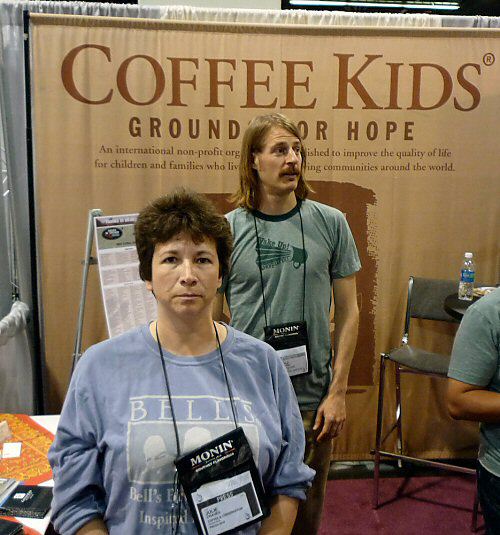
First off, we had to stop and visit our friend Kyle, at the Coffee Kids booth. This is an awesome charity, and Kyle is awesome as well. In fact, this photo has a backstory. Check it out.

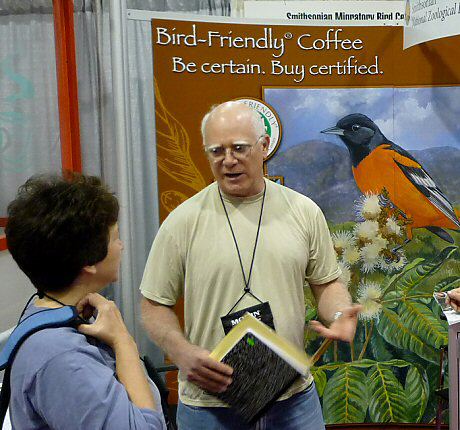
Andy Sprenger is the roaster at Caffe Pronto in Annapolis, MD. Andy is a birder and former field biologist, and we’ve been in touch for years now. Yet, we’d never met. He tracked us down when he recognized the slogan on my husband’s Rouge River Bird Observatory t-shirt! Julie: “A light-roast Central is best before a spring bird walk.” Andy: “No way. A blend with some Peru boosts your flycatcher ID skills.” [Stand off.]

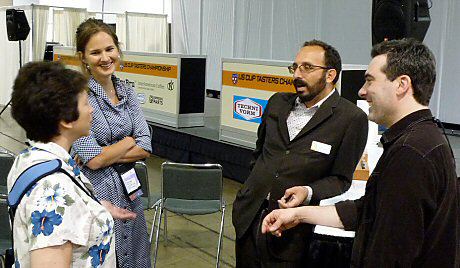
Andy competed in the U.S. Cup Tasters Championship, where he came in third place (second last year). This is a fast, fun competition where people have to pick the odd coffee out of eight flights of three cups. We found it more enjoyable to watch than the U.S. Barista Championship, which is much slower and more serious.

I’m in the odd position of not being in the coffee industry, but counting among my coffee friends some of the VIPs of coffee. I can’t tell you how much I’ve learned from Counter Culture Coffee’s sustainability and producer relations manager Kim Elena Bullock, Counter Culture director of coffee and co-owner Peter Giuliano and Intelligentsia’s VP of coffee and green coffee buyer Geoff Watts. They’ve been incredibly generous with their knowledge, and I’m very grateful!

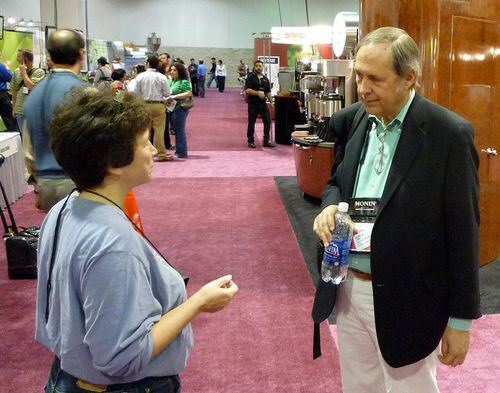
If only George Howell of Terroir Coffee had been in the previous photo. Another VIP of specialty coffee who has been thoroughly patient and kind in answering my questions. I always enjoy catching up with him at these events.

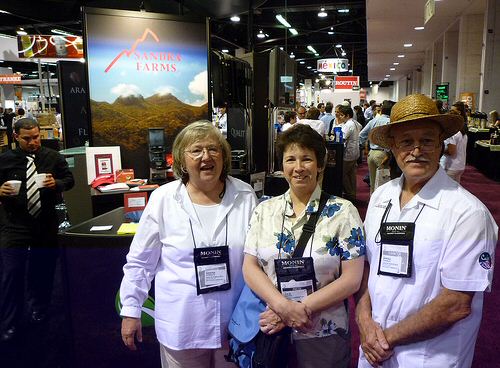
Meeting producers is a highlight of SCAA events. This is Sandra and Israel Gonzalez of Sandra Farms in Puerto Rico. They are the in-laws of one of my University colleagues and a supplier to Michigan roaster Rowster Coffee, so I have long wanted to meet them. What an incredibly charming couple! You’ll be hearing more about them and Sandra Farms in the future, because I know we will visit the farm when we go to Puerto Rico within the next couple of years.

Of course, we have to stop by the Smithsonian Migratory Bird Center booth and say hi to our friend Dr./Mr. Robert/Bob Rice (inside joke), who runs the Bird-Friendly certification program. Aside from Andy Sprenger, there aren’t too many people at these events with whom we can talk coffee AND birds.

We were invited to a cupping of some Utz Certified Latin American coffees…

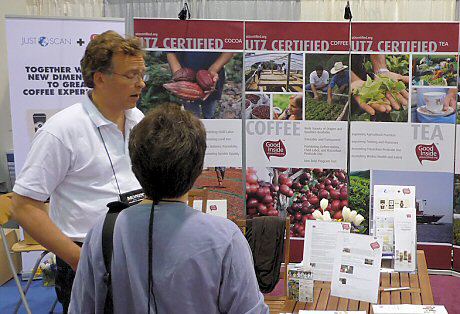
…and we got to spend more time talking with folks from Utz (Graham Mitchell here) about their certification. They have modified their standards since I last wrote about them, and I now have a better understanding of their goals and achievements. I’ll be writing more about them in future posts.

And we also spent time with the good folks from Rainforest Alliance, like Petra Tanos, who has been great about getting me information. RA rolled out an excellent implementation guide for Latin American coffee farmers, which I’ll be writing about, and told me about a couple of other upcoming initiatives that I am excited about — in spite of what the expression on my face might suggest. Believe it or not, there is a worse photo of me from this conversation!

We spent some time with folks from S&D Coffee. S&D supplies some McDonald’s and other restaurants and retailers, in addition to have several of their own coffee lines. I was impressed with their concern with sustainably-grown coffee, as evidenced by my conversation with two representatives from the importer Sustainable Harvest, who were at the S&D booth making deals. I am learning more about the import/export side of specialty coffee, as well as about the larger roasters and suppliers. Expect more on these topics as I incorporate this knowledge into my posts.

The foot soldiers of the specialty coffee industry are the roasters. Here I am talking trash (at the garbage bin next to the Barista Guild brew bar) with Chattanooga’s finest roaster, Bryan Dyer. Bryan is one of the funniest and sweetest coffee guys we know. We’ve met and befriended so many excellent people at SCAA events that we no longer wander around like aimless outsiders, but now have a full social schedule!

Aside from hob-nobbing, we attended several lectures every day on sustainable coffee issues, tasted a lot of great coffee, watched talented baristas do their thing, pondered many coffee-related products, and generally had a good time. I was invited to be on a panel on eco-certifications next year in Houston, and I hope we will be able to work it into our schedules. There’s this little conflict with spring bird migration and my day job…

Another endangered coffee relative

The genus Coffea has over 100 species other than the two commonly cultivated ones, Coffea arabica and Coffea canephora (robusta). New species are still being described, and over 70% of the species in this genus are threatened with extinction. There are other close relatives to Coffea, some of which are also extremely rare.

In honor of 2010 being the International Year of Biodiversity, the International Union for the Conservation of Nature (IUCN) is featuring a different endangered species every day. This week one of the species was a coffee relative.

Café marron (Ramosmania rodriguesii) exists in the wild as a single plant on the island of Rodrigues, part of the Mauritius islands in the southwest Indian Ocean east of Madagascar. It is surrounded by four fences. Cuttings are being propagated for a re-introduction program on to a nature reserve — the only hope in an island nation which has been nearly completely deforested. Success is not guaranteed, however. Not only is the in-vitro propagation process difficult, it sounds like the species faces problems even if it were to be re-established. The species account at the web site of the Royal Botanical Gardens at Kew (UK), which is leading the conservation effort, notes,

“As with much of Rodrigues’ native vegetation, it was probably a combination of introduced herbivores, invasive alien plants and habitat loss that devastated the Café marron population. Indeed, goats had reduced the remaining wild specimen to a small, half-eaten shrub when it was first discovered. Owing to the unprecedented level of scientific interest that surrounded the little plant in the aftermath of its re-discovery [in 1980], local people became convinced of the plant’s medicinal properties. Consequently, there was a period before the erection of multiple fences and even the installation of a guard, when people were intent on removing branches, twigs and leaves from the hapless plant.”

There is only one other species in the genus Ramosmania and it is also critically endangered.

Virtual hat tip to the Agricultural Biodiversity Weblog.

Sustainable instant coffee

I’ve been asked more than once about a source of sustainably-grown instant coffee. My usual reply is that there isn’t one. Understanding how instant coffee is manufactured will illustrate why the majority of the coffee beans that are used to make it are low-quality commodity coffee, and thus not a good option for consumers looking for coffee grown in an environmentally-friendly manner.

How instant coffee is made
Green coffee is brought to large manufacturing plants, often in the country of origin. Colombia, Brazil, and Mexico are the largest producers of instant coffee. At the factory, the coffee is roasted in large batches and ground. It then goes through multiple extractions using hot water under pressure. The resulting liquid is filtered and concentrated. Finally, the concentrated extract is dehydrated by either spray drying or freeze drying. Spray drying, in which the extract is spewed into an enormous tower and blasted by hot air, produces a fine powder. This powder must be “agglomerated” (other materials added to create familiar-looking granules that flow and dissolve more freely). Freeze drying creates clumps that resemble ground coffee, but the process is more expensive.

These production processes rob the coffee of most of the aroma. This is reintroduced by various combinations of natural or synthetic compounds, typically mixed with some type of oil, which are put back on the coffee particles prior to packaging in a process known as “replating.”

Why low-quality beans are used
The final goal of a specialty coffee roaster is great taste in the cup. To that end, they want carefully grown beans, processed properly at the mill, expertly roasted to bring out the best nuances of that particular bean.

The final goal of instant coffee is convenience. All the technology is aimed at leaching out all the water-soluble compounds to produce a product that looks and feels like coffee, but is quick and convenient to prepare.

This is the primary reason that low-quality beans are used for instant coffee: higher-quality beans with good flavor profiles would be used for the roast-and-ground market. Another way low-quality beans end up in instant coffee is because most countries don’t allow their lowest quality beans to be exported. Since instant coffee is often produced in the country of origin, it can be the final resting place of non-exportable beans.

Finally, instant coffees from the big corporate roasters such Nescafè’s Taster’s Choice (Nestlè), Maxwell House (Kraft), and Folgers (Smuckers) all contain robusta beans. Robusta is the lower-growing species of coffee (Coffea canephora) that is grown in large full-sun plantations. In some markets, some of these brands are 100% robusta (spray-dried instants are more likely to be all-robusta). In addition to the negative environmental impact of robusta plantations, these beans are considered inferior quality. To make robusta palatable, it generally must be steamed or treated in some way.

The big roasters not only use robusta, they will use very low-quality robusta. This article from Nestlè (a downloaded copy, since removed from their site)– incredibly boasting about quality — notes that they buy “coffee beans having eight percent to 16 percent triage.” Triage coffee, for the unsuspecting, is all the moldy beans, broken beans, sticks, stones, insect-damaged or rotten beans…all the stuff that is rejected or sorted out at the mill! [1].

The world’s largest producer of robusta is Vietnam, where it has been noted, “Wherever coffee was grown, forests have disappeared.” Brazil also grows a lot of robusta, but the variety grown there, called Conillon, is higher-priced than African- or Asian-sourced robusta. Côte d’Ivoire (Ivory Coast) is another major exporter. Côte d’Ivoire is the most biodiverse nation in west Africa, but has suffered severe deforestation and fragmentation, in part due to mass plantings of coffee and cacao in the late 1980s. Because of the time lag between environmental destruction and biodiversity loss (known as “extinction debt”), it has been projected that Côte d’Ivoire may still lose a third of its primate species.

In addition to being cheap, an additional motivation for manufacturers to use robusta is that it has a higher extraction rate than arabica. The rule of thumb is that it takes 2.6 kg of green beans to produce 1 kg of instant coffee. Manufacturers get a higher proportion of soluble materials out of robusta.

The authors of The Coffee Book: Anatomy of an Industry from Crop to the Last Drop put instant coffee in historical context:

“If in retrospect the coffee industry appeared to be out of its collective mind in pursuing the race for low quality, it is worth remembering that this blind love affair with consistency and technology was part of a larger cultural embrace of a mass-market modernism … Instant coffee was created by the same technophila that later produced technified cultivation systems.”

My mantra is generally that when it comes to the environment or farmers’ livelihoods, there is no such thing as “cheap” coffee. In the case of instant coffee, the cost of convenience and low consumer prices nearly always includes habitat loss and crappy proceeds to farmers.

One exception may be the new Starbucks VIA Ready Brew.  The majority of Starbucks beans are sourced under their C.A.F.E. Practices supplier guidelines (with a 100% goal by 2015), which use 24 criteria based on over 200 social and environmental indicators. I’ve received no confirmation so far that the beans used in VIA are part of this program.

[1] For a couple of discussions on how the use of this extremely poor quality coffee drags down the entire coffee industry, see this statement to Congress by the former SCAA director (scroll down halfway) and the post and comments on this blog post by Sweet Maria’s Tom Owen.

Photo from iStockphoto.