Coffee news and miscellany

Shade-grown coffees at Coffee Review
For August 2009, Ken Davids’ Coffee Review takes a look at shade grown coffee. First he describes the definition of the term “shade grown” and goes on to provide reviews of 12 coffees that scored 89 or over. Three were Smithsonian Bird-Friendly certified coffees, others were not certified, but grown under various levels of shade.

There were four coffees earning the highest mark of 92 points:

  • Counter Culture’s Finca Nueva Armenia (Guatemala). Certified organic and Bird-Friendly, this is one of my all-time favorite coffees. I reviewed last year’s crop, and this year it tastes even better. Ken describes a “slight hint of fruit ferment” that I find gives this year’s crop an extremely interesting, deep-toned, subtle wine-like complexity — it’s fantastic! I can be accused of giving a lot of love to Counter Culture, but I can assure you I recommend them and their coffees simply because they just do a bang-up job. Go buy this coffee!
  • Arbor Day Specialty Coffee Mexico ISMAM Co-op. Certified organic and Fair Trade. Coffee is traditionally grown under mixed shade in this region, and one or more of the many farms in this co-op (but not all) is or has been Bird-Friendly certified. I reviewed the Arbor Day Blend, which is sourced either from this co-op, or Nubes de Oro (which scored 91 points in this issue of Coffee Review). I wasn’t as enthused about either of these coffees as Ken, but suspect it was due to the crop I sampled being a little long in the tooth. I don’t see any way on their web site to order either of these Mexican coffees as a single origin, but you can go to the Arbor Day coffee web site and browse around.
  • Ecco Cafe Brazil Santa Terezinha. Organic. Santa Terezinha is indeed one of the only Brazilian farms that makes much use of shade; you can read more about the farming techniques at the blog of the importer, Sustainable Harvest. All the coffees I’ve had from Ecco Cafe have been excellent. I’ll be grabbing a bag of the Santa Terezinha with my next coffee order.
  • Flying Goat, Siberia, El Salvador. Certified organic, typically grown under shade in this region.  A classic, sweet Central from one of my favorite origin coffees.

There are other very nice sustainably-grown coffees in the list, many of which I’ve had and enjoyed. Go take a look at the reviews, the article, and while you’re there, the rest of Ken’s informative and authoritative site.
Specialty coffee on NPR

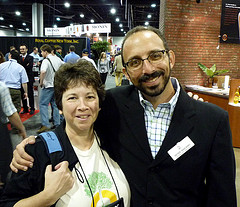
The Kojo Nnamdi show, out of WAMU in Washington, DC, had a segment on specialty coffee this week. Guests were Counter Culture’s Peter Giuliano (gratuitous photo of Peter and I at right; I’ve been waiting for an excuse to post this); Ric Rhinehart, Executive Director of the Specialty Coffee Association of America; Ryan Jensen, owner of Peregrine Espresso in DC; and Dale Roberts, owner of Java Shack in Arlington, VA.

Last month the Washington Post also had a terrific article about Counter Culture.

While I’m giving some love to great coffee and Counter Culture, the new crop of their Finca Nueva Armenia is in, and it is as fantastic, if not more so, than it was when we reviewed it last year. This is organic and also certified Smithsonian Bird-Friendly (although not marketed as such by Counter Culture) — it’s as good as super-sustainable coffee gets.

Caffeine-free coffee species one of top 10 new species in 2008

A species of naturally caffeine-free coffee from the Cameroon, Coffea charrieriana, has been named one of the top ten new species described in 2009 by the International Institute for Species Exploration (IISE) at Arizona State University.

The coffee was actually collected in 1983. Cuttings were cultivated in a research collection and remained unstudied by taxonomists until 1997. It wasn’t until last year that a description of it as a newly described species was published. The original cuttings from the plants were collected in wet, primary rainforest on a steep, rocky slope in the Bakossi Forest Reserve, Tombel Division, Southwest Province, Cameroon, at an elevation of 160 m. It is one of only a few species of caffeine-free Coffeas, and the first from Central Africa.

The top ten species from the previous year are announced by the IISE along with the release of the annual State of Species report, which discusses the status of our knowledge of earth’s species and summarizes the number of species newly described in the most recent year for which complete data are available. The 2009 report discusses the over 18,000 new species discovered in 2007. The report is produced in partnership with the International Commission on Zoological Nomenclature, the International Plant Names Index, Thomson Reuters (publisher of Zoological Record) and the International Journal of Systematic and Evolutionary Microbiology.

Stoffelen, P., M. Noirot, E. Couturon & F. Anthony. 2008. A new caffeine-free coffee from Cameroon. Botanical Journal of the Linnean Society 158: 67-72.

My mug is on In My Mug

One of the best things to happen at the the Specialty Coffee Association of America expo in Atlanta this year was meeting coffee people I had only corresponded with up to that time. Surely one of the highlights was getting to meet and talk to Steve Leighton of Has Bean Coffee in the U.K. I’ve been a secret fan of Steve’s for a long time. In addition to sourcing great coffees, he has excellent descriptions on his web site, travels frequently to origin and blogs about his experiences and other coffee news, and through his strong online presence really conveys his passion for coffee. Every roaster should aspire to communicate to consumers about coffee the way Steve does.

One of Steve’s gigs is In My Mug, a weekly video in which he describes a particular coffee he offers. Somewhere along the line people started sending him mugs to use in the videos. When I got home from Atlanta the first thing I did was send Steve a mug. Since Coffee & Conservation doesn’t have a mug, I sent him the simple but stylish Rouge River Bird Observatory mug from my real job.

This week Steve used the mug to review his Guatemala San Rafael Pacun, a 2008 Cup of Excellence winner. I should say that the second thing I did, once I packed the mug and sent it overseas, was place an order from Steve. Shipping is a bit pricey from the U.K. to the U.S., but I got my coffee just five days after ordering/roasting. Although I didn’t order the Guatemala, the coffees I got were excellent — especially the Bolivia Machacamarca, which Irish barista champion Colin Harmon served us in a cappuccino while he was practicing for the WBC finals.

Thanks, Steve, for the C&C shout out, and for your fantastic coffee!