
Sustainability at the SCAA expo
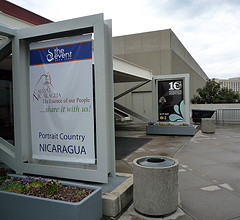 Having “green” conferences is all the rage the last few years. I’ve been to a few in my field. Of course, a bunch of ornithologists more or less just listens to research presentations — overall not much in the way of consumables. A trade show, on the other hand, is another story. As it was last year, the recent Specialty Coffee Association of America expo was billed as a “green” conference. Here were the measures the organization announced they were taking to minimize the impact on the environment:
- Part of the fee went to planting trees in a coffee-growing country to make the conference carbon-neutral.
- Attendee brochures (40 pages) were not mailed out, saving paper and transportation fuel costs. They were available on the expo web site…many stacks of them. The brochures were perfect bound, which may have made them harder to recycle. I didn’t check to see if they were printed on recycled paper, but I believe it was glossy.
- Participants were asked to fill out session and conference evaluation forms online.
- All of the many large vinyl banners inside and out of the expo venue (like the ones shown above) will be made into tote bags which were available for pre-order.
- Coffee grounds were donated to a worm farm or nursery in the Atlanta area.
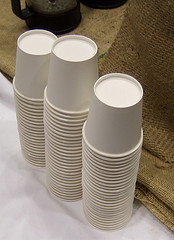 The real waste at one of these shows occurs on the expo floor. There were hundreds of vendor booths, and many of them offered coffee (or smoothie or tea) samples — in little disposable paper cups. How many thousands of cups were used for 10 seconds before heading to the landfill? Were any made from recycled paper? This bothered us so much last year that this year we brought our own espresso shot glasses and used them. Saves paper, and the coffee tastes better.
The Counter Culture Coffee booth was the only one we noted that solved the problem by 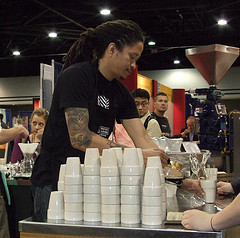 using small ceramic cups (29 cents at IKEA), shown here with barista Lem Butler. Their whole booth was inspiring, and keeping with the company goal of zero waste. The exterior was made of Plyboo — a formaldehyde-free, Forest Council-certified bamboo material, while the frames were lightweight aluminum and the countertop stainless steel (all recyclable). Carpet squares were recyclable FLOR carpet tiles, and LED lighting was used. CCC was also using locally sourced dairy products, and their coffee grounds were headed to a local farm for composting.
While the SCAA can’t really dictate that all vendors have booths this green, it would go a long way if they could discourage the use of disposable cups — such as giving out small glasses to registered attendees. I’ve been to 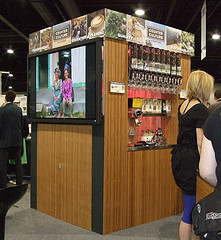 conferences where everyone received a coffee mug, and that’s what people used on the coffee breaks. At SCAA, the multiple coffee break stations should certainly have used ceramic mugs rather than paper cups.
Another way the could have cut down on waste might be in the printing of the four-page color newsprint newsletter published daily at the show. There was some useful content in it, but they were discarded all over the place. Could they have sent a copy to everybody via email and/or made them available for printing at print stations instead? There was no indication that the paper it was printed on was recycled, either.
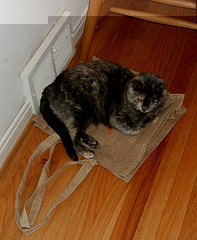 Everybody at the expo got a swag bag — a burlap tote that had some literature and a few samples of odds and ends. I saw a lot of the innards, particularly the paper stuff, discarded. A literature table might make more sense and be less wasteful, as people could pick up what they were interested in. The bags themselves were stiff and scratchy. Since they were presumably supposed to look like jute coffee sacks, seems like it would have been a cool idea to recycle real coffee sacks, which are a pain in the butt to get rid of, according to roasters I’ve talked to. Personally, I wasn’t that crazy about the bag. However, one of my cats immediately claimed it, maneuvered it in front of the heat vent, and it’s now one of her favorite places to sit. She loves it.
I’ll be the first to admit I have no experience planning a trade show, but the paper waste alone at this expo made me cringe. I think SCAA could have done a lot more to make the event much greener.