Rainforest Alliance

Quick look at differing shade criteria

[NOTE: Rainforest Alliance standards have undergone several revisions since this post was first written. There is now no criteria for canopy cover and tree diversity, and native vegetation criteria do not have to be met for six years. The Bird-Friendly standard outlined below has been slightly revised, in part to align with requirements for certifying chocolate; while the older criteria are listed the new standard is still much more stringent than the RA standard. This post should only be for historical reference.]

I recently reviewed a paper, Field-testing ecological and economic benefits of coffee certification programs, that included a  summary table of the criteria used for shade certification by Rainforest Alliance, and Smithsonian Migratory Bird Center (under the “Bird-Friendly” trademark).  I thought it would be useful to post a summary here, with a little commentary.

SMBC’s criteria are mandatory, while RA has no required criteria for shade management — the standards below are one of the optional criteria (more on the RA standards and scoring can be found here).


Criteria SMBC RA
No. tree species >10 >12/ha*
No. trees/ha (mean) na >70*
% allowed to be Inga trees <60 na
% shade cover >40 >40*
No. of shade layers 3 2
% leaf volume in each shade layer
….. >15 m (emergent) >20 na
….. 12 to 15 m (backbone) >60 na
….. <12 m (understory) >20 na
Epiphytes required? Yes na

*As of April 2009, standards were modified from the previous version, February 2008. In the old standards, one requirement was for at least 12 native tree species and at least 70 trees per hectare; now it is an average of 12 native tree species, with no minimum number of trees per hectare. Previous criteria stated a minimum of 40% shade cover, now the standard specifies this minimum only on cultivated land.

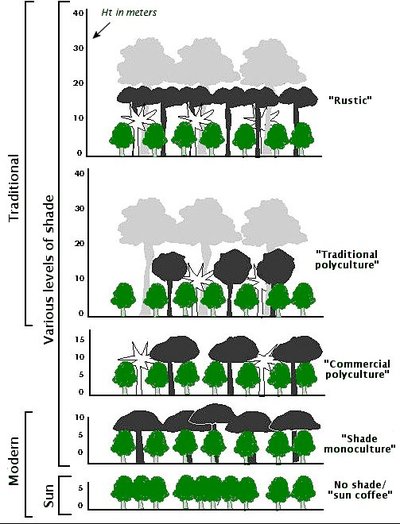
As noted in the previous post, the criteria having to do with vertical stratification — the number of layers of vegetation and the leaf volume in each — are critical components for preserving a rich mix of species.  Many ecological studies support the key role of structural diversity (sometimes referred to technically as floristic heterogeneity) in increased biodiversity — of many types in many ecosystems well beyond the realm of coffee growing. This is the classic schematic illustrating the various coffee production systems and their layers of shade diversity, from a paper by Patricia Moguel and Victor Toledo [1].
Here is a new graphic from SMBC that also illustrates this continuum:

As you can see from the table above, Rainforest Alliance requires (if this criteria is used) only two layers of shade, while Smithsonian requires three. RA has no standards for leaf volume in the shade layers. In short, RA certified farms that use these criteria would have still have structurally-simpler habitats (closer to commercial polyculture) that would likely not support as much biodiversity as farms that met SMBC criteria (closer to traditional polyculture).

A further note. SMBC inspectors visit farms and set up a number of plots and measure various vegetation parameters following methods used in typical ecological studies. The aforementioned paper reports that “Rainforest Alliance inspection auditors rely heavily on data provided by farm managers” (who are not ecologists), and confirm data provided during visits by various estimates and extrapolations.

As an ecologist myself, I am more comfortable that SMBC offers the more stringent, reliable assurance that coffee is grown sustainability if one is comparing certification schemes. And not to beat a dead horse, but the usual caveats apply: there are pros and cons of certification, and many uncertified farms grow coffee sustainably, meeting or exceeding the strongest criteria.

More on SMBCs criteria here, and in the “certifications” category of C&C.

[1] Biodiversity Conservation in Traditional Coffee Systems of Mexico. 1999. Conservation Biology 13:11—21.

KLM to serve Rainforest Alliance coffee

KLM Royal Dutch Airlines joins Asiana Airlines (Korea) and ANA (Japan) in pledging to serve Rainforest Alliance certified coffee on all its flights.  KLM serves 22 million cups of coffee annually.

This is a step in the right direction, but only a step.  First, the commitment is for "at least 30%" of the coffee it buys to be RA certified. This is the minimum level allowable by RA for a product to carry the RA seal.  It’s a familiar figure…remember the Yuban ad campaign?

According to the press release, the certified bean portion of KLM’s coffee comes from shaded coffee farms in the highlands of Colombia and the cerrado region of Brazil. I’m sure the Brazilian coffee isn’t shaded, since cerrado is savannah, not forest, and RA standards call for "Farms in areas where the original natural vegetation is not forest must dedicate at least 30% of the farm area for conservation or recovery of the area’s typical ecosystems."  I have yet to find a Brazilian coffee I am comfortable with, because the cerrado area is so unique, biodiverse, and endangered that I am reluctant to encourage any further expansion of coffee agriculture there.

I can understand the charges of greenwashing reported in the press, as environmentalists correctly point out that airlines produce massive emissions that contribute to global warming. An industry spokesman made a great point when he said, ”While this is not a directly hypocritical move and it’s great that sustainable coffee is being used, it does not make KLM an ethical company.” 

I tend to think that any move in the right direction is a good one, which I believe is the outlook taken by RA when they are criticized for what appears to be aiding large corporations green their images.  If RA required 40% of beans to be certified to allow use of their seal, would that really thwart some companies from participating? Could they require a phased approach, with increasing volumes over time as a requirement?  Frankly, it looks like there needs to be a "next step" beyond these first steps.

Yuban ad campaign

As I was perusing a magazine, I came across an ad for Yuban coffee with the headline “The coffee you make can make a difference.”  It showed their coffee cans, emblazoned with the Rainforest Alliance seal and a banner saying “Conserving the environment & supporting coffee farmers.  Minimum 30% Rainforest Alliance Certified Coffee.”

Let’s examine. Who are we dealing with? Yuban is a Maxwell House brand, which in turn is owned by Kraft Foods. (More on which corporations own which brands here.)

How big a deal is it that Kraft is buying RA beans? While Kraft will purchase 12,000 tons of RA coffee in 2006, this represents a tiny fraction (I’ve calculated about 1.5%) of Kraft’s coffee bean purchases.

What’s with the 30%? Rainforest Alliance (RA) allows use of their seal on products with a minimum of 30% certified beans (a fact for which they are sometimes criticized).  In order for Kraft to keep their prices so low (suggested retail for a 12-ounce can of RA-bean-containing Yuban is $3.89; a 13-ounce can of Maxwell House is $2.56), the other two-thirds of the beans in the can must be lower quality, likely technified/sun coffee.  I don’t see any other way they can do it.  The cost differential between certified beans and non-certified beans also means that I doubt Yuban will ever contain more RA certified beans than the 30% minimum required for use of the RA seal. (Update: As of January 2013, the Yuban can still indicates 30% certified beans. However, RA is requiring companies to scale up their percentages over time…read more here.)

Does this move really help farmers? While RA certification includes fair labor practices, and RA certified coffee usually commands some premium, the criteria does not set a minimum price paid to farmers. RA certification is cheaper for corporations that Fair Trade certification.  Oxfam is still pressuring Kraft to agree to buy Fair Trade coffee.

RA cannot be faulted for their efforts in promoting and making sustainable coffee available to mainstream consumers.  Nor can they really be criticized for partnering with Kraft, since RA certifies a product, not a company.

Still, it difficult for me to endorse supporting a corporation like Kraft which has a dubious ethical record (Responsible Shopper profile here). And while Kraft deserves some credit, as none of the other Big Coffee companies is making this type of effort, real environmental preservation and fair prices for farmers is far, far better served by purchasing sustainable coffees from small companies and roasters with relationships with their suppliers, especially those that provide information on the specific farms where their beans are sourced.  Plus I guarantee it will taste better!

UPDATE! The January 2007 issue of Coffee Review goes over supermarket coffees, including this coffee, which is “dominated by a cloyingly sweet nut character, the calling card of inexpensive coffees of the robusta species.”  Robusta tastes bad, and is sun coffee.  Very bad!  As for the Yuban Organic brand, that review notes it is recommended for “Those on a budget with a commitment to organic growing principles that transcends the desire to drink decent coffee.”  Please also read the accompanying article or my post about it.

More information:


Rainforest Alliance to certify 10% of coffee exports

Rainforest Alliance (RA) received a seven-year, $12 million grant to increase the number of certified farms in six Latin American countries: El Salvador, Guatemala, Honduras, Colombia, Peru, and Brazil. By the project’s end, RA will have certified 10% of the world’s coffee (they currently certify less than 1%).  The grant comes from the Global Environmental Facility, an independent financial organization established in 1990 by the World Bank, the United Nations Environment Program, and the United Nations Development Program. These entities manage projects that benefit the global environment and promote sustainable livelihoods in local communities.

Grant funds will go towards increasing production and demand of RA coffees. On the production side, RA indicates it will “provide farmers with the information and tools necessary to improve their management practices and make them more responsible with regards to the environment, workers and communities.”  Plans for increasing demand include encouraging companies to buy and promote RA certified coffee, and arranging media tours of RA certified farms so that consumers realize “their potential roles in fostering the conservation of habitats and quality of life for millions of third-world workers.”

The press release (PDF) as well as a separate project summary put the emphasis on the marketing side.  Elsewhere, there was mention of a research or monitoring component, noting that the “project also plans to monitor and document the impact of coffee plantations on biodiversity.”

Obviously there is no incentive for farmers to produce coffee which is sustainable (under any certification scheme) without sufficient demand. I think it will be very important for third parties to make sure that consumers are clearly educated about what they are supporting when they purchase RA certified coffee — especially versus other certification programs.