Birds and other biodiversity

Research: Forest birds using Costa Rican coffee farms

Persistence of forest birds in the Costa Rican agricultural countryside. C. H. Sekercioglu, S. R. Loarie, F. Oviedo Brenes, P. R. Ehrlich, and G. C. Daly. 2007.  Conservation Biology 21:482-494.

This study radiotracked several species of resident forest birds in the Coto Brus province of southern Costa Rica, now "dominated by sparsely-shaded coffee farms" — recall that in my post on coffee growing in Costa Rica that most farms, including those marketed as "shade" coffee, have few shade trees of only a couple of species, and lack the structural complexity necessary for true biodiversity preservation.  Two of the three species studied, Silver-throated Tanager (Tangara icterocephala) and White-throated Thrush (Turdus assimilis) are more habitat-sensitive and utilized the coffee farms, but were highly dependent on the remaining trees, and spent more time in remnant forest. The third species, Orange-billed Nightingale-Thrush (Catharus aurantiirostris), is more tolerant of deforestation, and preferred coffee farms and second-growth areas. The authors concluded that agricultural areas have high potential conservation value, which can be enhanced with even modest increases in tree cover. Imagine what true shade coffee would do!

Research: Birds in shade coffee favor plant diversity

Dietsch, T.V., I. Perfecto, and R. Greenberg. 2007. Avian foraging behavior in two different types of coffee agrosystem in Chiapas, Mexico.  Biotropica 39:232-240.
Other studies have documented that structural diversity is important in coffee farms — it is the complexity of multiple layers of vegetation in shade coffee systems that are so important and attractive to birds and other organisms. This study looked at Finca Irlanda in Chiapas, a 290 hectare shade coffee farm, during both summer and winter seasons. Forty of those hectares are being further restored by additional plantings of native plants in order to qualify for Smithsonian Bird-Friendly certification. At the time of the study, the structural diversity of the entire farm was similar, but the 40 ha under restoration had a wide variety of plants.

Eighty-eight bird species were observed, and more species were found foraging in the restoration plot than the rest of Finca Irlanda. The study revealed the importance of plant diversity in addition to structural diversity. These diverse plants provide varying resources throughout the year — from nectar to insects to fruit — that are critical to birds.

Rogers Family Company is Finca Irlanda’s roaster in the U.S., but I was unable to determine which one of their brands or coffees uses beans from this farm. One expects it would be used in the Audubon coffee line, but as noted in our review of the Audubon Breakfast Blend, there is no information on the origin of those coffees; specific information is lacking on most Rogers Family coffees. You can also buy Finca Irlanda coffee from Cafe Altura.

Saving the Cerulean Warbler campaign

I last wrote about the Cerulean Warbler and shade coffee in August 2006, when the American Bird Conservancy (ABC) announced they would be working with coffee growers to  preserve critical wintering habitat around the new 500-acre Cerulean Warbler Bird Reserve in the Rio ChucurÁ­ basin of Santander department, Colombia.

ABC, along with their Bird Conservation Alliance network, has now announced a full-fledged to raise US$100,000 to purchase habitat, train and equip forest guards and local ecotourism guides, and improve reserve infrastructure. The conservation plan is looking to purchase over 1,500 acres currently owned by nearly 20 different owners; some of the land is shade coffee farms. All properties in the reserve will be owned and managed by ProAves Colombia, the major conservation organization there.

You can donate directly, purchase the posh Cerulean Warbler postage stamps, or buy Cerulean Warbler Conservation Coffee, offered by Thanksgiving Coffee Company, roaster of the Songbird Coffee line discussed here.

Although some of the promotional material indicates that the coffee comes from shade plantations that are part of or are adjacent to the Cerulean Warbler Bird Reserve in Santander, it is sourced from COOPERAN, a cooperative in southwestern Antioquia province (A on map, dot is co-op area). The aforementioned reserve is about 180 miles away within the Serrania de los Yariguies Important Bird Area (S on map, dot is Reserve).

Although it is a different location, this area is also important to Cerulean Warblers, as well as the endangered Yellow-eared Parrot (below), and other North American migrants. The very endangered Gorgeted Wood-Quail, another target species, is not found in the area where the coffee is sourced, but is found in the Reserve.

Santander has more extensive shade coffee farms versus Antioquia, which has only about 10% in typica varieties grown by traditional shade methods [1,2].  Thanksgiving Coffee sources its other Colombian coffees from the same co-op (although it is not labeled shade-grown), so they are apparently building on an existing relationship. A page (in Spanish) on the ProAves site notes that COOPERAN farmers are sharing their experience with farmers from the Reserve region.

There are 4,600 members in the COOPERAN cooperative.  One subgroup in the co-op mentioned as a Thanksgiving source was represented in the 2005 Cup of Excellence competition. I found information on one of the Los Sauces farm, El Clavel, which states the coffee there is 30% shade grown. ABC reassured that the Colombian conservation partner ProAves visits the farm(s) to make sure that the coffee is grown under shade.

Support of this campaign is highly worthwhile. Although the coffee does not come from the official Reserve, there is arguably more need for encouraging shade coffee farming in Antioquia, where less than 3% of the native forest remains. Just $1.50 of each bag of coffee goes to ABC, so don’t forget to donate directly to help purchase habitat.

Cerulean Warbler Technical Group el Grupo Cerleo page.

More on the partnership with COOPERAN (also in Spanish).

[1] Colorado, G., and T. Cuadros. 2006.  Geographic distribution and habitat use by Cerulean Warbler in natural vegetation and agro-ecosystems of northern Colombia. Final report to Nature Conservancy and USFWS. Medellin, Colombia.  56 pp.

[2] Armenteras, D., A. RincÁ³n, and N. Ortiz. 2005. Ecological Function Assessment in the Colombian Andean Coffee-growing Region. Sub-global Assessment Working Paper. Millennium Ecosystem Assessment, United Nations.
Endangered coffee

I previously discussed the important species and varieties of coffee. An understanding of these varieties can be of great help to consumers looking for sustainable coffee, as different types are typically grown under shade or sun conditions.  The species and varieties of coffee familiar to consumers, however, are just a tiny part of the coffee family tree.

Rather astonishingly, no comprehensive monograph on the taxonomic status of coffee has been published since the 1940s.  That was recently remedied by a lengthy paper published in the Botanical Journal of the Linnean Society.* It details 103 species in the genus Coffea: 41 species in Africa, 59 in Madagascar, and three in the Mascarene Islands; no naturally-occurring Coffea species are found outside of these three areas, and no species is shared between the three areas.

While most of the paper is of interest only to botanists, one aspect is quite striking.  Over 70% of coffee species can be categorized as threatened using World Conservation Union (IUCN) Red List definitions:

  • 14 species (13.6%) are Critically Endangered,
  • 35 species (33.9%) are Endangered, and
  • 23 species (24.2%) are Vulnerable.
  • An additional 13 species (13.7%) are Near Threatened.

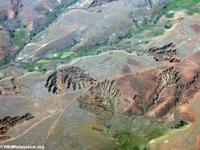
The majority of the most threatened species are from Madagascar, an island with a high level of endemism and deforestation. The authors note there is virtually no in situ preservation of coffee genetic resources, and there are difficulties in conserving coffee genes ex situ because of its general lack of suitability for placement in seed banks (see also my post on The value of wild coffee). Habitat loss is the single most important threat to rare coffee species. The photo shows dramatic erosion on deforested areas in western Madagascar, courtesy of Rhett Butler’s excellent Wild Madagascar web site, where you can read more about this country’s environmental issues.

*Davis, A. P., Govaerts, R., Bridson, D. M., and Stoffelen, P.  2006. An annotated taxonomic conspectus of the genus Coffea (Rubiaceae). Botanical Journal of the Linnean Society. 152:465-512.