
Birds and other biodiversity

What shade coffee looks like

One trip to one part of one county’s coffee growing region is limited information to work with. Nonetheless, my recent visit to the western highlands of Panama was an eye-opener, replacing a mental image based on a great deal of reading and examining photographs with the reality on the ground.  I’d like to share some of what I learned.

First, a little overview of the entire landscape. The highest point in Panama is in the western highlands: Volcan Baru, at nearly 3500 m (almost 12000 ft). The town of Volcan is on one flank of the volcano, Boquete is on the other. These are Panama’s major coffee-growing areas, some of the most important in the world. Coffee is not the exclusive crop, however. Many cool season crops are grown here. We were on the Volcan side, where cabbage, lettuce, and onions were common, as well as dairy farms. Small farms and plots were everywhere, creeping up the flanks of the mountains. Most were not large, and from what we could gather by observing harvesting and taking crops to central depots, tended by one to several families. We have urban sprawl. They have a sort of agricultural sprawl.

Definitions of shade-grown coffee describe various systems that go from very rustic (coffee in a forest) to sun coffee (plots of coffee with no shade trees). I talk about this continuum in my introductory post “What is shade-grown coffee” and provide a graphic in a later post on shade certification criteria. Coming from an industrialized country with industrialized agriculture, where even small garden plots nearly always follow an orderly, genteel, Euro-centric plan, I really didn’t consider how “messy” agrosystems are in Latin America. We spent a lot of time on one coffee finca, lesser amounts in two others, and passed through a number of others. The various levels of shade management are present, but they can be difficult to categorize as they are often interspersed with each other and other types of land use (crops, livestock, homesteads).

We spent two half-days at Finca Hartmann, a very eco-friendly farm near Santa Clara. It is in two sections: the lower Palo Verde section (1200-1300m), and the higher-altitude Ojo de Agua section (1500+ m), which is directly adjacent to the La Amistad International Park. The property (aside from housing and other human infrastructure) is a mix of remnant and regenerating forest, pasture, and coffee.  Coffee occurs in plots ranging from 1 to 15 ha, and itself grows intermixed with native vegetation and/or crops such as citrus and bananas. This photo shows some fairly young coffee (probably 2-5 years old; the Hartmann’s are in the process of replanting much of the farm which was established in the 1950s) at Palo Verde, shaded by citrus, castor, and native trees. We had a large mixed flock of birds here, including forest birds such as White-ruffed Manakin and Bay-headed Tanager.

In another area in Palo Verde, older coffee trees are growing amid a mid-story of bananas, and an open canopy of tall native trees, encrusted with many epiphytes — which are very important to biodiversity in tropical agrosystems.

The Hartmann’s have preserved a lot of forest on their land. Below, my husband consults a field guide in a beautiful forested patch along a stream. There is extensive old forest at Ojo de Agua which many researchers have used to study forest and shade coffee ecosystems.

Nearly 300 species of birds have been recorded at Finca Hartmann, as well as 62 mammal species and hundreds of other organisms. Patriarch Ratibor Hartmann is a devoted naturalist, and visitors can examine some  carefully-curated collections he has made on the farm. We photographed many insects ourselves. One was a damselfly that had only been described about 30 years ago, and had never been photographed, according to an expert back here in the states.

Other insects were just stunning, such as this metalmark, Mesosemia asa. Although we really only explored for 6 or 7 hours over the two days, were working without a guide, and spent equal amounts of time looking at insects, we observed nearly 80 species of birds at Finca Hartmann.

Other farms in the region were in contrast with Finca Hartmann. The photo below is from Finca Florentina near Paso Ancho, a large plantation that has been a source of beans for Starbucks. This farm also had patches of forest, but coffee typically grew in larger plots than at Finca Hartmann.

Still at Finca Florentina, an even larger plot of coffee, with sparser large trees. This area had a lot of non-native eucalyptus trees. We wandered through these areas for several hours, and saw far fewer species of birds and insects. Many were more common species typical of open areas, such as various species of grassquits, or the ubiquitous Rufous-collared Sparrow.

And along a road near Santa Clara, were big areas of sun coffee. These farms are likely owned by or sell their beans to the large Cafe Duran, which is a common brand in Panama. Their mill was nearby.

None of the coffee growing areas we saw came close to matching the structural complexity of native forest, a characteristic that is highly important to biodiversity. Nonetheless, it was clear that birds and other fauna used coffee growing areas that were integrated with or close to native vegetation.

This gave me a great deal of insight into the issue of shade certification, and I will talk about that in my next post (Why certifying shade coffee is so complex).
Research: Butterflies in Indian coffee farms

Adult butterfly communities in coffee plantations around a protected area in the Western Ghats, India. J. Dolia, M. S. Devy, N. A. Aravind, and A. Kumar. 2008. Animal Conservation 11:26-34.

Butterfly diversity was examined in 12 coffee plantations in India’s Western Ghats, a region of high biodiversity. Distance from a protected area, the Bhadra Wildlife Sanctuary, was the most influencial variable for the abundance and richness of butterfly fauna. The closer the coffee farms to the sanctuary, the higher the species richness and abundance. The composition of butterfly species on coffee farms also became less similar to that of native forest as distance from the sanctuary increased.

The proportion of Australian Grevillea robusta, often called silver oak, a fast-growing, sparse shade timber species now being planted in place of native species on Indian coffee farms, did not seem to effect butterfly abundance or diversity (more on silver oak on coffee farms here). However, the authors stated that three or four species of shade trees dominated at the coffee farms, and none seemed attractive to butterflies.  Coffee has traditionally been grown under native, rustic shade, but there has been an increasing use of fewer, often exotic, species and less shade in recent years.

There were some limitations to this study. It took place during the dry season, when there were not many trees and plants in flower in the sanctuary, but some (mostly non-native species) in the coffee farms. Nectar-feeding butterflies of larger species, which are strong fliers, may have therefore been disproportionally represented at farms farther from the sanctuary. The authors also noted a lack of information on host plants for butterfly larvae, but that many feed on understory shrubs and plants, which tend to be absent from coffee farms. Pesticide use also has a detrimental effect on butterflies. Although coffee farms may serve as corridors or provide roosting or basking sites, they may not have adequate resources for reproducing butterflies.

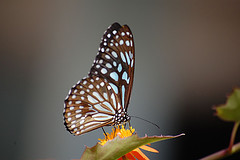
Photo of Blue Tiger (Tirumala limniace), a common south India species, by Challiyan.

J. Dolia, M. S. Devy, N. A. Aravind, A. Kumar. (2008). Adult butterfly communities in coffee plantations around a protected area in the Western Ghats, India Animal Conservation, 11 (1), 26-34 DOI: 10.1111/j.1469-1795.2007.00143.x

More shade coffee farms for Cerulean Warblers

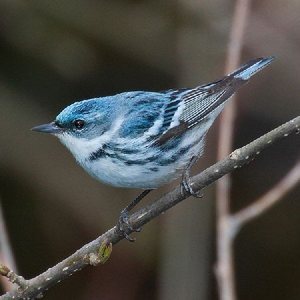
If there is a single bird strongly associated with shade coffee right now, it’s the Cerulean Warbler. I’ve written about the connection between coffee and Cerulean Warblers in the past. I’ve also discussed the Save the Cerulean Warbler Campaign by the American Bird Conservancy (ABC). That post mentioned the Cerulean Warbler Bird Reserve in the Rio ChucurÁ­ basin of Santander department, Colombia.

The latest news is the ABC and their Colombian partner ProAves have acquired another 3300 acres (1335 ha) of forest and shade coffee plantations just 8 miles (13 km) across the valley from the original reserve. The new preserve will be called Pauxi Pauxi, which is the scientific name for the Northern Helmeted Curassow, one of the threatened species that occurs there. Of course, the preserve is significant wintering habitat for the Cerulean Warbler, as well as other North American migrants.

Earlier this year, ABC was working with Thanksgiving Coffee Company who roasted and sold Cerulean Warbler Conservation Coffee, which I wrote about here. The plans were to begin using coffee that came from in and around the original reserve, with plans to acquire more land and farms and utilize that coffee as well. Right now, I don’t see any mention of the coffee on either web site. Perhaps they are working on the logistics. I look forward to trying some coffee that comes from land that supports these beautiful birds.

Photo: Wikimedia Commons

Research: Mammals in coffee plantations in India’s Western Ghats

The mammalian communities in coffee plantations around a protected area in the Western Ghats, India. A. Balia, A. Kumarb, and J. Krishnaswamy. 2007. Biological Conservation 139: 93-102.
This study looked at the number of mammal species found in 15 coffee plantations around the Bhadra Wildlife Sanctuary in the Western Ghats of India, and any correlation between the number of species and distance from the park or vegetation characteristics.

First, a bit of background. Climate conditions in India — monsoon seasons followed by long dry periods — require coffee to be grown under a protective canopy of shade trees, usually under a three-tier system. Although coffee plantations have replaced much of the mid-elevation moist deciduous and evergreen forests in India, coffee has at least traditionally used native forest tree species for shade, such as Ficus glomerata (Doomar, Gular, or Cluster Fig), Dalbergia latifolia (Rosewood), Sapindus laurifolius (Soapnut), and Artocarpus integrifolia (Jackfruit tree).

More recently, non-native species have been used in Indian coffee plantations. In the lowest layer, nitrogen fixing species such as Erythrina lithosperma (Dadap; native to the Philippines and Java) and Gliricidia maculata/sepium (native to Mexico and Central America) are planted. The middle layer, trees that shed their leaves in the monsoon and maintain a dense canopy during the summer, are often native Ficus species. For the canopy layer of hardwood, many coffee farmers are now planting a fast-growing, sparse shade timber species from Australia, Grevillea robusta, often called silver oak although not related to North American oak species.

Twenty-eight species of mammals were recorded in the plantations; this included a number of large carnivores (e.g., tigers and leopards) and herbivores (e.g., elephants and deer). Not surprisingly, more species were found in plantations nearer to the sanctuary. The authors concluded that coffee estates act as a buffer around the park for large mammals, protecting them from the direct effects of more intensive agriculture and higher-density human settlements.

The study did not find any negative correlation with Grevillea abundance, but the fact that the estates with the highest proportion of Grevillea were the closest to the sanctuary may have diluted the effect. The percentage of Grevillea was about 30%; a high percentage of this species is usually avoided, because they drop their leaves during the monsoon, a situation which can cause rot.

Nonetheless, the authors noted that the non-native timber species provide few or no resources for resident wildlife and cautioned that “Such conversions not only lead to the loss of biodiversity values of these plantations, but also severely affect the integrity of the adjoining protected areas.”