Background information

Quick look at differing shade criteria

[NOTE: Rainforest Alliance standards have undergone several revisions since this post was first written. There is now no criteria for canopy cover and tree diversity, and native vegetation criteria do not have to be met for six years. The Bird-Friendly standard outlined below has been slightly revised, in part to align with requirements for certifying chocolate; while the older criteria are listed the new standard is still much more stringent than the RA standard. This post should only be for historical reference.]

I recently reviewed a paper, Field-testing ecological and economic benefits of coffee certification programs, that included a  summary table of the criteria used for shade certification by Rainforest Alliance, and Smithsonian Migratory Bird Center (under the “Bird-Friendly” trademark).  I thought it would be useful to post a summary here, with a little commentary.

SMBC’s criteria are mandatory, while RA has no required criteria for shade management — the standards below are one of the optional criteria (more on the RA standards and scoring can be found here).


Criteria SMBC RA
No. tree species >10 >12/ha*
No. trees/ha (mean) na >70*
% allowed to be Inga trees <60 na
% shade cover >40 >40*
No. of shade layers 3 2
% leaf volume in each shade layer
….. >15 m (emergent) >20 na
….. 12 to 15 m (backbone) >60 na
….. <12 m (understory) >20 na
Epiphytes required? Yes na

*As of April 2009, standards were modified from the previous version, February 2008. In the old standards, one requirement was for at least 12 native tree species and at least 70 trees per hectare; now it is an average of 12 native tree species, with no minimum number of trees per hectare. Previous criteria stated a minimum of 40% shade cover, now the standard specifies this minimum only on cultivated land.

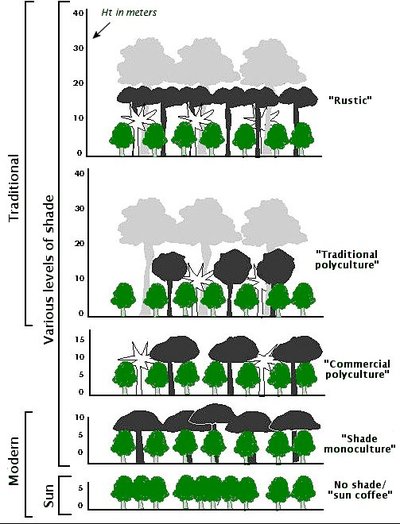
As noted in the previous post, the criteria having to do with vertical stratification — the number of layers of vegetation and the leaf volume in each — are critical components for preserving a rich mix of species.  Many ecological studies support the key role of structural diversity (sometimes referred to technically as floristic heterogeneity) in increased biodiversity — of many types in many ecosystems well beyond the realm of coffee growing. This is the classic schematic illustrating the various coffee production systems and their layers of shade diversity, from a paper by Patricia Moguel and Victor Toledo [1].
Here is a new graphic from SMBC that also illustrates this continuum:

As you can see from the table above, Rainforest Alliance requires (if this criteria is used) only two layers of shade, while Smithsonian requires three. RA has no standards for leaf volume in the shade layers. In short, RA certified farms that use these criteria would have still have structurally-simpler habitats (closer to commercial polyculture) that would likely not support as much biodiversity as farms that met SMBC criteria (closer to traditional polyculture).

A further note. SMBC inspectors visit farms and set up a number of plots and measure various vegetation parameters following methods used in typical ecological studies. The aforementioned paper reports that “Rainforest Alliance inspection auditors rely heavily on data provided by farm managers” (who are not ecologists), and confirm data provided during visits by various estimates and extrapolations.

As an ecologist myself, I am more comfortable that SMBC offers the more stringent, reliable assurance that coffee is grown sustainability if one is comparing certification schemes. And not to beat a dead horse, but the usual caveats apply: there are pros and cons of certification, and many uncertified farms grow coffee sustainably, meeting or exceeding the strongest criteria.

More on SMBCs criteria here, and in the “certifications” category of C&C.

[1] Biodiversity Conservation in Traditional Coffee Systems of Mexico. 1999. Conservation Biology 13:11—21.

Top 5 Indicators of Sustainable Coffee

Coffee is grown in over 60 tropical countries, with most of it still produced on small family farms, but adding up to tens of millions of acres. Coffee growing supports 25 to 100 million people around the world. In the last decade, a huge worldwide surge in demand for coffee has had two profound consequences.  It caused a rapid worldwide expansion in production, largely of cheap beans that flooded the market and contributed to plummeting prices. And in the rush to increase production, it caused a shift from traditional, sustainable coffee growing methods (with coffee plants grown in the shade of diverse native trees) to intense monocultures that require large inputs of fertilizer and pesticides which bring about a loss in biodiversity and quickly deplete the land.

If choosing sustainable coffee was easy for consumers, there would be no need for a blog like Coffee & Conservation. Here is a look at the top five indicators of sustainable coffee:

1. Certification. Because of the substantial costs of certification — to the farmer and/or the roaster — not all sustainable coffees necessarily carry a seal.  And if they do, it could be one of several. Here at C&C we have an excellent guide to the environmental standards of the five common coffee certifications. It includes links to more information and on the standards used by biodynamic farmers, Starbucks, and Nespresso. Meanwhile, here are three common certifications associated with sustainably-grown coffee:

  • If a coffee is certified as Bird-Friendly by the Smithsonian Migratory Bird Center, it is grown under the most stringent environmental standards of any certification system, and it is also required to be certified organic. If you see this seal, it is one of the best assurances that the coffee was grown with biodiversity and sustainability as top priorities.
  • Organic certification, by the USDA and its accredited agencies, is an important indication that many (but not necessarily all) chemical inputs have been eliminated or reduced. Generally, coffee that is organic is grown under at least some shade cover (which preserves biodiversity).
  • Rainforest Alliance also has environmental criteria, but the standard has been seriously watered down in recent years and this certification is no longer assurance that coffee was grown under shade or in a way that is beneficial to birds or wildlife. Also, coffee may carry the seal and only contain 30% certified beans.

2. Country of origin. Some countries still grow much of their coffee under shade, preserving native forest and biodiversity and using few if any chemicals.  Other countries have removed shade trees or cut down areas of native forest and planted sun-tolerant coffee varieties.  These countries are more likely to grow shade coffee:

  • Mexico (also largest area in organic coffee in the world)
  • El Salvador
  • Nicaragua
  • Guatemala (Huehuetenango has the most diverse shade cover; other regions, especially Antigua, do not use as much high-quality shade)
  • Honduras
  • Bolivia
  • Papua New Guinea
  • Ethiopia (large percentage grown organically)
  • Peru (second-largest organic origin)
  • India

These counties are more likely to grow sun coffee, and unless they are Smithsonian Bird-Friendly certified, it’s probably best to avoid them:

3. Botanical variety. There are two species of coffee used commercially: Coffea arabica or arabica coffee, and Coffea canephora, or robusta coffee.  Arabica is high quality. Robusta coffee is nearly always low quality, mass produced in deforested sun coffee monocultures with lots of chemicals, and is used in most supermarket coffees. You won’t see “robusta” on the label, so look for “100% arabica.”

There are also many different cultivars of arabica coffee. “Bourbon” and “typica” are older types that need at least some shade, so seek those out. “Catuai”‘ and “Caturra” are varieties that are often grown as sun coffee.

Learn more about botanical varieties of coffee.


4. Roaster.
Buy coffee from a small, specialty roaster. A good roaster develops a relationship with the farms and co-ops that grow their coffee — it’s in everybody’s best interest for the coffee to be grown sustainably. The farmer gains by having a reliable buyer and a safe, healthy environment, and the roaster gains by having a reliable source of quality coffee. A conscientious roaster will have very specific information on the precise origin of each coffee it sells, and you can determine how the coffee was grown to guide your purchase.

My list of recommended providers of sustainable coffee is at the bottom of every page here (click to refresh, there are more than what shows at one time; criteria for inclusion is here), with more on my interactive map of roasters. A list of online retailers that regularly sell Smithsonian Migratory Bird Center Bird-Friendly®-certified coffee is here.

5. Price. This is nearly a given: cheap coffee is not sustainable. Not for the farmer, not for the environment. People who are used to paying less than $5 a pound for grocery store coffee shudder at the idea of paying $10 or more for a pound of coffee from a specialty roaster.  Ounce for ounce, it’s still cheaper than a good bottle of wine or scotch or many other beverages.

The farmers that grow grocery store coffee get less than $0.25 a pound for it; obviously this is not a living wage. Impoverished farmers are more likely to exploit the environment, convert their coffee to other less ecologically-friendly crops, or abandon their land altogether (contributing to illegal immigration into the U.S. from south of the border). Coffee is often the most important source of income for nations that produce it; if it is no longer profitable, it creates social and economic crises, and impacts governments and democracy. (Read more about how cheap coffee contributes to poverty and why you should care here.)

And trust me when I tell you — you get what you pay for! A year ago you couldn’t have told me that there were so many incredible, distinctly unique coffees out there, an entire world to explore! We’ve only scratched the surface in our reviews.

Learn more in the corporate coffee category, in particular about the coffee crisis and why you shouldn’t buy coffee from the big commodity coffee providers.

~~~

Coffee drinkers have the potential to make a huge impact on the environment and economies of coffee growing nations. If we understand the stakes, we can make a significant difference, and enjoy our favorite beverage at the same time!

Answers to BirdChatter questions

(updated June 2009) Recently, the topic of shade coffee came up on the popular Internet bird list, BirdChat.  I hope BirdChatters will have a look around Coffee & Conservation, beginning with some of the posts listed under "Overview" at left. But I thought I would take this opportunity to directly answer some specific questions which were asked on the list.

First up was the issue of "dueling" eco-labels.  Smithsonian Migratory Bird Center has a trademarked certification called "Bird-Friendly."  It is the strongest assurance you can have that the coffee was grown under sustainable conditions: it must be certified organic, grown under a certain level of shade, and meet other strict ecological criteria.  This certification is mostly limited to Latin American coffee, but has recently been expanded into Africa.

Rainforest Alliance also certifies coffee and other products.  Their criteria are not as strict (for example, coffee does not have to be certified organic) and they include social criteria as well.  They allow use of their seal for products containing just 30% Rainforest Alliance certified beans. Large companies such as Kraft have used this to their advantage, for example on their Yuban brand, where the rest of the beans may be from totally awful sources. In fact, I am waiting response from Rainforest Alliance regarding some of the criticisms leveled at them. You can read more about certification at this post, and clicking on the category "Corporate coffee" will show you posts about specific problems with many of the big brands.

There is no law regulating the use of the term "shade grown."
I wrote two posts (one, two) on who determines if a coffee is shade grown if it is not certified. The certification process is expensive, and many farms use completely organic methods (as they cannot afford chemicals) and grow coffee under shade in a traditional manner. With careful research, it's possible to determine if the coffee you drink is grown sustainably.  It's easiest if you buy coffee sourced from a single farm or coop, and it is useful to know how coffee is grown in certain regions, and the type of bean grown.  This is the kind of research I try to do for readers, and the list of sustainable coffee retailers in the left sidebar are good bets, and all coffees that are reviewed undergo similar scrutiny.

Regarding Trader Joe's and Whole Foods in general, Whole Foods subsidiary Allegro Coffee has many sustainable coffees in its line, and depending on the region Whole Foods carries other reliable brands: in much of the southeast, they carry Counter Culture's Sanctuary line, which I've reviewed. You can find other reviews of Allegro coffees in the coffee review section. Trader Joe's is very secretive about where they source their coffee and none of it is certified shade coffee. Read all about Trader Joe's coffee here.

Is Thanksgiving Coffee Company legit? Yes, although the fact that they imply that their Songbird Coffees are certified shade grown is misleading, which bothers me.  I wrote about Songbird Coffees here and here.  Who determines whether their coffees are shade grown?  The founder of the company.  Great guy and dedicated social activist, but not an ecologist. Nonetheless, from what I've determined, most of Thanksgiving's shade are grown quite sustainably.  My personal choice for a "conservation" coffee is Green Mountain Coffee Roaster's National Wildlife blend, reviewed here. 

I hope BirdChat readers find these answers helpful, and I welcome feedback in the comments.  What other questions do you have after looking over C&C?  What coffees, brands, companies, regions, or birds would you like to see researched and reviewed?  I want this blog to be as useful to you as possible, so feel free ask away.  Just remember, I have a day job!  I'll get to your burning issues as quickly as I can!

Coffee and biodiversity hotspots

The image above (click to enlarge) is from the May 2002 issue of Scientific American (“Rethinking Green Consumerism” pdf) and shows the overlap of coffee growing areas and biodiversity hotspots (defined as spots housing 44% of all vascular plant species and 35% of all land-dwelling vertebrate animal species). I think this handily illustrates the importance of encouraging — through our purchasing power — coffee farms that preserve habitat, do not use harmful chemicals, and cultivate coffee in a way that is as close as practical to nature.

In 2007, resolve to buy coffee that protects and and cherishes the health of the people who grow it and the environment in which it is grown.  Happy New Year.