Plainspoken Coffee. A Coffee Review for Ordinary People by Ordinary People, #31.
 We don’t review many blends here at C&C (yet), mostly because it is easier and clearer to provide background and information on single-origin coffees. But we were fascinated by the 2007 Holiday Blend from Counter Culture Coffee. The coffee is a single origin, from the 21st de Septiembre co-operative in Oaxaca, Mexico. The “blend” is actually the use of different roasts of this same coffee, mixing and blending them in an old European technique called Vienna MÁ©lange. More on that in a moment.
The 21st de Septiembre co-op consists of over 950 small family farms (all under 3 hectares) growing certified organic coffee. Over 40% of the coffee comes from the vicinity of the small mountain town of Zaragoza, but there are over 20 communities contributing to the co-op. These farmers were once all part of a larger co-op, but broke away in order to market their higher quality crop alone rather than have it intermixed with lesser beans. Counter Culture buys nearly all of its coffee lots from Zaragoza; as the highest-altitude community (around 1800 meters) it tends to have the best beans.
And, as in much of Oaxaca, the coffee is grown in a fairly traditional manner, in small plots under shade. You can plug in the coordinates of Zaragoza (16.670, -97.793) to see how forested the area is, also shown in the photo at right. The forests of this region, the Sierra Madre del Sur, are considered important endemic bird areas by BirdLife International. This conservation organization lists deforestation from agriculture, including coffee, as one of the threats to the area, so supporting farmers who grown coffee under shade and are able to make a living from their coffee is a way to help preserve this area. The White-throated Jay, shown here, is one of the restricted-range birds found only in the Sierra Madre del Sur.
Counter Culture has developed a direct relationship with the 21st de Septiembre co-op, providing them with generous fair prices for their beans. Additionally, Counter Culture will donate $1 of each pound of the Holiday Blend to the women of the co-op to help them diversify through raising small livestock, and increase their income via a tortilla-making business. Around the world, empowering women is one of the fastest ways to help eradicate poverty. Not only does this buoy entire communities, it goes a very long away in preserving biodiversity and ecosystems. I wrote about the connections between poverty, biodiversity, and coffee here.
On to the coffee itself!
As mentioned above, the Holiday Blend used a roast style called vienna mÁ©lange, mixing and blending different roasts of the same bean selection. I thought this might be something like the “black and tan” blends I’ve seen before, but really the Holiday Blend looked more uniform than expected. In fact, I found it difficult to pick out notable color differences in the beans. This makes sense, as dark roasting Mexican beans would stamp out their delicate sweetness. I’ve done a little coffee roasting in my time, and one reason I quit was because there was no way I would ever be able to figure out whichever precise roast level brought out the very best in each type of bean. I leave that to the experts. So my/our inability to discern subtle differences in the light roasts just proves that we are indeed ordinary people and not coffee experts. Counter Culture isn’t talking smack here — there are really two distinct roasts that each have their own cupping profile in this blend.
Nutty was a word that popped up in descriptions of both the aroma and the flavor of the Holiday Blend. Honey and caramel, and a buttery smoothness were initial impressions, with the nuttiness becoming more pronounced as the cup cooled. Everybody seemed to have had a different nut in mind: peanuts, hazelnuts, almonds, or “anonymous nuts” (trust me, those were in the room that day!). Without having a one-roast-level sample of this coffee to compare it with, it’s hard to say if the vienna mÁ©lange technique added a lot to the coffee. However, the Holiday Blend is mild and mellow, silky and sweet, and I think it would be hard to find anybody that wouldn’t like it. Ergo, it would surely be a great coffee to serve guests. It earned 3.5 motmots, with bonus points for the coffee being organic, Counter Culture’s direct relationship with the 21st de Septiembre co-op, and the financial support empowering women in the community. That all adds up to a great sustainable coffee story.
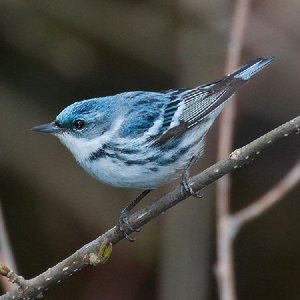 If there is a single bird strongly associated with shade coffee right now, it’s the Cerulean Warbler. I’ve written about the connection between coffee and Cerulean Warblers in the past. I’ve also discussed the Save the Cerulean Warbler Campaign by the American Bird Conservancy (ABC). That post mentioned the Cerulean Warbler Bird Reserve in the Rio ChucurÁ basin of Santander department, Colombia.