JulieCraves

Coffee: The World in Your Cup is hitting the road

Coffee: The World in Your Cup is an exhibit providing a broad overview of the powerful influence of coffee on environments, human cultures, and economies worldwide. For nine months this year it was at the organizing institution, the Burke Museum of Natural History and Culture, in Seattle. Now it is going on the road.

The exhibit, done in collaboration with the University of Washington, the Smithsonian Migratory Bird Center, Seattle University, Seattle Audubon, and the Specialty Coffee Industry, includes videos, photographs, and coffee tastings from local roasters. The web site describes some of what visitors learn:

Coffee explores the environmental and social impacts of the coffee industry and recommends ways for consumers to make socially and environmentally responsible coffee purchases at the grocery store or in a coffee shop. Concerned about how coffee affects human health? Learn about the impacts of caffeine, the world’s most commonly-used drug, on your body. Curious about how coffee became so popular? Discover its early controversial reputation as a “revolutionary drink,” and consider the culture that surrounds coffee in the twenty-first century.

Here is the current schedule:

  • World Forestry Center, Portland: Oct 17, 2009 to Jan 10, 2010 (includes coffee break weekends featuring local roasters)
  • University of Northern Iowa Museums, Cedar Falls: Feb 13 to May 9, 2010
  • Yale Peabody Museum of Natural History, New Haven: May 20 to Sep 19, 2010
  • Gwinnett Environmental & Heritage Center, Buford, GA: Oct 9, 2010 to Jan 2, 2011
  • Museum of the North, University of Alaska, Fairbanks: Jan 22 to Apr 17, 2011
  • Museum of Texas Tech University, Lubbock: May 14 to Aug 7, 2011

This exhibit was so popular at Burke that it was extended three months beyond the initial run. If you have attended or do attend, drop a note in the comments regarding your impressions.

Greenwash alert: Nespresso and sustainability

Several months ago, Nespresso, a division of the giant Swiss multinational food corporation Nestlé, announced a major sustainability initiative they are calling Ecolaboration. Nespresso manufactures espresso machines that use proprietary single-use aluminum coffee capsules.

Ecolaboration has three main goals they aim to achieve by 2013:

  1. To reduce its carbon footprint by 20% per cup, primarily by developing “greener” espresso machines.
  2. To increase its capacity to recycle its aluminum capsules to 75% (this does not mean 75% will be recycled, see note 1 below and this post) and to “co-convene an industry roundtable on improving the sustainability performance of the aluminum.”
  3. Source 80% of its coffee from Rainforest Alliance (RA) certified farms (previously, RA was only helping assess farms in their compliance with Nespresso-specific standards, not certifying them; see note 2).

I’m only going to address the coffee sourcing aspect, as sustainably-grown coffee is the focus of this blog.

First, I read Nespresso’s fact sheet on “protecting coffee ecosystems.” A third of the document explains the importance of shade and biodiversity, while the rest neglects to specify any criteria or concrete measures proposed by the company protect the environment.

Thus, the Rainforest Alliance certification criteria will have to act as surrogate for Nespresso’s sustainability efforts. That’s fine, but exactly how much coffee does that “80% certified” represent? Specifically, and importantly, how much as a percent of coffee purchased by parent Nestlé, a company famous for its dismal corporate responsibility ratings [3]?

(Updated August 2010 to reflect actual published figures) In 2008, Nestlé purchased 780,000 tons of green coffee, similar to previous years and typical of their annual volume [4]. In 2010, Nespresso purchased 490,000 bags (60 kg each) or 29,400 tons under their “AAA Sustainable Quality Program” which includes, but is not exclusively, Rainforest Alliance certified farms [5]. This represents 60% of Nespresso’s purchases, but just under 3.8% of Nestlé’s total purchases. Their stated goal is now to source 80% of Nespresso coffee from the AAA program by 2013 (again, not exclusively Rainforest Alliance certified), which would be 5% of Nestlé’s total purchases.

The commitment to sustainably-grown, eco-friendly coffee by Nespresso is an extremely small percentage of Nestlé’s total purchases. This situation qualifies for what I consider to be the most offensive of the four greenwashing criteria set forth by Greenpeace: Dirty Business. This criteria states “Touting an environmental program or product, while the corporation’s product or core business is inherently polluting or unsustainable.”

I don’t even have to dig any farther into the elaborate hoopla on the Ecolaboration site (which frankly sounds like a rip-off of General Electric’s Ecomagination program). I cannot support such a meager effort, in particular from a company with such a long track record of disregard for labor and human rights, environmental protection, honesty in labeling and marketing, and other unethical business practices.

Notes:

[1] Nespresso offers recycling of the aluminum (home and office type only) capsules in several European countries. Even when Nespresso has expanded recycling efforts, it fails to create any meaningful increase in recycling rates. Due to technical constraints, the capsules themselves are not made from 100% recycled aluminum. This post explains that the whole pod recycling issue is greenwashing.

[2] Nespresso first partnered with Rainforest Alliance (RA) in 2003, and signed a five-year pact in 2006. In the first phase of this partnership (known as the Nespresso AAA Sustainable Quality Coffee Program), RA developed guidelines specifically for Nespresso to improve quality and sustainablity practices on farms supplying Nespresso. These farms were not being certified by RA under their usual criteria. RA appraised the farms to see if they were “implementing better methods and are decreasing their impact on the natural world.” Nespresso must have been happy with the partnership, as they routinely donate tens of thousands of dollars to RA (see annual reports). Under the Ecolaboration project, the goal is for 80% of the coffee to actually come from certified farms meeting RA’s standards. Update 2015: here is a post on the environmental and social requirements for producers in the AAA program. Note the low bar for entrance into the program.

[3] Corporate Watch lists numerous corporate crimes; another laundry list is at Global Investment Watch; Responsible Shopper outlines some boycotts and alerts; Source Watch lists more problems; and Ethical Corporation provides an article skeptical of Nestlé’s CSR report. Add it all up, and you get an award for least responsible company in 2005 (nomination here).

[4] Coffee Barometer 2009, linked to and summarized here; Ethical Sourcing – Creating Shared Value, 2008, Nestlé (PDF).

[5] Nestlé’s Nespresso Ecolaboration Progress Report, June 2011 (PDF).

Photo by svet under a Creative Commons license.
The water footprint of coffee

The water footprint of coffee and tea consumption in the Netherlands. 2007. Chapagain, A.K., and A. Y. Hoekstra. Ecological Economics 64:109-118.

This is not a newly published paper, but I found it well worth summarizing here.

“Footprint” evaluations — ecological, carbon, or water — determine the amount of a resource needed to produce a unit of a good. This paper calculated the water footprints per ton and per cup of tea and coffee, as well as “virtual” water imports into the Netherlands for each beverage. I’ll only summarize the water footprint of coffee here, but the paper can be downloaded from the publications list at the Water Footprint Network.

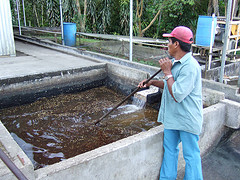
The authors measured coffee crop water requirements in different parts of the world. Some regions must irrigate (e.g., Brazil) while others rely on rainfall. Water used in processing, which also varies by region, was then factored in. Much of the world’s coffee (especially arabica) is wet processed, requiring a water source such as a river or groundwater to ferment and wash the coffee prior to drying the beans.

The calculations also took into account the shrinking weight of the product throughout processing — e.g., fresh cherries to pulped cherries to hulled beans, etc.– in order to keep the metric (cubic meters of water per ton of coffee) consistent.

Because of all the variability, from annual crop water requirements (they used FAO estimates) to the number of grams of ground or instant coffee used to make a weak or strong cup, this whole operation is somewhat of an inexact science. However, the authors appeared meticulous in their choices and inclusiveness, and the results seem to at least give us a relative picture between regions and methods, if not numbers that are actually well in the ballpark.

As it turns out, there was little difference whether coffee was wet or dry processed. The water used in wet processing made up only 0.34% of water used to grow the coffee. The summary tables provided figures for wet processing only.

The main results summarized the cubic meters of water used per ton of coffee (for each step from fresh cherry to roasted) for 25 countries.  The two countries with the highest totals were both robusta-producing nations: Togo (49341 m3/ton) and Ghana (47554). In fact, six of the top ten countries grew robusta either exclusively or in addition to arabica. The highest arabica-only country was Panama at 37660 m3/ton.

The average (weighted for world production) “virtual water content” was calculated at 20987 m3/ton. Lowest countries were Vietnam at 6054 and the U.S. (Hawaii and Puerto Rico, 9061). Other countries that grow primarily arabica which were ranked below-average were Ethiopia, Guatemala, Costa Rica, El Salvador, Bolivia, and Colombia.

Finally, the authors calculated that the “average” cup of coffee required around 140 liters of water; several variations were provided. The authors also estimated that if the price of coffee included the economic value of rainwater, it would increase about 20 cents per kilo. This cost increase does not include surface or groundwater used for processing or irrigation water, nor any environmental costs due to erosion or water pollution.

Coffee flotation in Chiriqui, Panama; photo by Darrin O’Brien, used with permission.

Chapagain, A., & Hoekstra, A. (2007). The water footprint of coffee and tea consumption in the Netherlands Ecological Economics, 64 (1), 109-118 DOI: 10.1016/j.ecolecon.2007.02.022

Know your coffee birds: Violet Sabrewing

One of the most enduring memories of my visit to Finca Hartmann is that of passing a spot that was frequently visited by a vivid male Violet Sabrewing (Campylopterus hemileucurus), a large tropical hummingbird found from southern Mexico to western Panama. Many of us in the U.S., especially in the east, think of hummingbirds as diminutive creatures. Violet Sabrewings, however, are big, spectacular birds the size of sparrows. The males are a brilliant dark violet while the females are largely metallic green. Both sexes have white-tipped outer tail feathers that flash as they hover and flit about. They are unmistakable and not soon forgotten.

Violet Sabrewings are most common at 900-1650 meters, the same elevations at which coffee is grown. These hummingbirds like open forests or edge habitats where they can find an abundance of flowering plants, and are found on most bird lists of shade coffee farms within their range.

Hummingbirds are among the most important pollinators, especially in the tropics. Many tropical plants have co-evolved with their specialized hummingbird pollinators, so that the flower is shaped in such a way that only a hummingbird with a matching bill can pollinate it. Violet Sabrewings pollinate a wide variety of flowers, and utilize a foraging strategy known as long distance traplining. They repeatedly visit flowers along a long, fixed route.

Coffee itself is rarely pollinated by hummingbirds (arabica coffee is self-pollinating, although fruit set increases when bees help cross-pollinate). Therefore, sabrewings and other hummingbirds are rarely found in sun coffee farms, but are reliant on the other flowering trees and plants found in shade coffee. Trees in the genus Erythrina are commonly used to shade coffee, and most tropical species are pollinated only by hummingbirds. Bananas and plantains, also frequently used in shade coffee, heliconias, and various ephiphytes are all very important to Violet Sabrewings and other hummingbirds. This plant diversity is not found in sun coffee, but shade coffee farms provide excellent habitat for these dazzling birds.

Another important feature for Violet Sabrewings found in shade coffee farms is nesting habitat. This species inevitably nests on the branch of a tree or shrub over a small stream (we found several nests near creeks at Finca Esperanza Verde). Some source of running water is characteristic of most coffee farms in Latin America, which use the washed or wet processing method. Without streamside vegetation, it’s unlikely Violet Sabrewings could nest successfully.

Another group of organisms depends on hummingbirds to complete their life cycle. Known as hummingbird mites, these tiny invertebrates live and reproduce in flowers, feeding primarily on the nectar. There is only one way for these specialists to move between plants: in the nostrils of hummingbirds. Mites that need to move to another flower of  their specific host plant (when the flower is dying) must clamber onto the bill and into the nostrils of a hummingbird in the brief few seconds the hummingbird is probing the flower. The mites recognize the scent of their host plants, and have an equally brief time to disembark into a new flower.

Hummingbird mites do not harm the birds; in ecological terms this is known as phoretic commensalism, when one species (the mite) uses another (the hummingbird) just for transportation. The mite benefits, the bird is not affected.

Swaths of sun coffee fragment hummingbird habitat, creating barren deserts essentially void of these beautiful birds, all for the want of a cheap cup of coffee. Save hummingbirds (and hummingbird mites!), drink sustainably-grown shade coffee.

Top photo by Jerry Oldenettel, second by Doug Greenberg, under Creative Commons licenses. Violet Sabrewing nest at Finca Esperanza Verde by Darrin O’Brien and Julie Craves, all rights reserved.