Coffee in Australia?
Coffee was first grown in Australia over a century ago, without much economic success. The high cost of labor made commercial coffee growing unprofitable until mechanical harvesting became common in the 1980s.
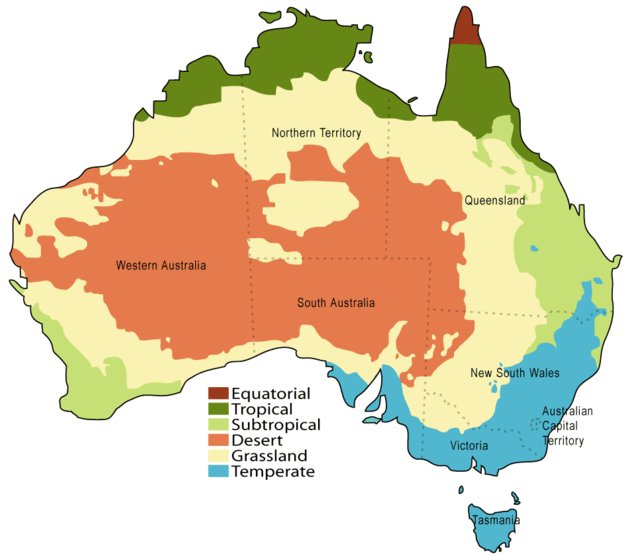
Today, coffee is grown mostly in the far eastern part of the country, corresponding to the light green subtropical regions on the map (click to enlarge). Two important areas are the Atherton Tablelands in northern Queensland outside of Cairns, with about 30 large growers on over 700 ha, and in northern New South Wales (NSW) just south of the Queensland border, where there are around 170 growers on 500 ha. If you have some sense from the vague atlas in your head that these areas are not high elevation, you’d be correct. Australian coffee is a rule breaker. Not only is the country outside the tropics, but coffee is typically grown at 200-400 meters, not infrequently lower, and rarely much above 900 meters.
Despite the low elevations, Australia grows arabica almost exclusively. The typica variety is grown, but also catuai, Mundo Novo (hybrid of bourbon and typica), and especially Kenyan varieties more suited to the drier Australian climate such as K7 and SL6. Coffee is processed every which-way: some wet processing, some semi-washed (pulped natural), some dry processed (full natural), and a unique method developed by the Mountain Top Coffee Company called “double pass.” This is where a full natural process bean (dried on the tree) is rehydrated before being pulped.
Australia currently produces 200 to 600 tons of coffee annually, half of which is exported, an amount so low it does not even get listed in the International Coffee Organization’s production statistics. It’s rarely seen in the United States, but there has been considerable investment in the specialty coffee industry in Australia along with increasing market presence.
Sustainability
I mentioned the advent of mechanized harvesting helping the Australian coffee industry turn the corner. Mechanical harvesting reduces or eliminates the need for workers to hand-pick beans, which can account for 50% of labor costs. It also requires coffee to be grown on flat land in rows in a monoculture. Thus, all the mechanized coffee in Australia (which is most of the commercial crop) is grown in full sun (an example here).
Mechanical harvesting also works best when the beans ripen simultaneously rather than over an extended period of time. The Australian climate, with pronounced dry seasons, lends itself to this as well. As in Brazil, coffee is irrigated after a dry period — sometimes water is deliberately withheld — in order to induce a bloom.
It’s often written that Australian coffee is grown without pesticides, as most of the usual coffee pests are not present Down Under. However, some have been recently introduced (e.g., green scale), and others are a problem as well (brown scale, avocado leaf-rollers, and mealy bugs). Insecticides are in fact used for these insects by some growers. Further, sun coffee usually needs a lot of fertilizer. I have had trouble finding any Australian coffee that is actually certified organic. The Australian Coffee Traders Association even notes, “There are many Australian brands which claim to be 100% organic but the certification is questionable.”
Habitat loss in Australian coffee-growing regions
According to the Australian Natural Resource Atlas (ANRA), 30-70% of subregional ecosystems are at risk in the coffee-growing areas of Australia, with higher instances in NSW. The major growing areas have different types of native vegetation. The major Queensland native type in the coffee-growing highlands is eucalyptus woodlands (pdf), and a good deal of it remains. The New South Wales north coast area is slightly different, with eucalyptus open forest (pdf), although far less native vegetation remains in this region. This loss of habitat contributes to the fact that the NSW coffee areas also have many threatened plant and animal species; it is considered one of the richest bioregions for birds in the country. Although traditionally the area with smaller coffee farms, it is the NSW region that is pushing for a major expansion in coffee production.
The map (click to enlarge) shows the change in breeding bird species reported during the last 20 years. The Queensland coffee area shows no significant change, but the NSW area has a significant decrease. The super-cool endemic Crested Tit-Shrike (Falcunculus frontatus, pictured) is considered an indicator species in both areas, as it is found in both characteristic types of eucalyptus forests. The Black-breasted Button-quail (Turnix melanogaster)
is an example of an endemic bird that is under severe threat from land-clearing due to agriculture; its range is restricted to coastal and near-coastal regions of southeastern Queensland and north-eastern NSW.
In contrast with researching how agriculture and coffee might impact biodiversity in some areas of the tropics, there is an abundance of information on habitats and threats in Australia (almost too much data to digest!), although nothing specific to coffee, given the relatively small footprint. You can read biodiversity assessments for the NSW North Coast and the Einasleigh Uplands of Queensland, which cover the important coffee-growing areas in Australia.
Bottom line
Overall, I was not left with a great feeling about compatibility of natural habitats and biodiversity and the coffee industry in Australia. Australian coffee is not common in the U.S., but the one bag we tried — from a leading Australian brand and a U.S. roaster with a very good reputation — was nothing special. In fact, nobody liked it. It was flat, and the most frequent adjectives were “ashy,” “tobacco,” and “coal.” Should we be able to taste a wider sampling, we will post some reviews, but I’m really not motivated or inclined to seek them out. There are plenty of great coffees from that part of the world that are grown more harmoniously with native ecosystems.
Kangaroo crossing sign by Casa de Queso; thanks for publishing under a Creative Commons license; Climate map from Wikipedia; bird map from the Australian Natural Resource Atlas; Crested Tit-Shrike from the Australian Museum.