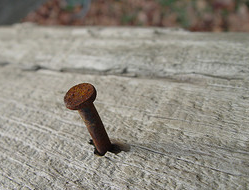
A rusty nail in the coffin of organic-certified coffee?
Coffee leaf rust (Hemileia vastatrix) is a highly contagious fungal disease that is devastating coffee production in Latin America, with losses estimated at 15 to 70%, depending on the region. One essential component to combating this disease is the use of fungicides. Copper-based fungicides are relatively inexpensive and are permitted under organic certification. However, they must be reapplied frequently (around every three weeks, or more often if it rains and gets washed off) and are not without ecological risk. If used frequently or in excessive amounts, copper can build up in soils and can also be harmful to aquatic organisms. Some types of synthetic fungicides*, not allowable under organic certification, can be more effective — and in some circumstances may actually be safer for the environment.
Some of the best reporting on the coffee rust crisis is from Michael Sheridan writing at CRS Coffeelands. As I was contemplating writing this post on the connection between coffee leaf rust and organic certification, Michael hit on the topic himself. He notes that farm management [use of shade, planting density, pruning, proper timing of fungicide applications] has as much or more to do with crop losses from rust as does whether the farmer uses organic or conventional production; this was echoed in survey results gathered by Green Mountain Coffee Roasters. The severity of this disease is also very dependent on climate and weather factors such as wind, moisture, and temperature. Still, Michael notes that the “official response to coffee rust in Central America so far seems to have been heavily skewed toward agrochemical-intensive approaches”.
For example, at a recent coffee rust summit, a representative from PROMECAFE, a Central American coordinator for coffee-related technical training, suggested that in the short term, organic farmers might consider leaving organic for conventional production.
 CRS Coffeelands quotes Miguel Medina of the Guatamalan national coffee organization Anacafé as saying, ”I don’t know how organic coffee can have a future. There is nothing that works to control rust in the field and I am not seeing anyone in the market offering more to create additional incentives for organic farmers.”
Despite a strong commitment by farmers in many Latin American countries to preserve their environment and even a suspicion by a few that chemical companies may be behind the rust epidemic, many farmers may feel compelled to give up their organic certification to fight the rust. With the severity of this threat to their livelihoods — and even survival — the choice between trying to salvage their coffee trees with artificial fungicides or stick with organic certification is straightforward. Many will do what they can to keep afloat and give up organic certification. This not only allows them to use more potent artificial fungicides to try to control the coffee leaf rust, but it also frees them to use pesticides and artificial fertilizers that may be considered necessary to protect or help vulnerable or ailing coffee trees.
Over the past few years, some farmers have already abandoned organic certification because the extra money they receive for it simply does not compensate them for the added expense of producing coffee this way. The rust crisis adds to this dilemma. Eventually, coffee fields are likely to be replanted with rust-resistant varieties, but even those in the ground today will take three to five years to produce a crop. Meanwhile, we as consumers need to brace ourselves for higher coffee prices as crop yields decline, and be that much more willing to pay extra for organic coffee.
More reading on the topic:
- The Livelihood of Small Coffee Growers Is Threatened By A Plant Disease (Applied Mythology)
- Coffee Leaf Rust: It’s Coming for Your Morning Joe (The Atlantic)
- Sustainable Harvest is a coffee importing company that focuses on building relationships with farmers and investing in their training and development. They’ve launched the Roya Recovery Project to provide small farmers with tools to adapt to the coffee leaf crisis. Best of all, it is geared toward organic farmers.
- CRS Coffeelands posts on the coffee rust crisis.
*Some media mention “Triazaline” as the synthetic fungicide used for coffee leaf rust control. From what I can tell, there is no fungicide named triazaline. However, there is a group of synthetic fungicides called triazoles that are used. Triazaline may be a brand name in this family, or a misinterpretation/misspelling of triazole.
Update (January 2025): A study has now confirmed the toxicity of triazoles to humans using these fungicides to combat coffee rust.
Rusty nail photo by Scott Robinson under a Creative Commons license.
 The Rainforest Alliance Cupping for Quality recognizes Rainforest Alliance certified coffees, highlighting the linkage between sustainable farm management practices and cup quality. There are two annual cuppings and awards, divided by geography. In December, coffees from the southern hemisphere compete. The April cupping covers countries in Latin America, as well as Ethiopia and India. The following results were announced last week at the annual Rainforest Alliance Sustainable Coffee Breakfast at the
  Inambari (Peru) – 87.38. Inambari is one of the organic cooperatives that is part of CECOVASA (Central de Cooperativas Agrarias Cafetaleras de los Valles de Sandia), a group of Fair Trade cooperatives totaling nearly 5000 members. CECOVASA has also been working with Conservation International. CECOVASA has won coffee quality awards before, with members winning Cupping for Quality awards the past several years, as well as an award for their work preserving biodiversity. The Inambari logo is a stylized hummingbird.
 Moredocofe (Ethiopia) – 87.06. Family-owned, also organic and UTZ Certified. Their logo features a