“B Corp” coffee companies – what and why

Updates: Michael Sheridan at CRS Coffeelands offers his overview of B Corp certification, and an updated list of coffee companies (January 2015). Daily Coffee News had a good article on B Corps, with an overview and focus on the coffee industry (December 2018).

You may have seen companies promoting the fact that they are “B Corps,” including many coffee companies. What are they? Which coffee companies are B Corps? Should we care?

Benefit corporations — the legal kind

First, there are “benefit corporations” or “B corps” for short, which are legal corporate forms recognized in 20 states plus the District of Columbia as of this writing.  Benefit corporations are for-profit companies which have chosen a governance that also requires them to consider the social and environmental benefits of their corporate actions. These companies have transparency requirements including publishing a public annual report on their benefit efforts.

certified-b-corpB Corps — the certified kind

Whether a legal benefit corporation or not, a company can go through a qualification process to become a certified B Corp, verified by the non-profit B Lab. The organization certifies companies once they have met standards of social and environmental performance and have changed their bylaws to take into account the impact of their decisions on the environment, community and employees. The non-profit also supports the enactment of legal benefit corporations, and created GIIRS – Global Impact Investing Rating System — a rating and analytic tool to measure social impact of companies, much like financial metric ratings such as Morningstar.

The process involves a self-assessment by the applicant company. The assessments are developed and updated by an independent advisory council. This is followed by a phone review by B Lab staff to clarify points, and if the company scores 80 out of 200 points on the assessment, a request for documentation of key points. Companies then are required to amend their governing documents to reflect their commitment to social and environmental impacts. Finally, they sign a declaration and pay. Certification costs $500 to $25,000 a year depending on a company’s annual sales. Certification is good for two years.

How rigorous?

I’m generally uncomfortable with corporate self-assessments, although they are a starting point for a strong review. However in this case, the initial scoring review and any on-site review (only 10% of companies are chosen at random per year for the latter) are not done by an accredited third-party auditor.  I’m also a bit leery of a certification where 40% is a passing grade, but it depends on what is actually being scored.

I was most interested in the environmental assessment and scoring.  The assessment questionnaires are not posted online, as there are 40 different versions tailored to company size, sector, etc. I think this is positive, because a one-size-fits-all approach is less likely to be meaningful. The B Lab staff let me go through and review a self-assessment such as might be used by a medium-sized coffee roasting company. For the most part, the environmentally-oriented questions dealt with the physical plant and overall company operations. For instance, there were questions on:

  • LEED certification or other green building initiatives
  • Recycling at the company, as well as use of recycled and other green supplies and materials
  • Monitoring environmental impacts of company operations (water use, solid waste, greenhouse gases), and reduction of the company’s carbon footprint by commuting practices (allowing use of telecommuting, encourage carpooling, public transportation, etc.)
  • Overal energy use and conservation, including monitoring, the use of renewable energy sources, and so on.

Product-oriented questions were aimed at recycled packaging, energy use, and waste generation/reduction in production; the use of Life Cycle Assessments, and things that seemed a bit on the periphery of what we as consumers might be interested in as far as coffee as a product.

When I ponder a coffee roaster’s sustainability efforts, I admit I generally think about their sourcing and whether they purchase coffee that is sustainably grown. Of course, the company’s own efforts at being environmentally responsible are important, too, and a high score in this category gives an indication of how deep the commitment goes. Perhaps many of the questions (at least in the version I poked through) are not entirely appropriate to many small specialty coffee roasters and retailers.  The B Lab folks completely get that, and request comments on content, wording, scope, or focus through a feedback link on each question.  Thus, the assessments can continue to evolve and become more customized to different businesses.

The final positive aspect to the assessment process was that it contains benchmarking, best practices, and tools and resources to improve scores.

If a company completes an honest assessment and then provides feedback and fully utilizes the resources available through this process, I think it says something meaningful and is a worthwhile designation. I’m not totally convinced there is a way for a consumer to really evaluate a company’s efforts just by looking at their scores, and especially if they just see the B Corp badge on a website. But I like the concept, intent, and spirit of the B Corp movement. Since it is a work in progress and still evolving, I think it has some real potential to help consumers assess the companies they do business with.

There are currently nearly 900 certified B Corps. Here are the coffee roasters and importers with their overall and environmental scores.

And here is the 2013 list of the companies of all types in the top 10% for environmental impact, divided by company size.

My year in beans: 2013 — all certified coffees

nuthatch-mugAnnual recap of how much we spend on coffee in a year

Here we are on year five of standardized tracking of how much the two-person Coffee & Conservation household spends on coffee. We keep track of each bag we buy, including shipping, since we purchase the majority of our coffee online.

Of course, we never buy cheap, fast-food, commodity, or mystery coffee. If we don’t know where it comes from, we don’t drink it. Usually, most have eco-certifications, but since we have a lot of knowledge on how to research the source of each coffee and gauge sustainability, we have traditionally purchased other coffees that we know are sustainably-grown, but did not carry certification.

Most consumers won’t go through this process, so for 2013, we decided to buy only certified coffees: organic, Rainforest Alliance, Smithsonian Bird-Friendly, or some combination. I confess, a few bags were from farms we knew or discovered did have certification, but were not sold as such.

Of our 79 bags, around 15 were duplicates, sometimes the same farm from different roasters. Sixty-two bags of coffee were certified organic, and 28 were certified Rainforest Alliance; 11 had both certifications. Five were also Bird-Friendly certified (of which organic certification is required).

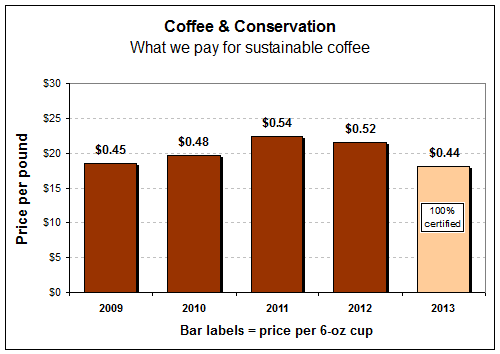
Despite buying exclusively eco-certified, specialty coffee this year, we paid the lowest price per cup in our five-year tracking history. Let us now put a fork in the myth, once and for all, that high-quality, sustainably-grown coffee “costs too much.”

Here are all the 2013 stats:

  • 79 bags of coffee totaling 65.5 pounds.
  • Total retail price for the coffee only = $1109. This year, we moved to a more coffee-friendly community, so we were able to buy more coffee locally and spend less on shipping, just $74. Our previous 5-year average for shipping was $127.  Our grand total was $1183 for the year.
  • Cost per six-ounce cup: only $0.44 ($0.41 without shipping), calculated using the common industry standard of 11 grams of coffee beans by weight per 6 fluid ounces of water.
  • The average price per pound including shipping this year was $18.08, or $16.95 excluding shipping.

Previous results

The five-year average is 63 pounds of coffee a year at an average of $20.04/lb, and $0.49 per 6-oz cup, including shipping.

year-in-beans-graph

We are not very typical consumers in two cost-inflating ways: 1) We buy most of our coffee online and do not buy more than we can drink in under two weeks, incurring high shipping costs; and 2) we buy from an average of over 20 different roasters each year, in order to try a variety of coffees, nearly always single origin farms and frequently higher priced microlots. Had we only repeatedly purchased our favorite locally-available coffees, our estimated cost for the year would have been around $900 total, and $0.34 a cup.

Update on JM Smucker’s coffee sustainability

rusty-folgersIn 2011, I profiled JM Smucker’s (lack of) approach to coffee sustainability issues. Since the company acquired Folger’s and some other brands, coffee has become the company’s biggest profit-maker. For two years, major investors pressed the company to develop and report on a coffee sustainability plan.

Last year, Smucker’s began to outline small steps toward a green coffee sustainability vision. In their 2012 Corporate Sustainability Report, they offered,

  • A goal for certified coffee purchases to reach 10% of its total retail purchases by 2016. This would be primarily UTZ Certified coffees, which don’t have strong ecological criteria (it’s the most popular certification for the big commodity coffee buyers), but will greatly improve transparency.
  • Partnerships with organizations that offer smallholder support: TechnoServe, the Hanns R. Neumann Stiftung Foundation, and World Coffee Research.

You can read my whole recap and analysis of the 2012 report here. As for the current 2013 Corporate Sustainability Report (PDF), it’s pretty much a rehash of the points above.

There are no further data on what progress they are making on reaching their 10% goal, e.g., how much certified coffee they are currently buying.

Regarding their partnerships, there is also no new information. The report does go into some detail discussing the goals and achievements of the organizations they support. While the company makes no claims about their specific role in these good deeds, I find this overall approach misleading.

Let’s put it this way:  I do some volunteer work and make an annual donation to a local environmental non-profit. While my contribution may be valuable to the whole, I would be called a fraud if I tried to pad my resme with this organization’s accomplishments.

Two new items are largely symbolic, in my opinion. First is their $50,000 a year membership in The Sustainability Consortium, originally established with funds from WalMart. Many very large corporations are now touting their association with TSC, who states that their mission is “to design and implement credible, transparent and scalable science-based measurement and reporting systems accessible for all producers, retailers, and users of consumer products.” Indeed, transparency is mentioned a lot on their website. For instance, they state that consumers desire “…product transparency” and are confused about “…what constitutes a sustainable product” — and that these were major motivations behind the formation of the organization. Alas, when I try to access the Key Performance Indicators and Category Sustainability Profile for coffee, I find it requires member login. I confirmed with TSC that these data are not available to the public. TSC could very well be doing fantastic work but although their website is extensive, I could not find or access any specific material to help me as a consumer determine whether member coffee companies are taking meaningful steps to improve their supply chain sustainability.

(For more background on TSC, see a couple of Joel Makower’s great pieces at GreenBiz, Inside Walmart’s Sustainability Consortium, and Driving the Sustainability Consortium’s ambitious agenda.)

Finally, Smucker’s is producing “Life is Good” branded coffee, which is is UTZ Certified.  You may know Life is Good for their t-shirts and stickers, etc., whose raison d’être is to spread the power of optimism, with 10% of its net profits going to their own foundation for children.  At $6.99 to $7.99 per 11-ounce bag, the coffee won’t fill the foundation’s coffers (or those of the farmers it was sourced from). While promoted as a premium coffee, it’s safe to be suspicious of the quality of a brand that sells banana bread-flavored and s’more flavored varieties.

I also believe in the power of optimism, but I am not optimistic that JM Smucker will ever be a significant purchaser/purveyor of truly ecologically-sustainable coffee.

Coffee can photo by Travis S. under a Creative Commons license.

Research: More birds eating coffee berry borers

Forest bolsters bird abundance, pest control, and coffee yield. Karp, et. al., 2013. Ecology Letters.

I’ve summarized several papers from Matt Johnson and his students at Humboldt State University (CA) who study how birds provide pest control on coffee farms in Jamaica by preying on coffee berry borers. Here’s a new paper on the same theme, with the research being done in Costa Rica.

cr-cbb-birds2

From top: Buff-throated Foliage-Gleaner, Rufous-breasted Wren, White-tailed Emerald, Rufous-capped Warbler, Yellow Warbler. Credits below.

These researchers looked at coffee berry borer (Hypothenemus hampei, CBB) predation by both bats and birds; since bats were not found to be significant predators on CBB in this study I won’t go into those findings. The farms examined were “sun coffee” with less than 25% canopy cover, as shade coffee is not common in Costa Rica. To determine what birds were eating CBBs, the authors used DNA analysis of bird droppings.  This is a great way to determine if birds are feeding on the CBB, since the insects are extremely tiny they would be difficult to detect in droppings visually. Still, the bird would have had to have recently fed on CBBs, and the DNA would need to have passed through the digestive system without too much degradation to be detected by this method.

When birds were excluded from the coffee shrubs, the number of shrubs infested with CBB almost doubled, and the CBB drilled deeper into the coffee cherries. Birds were more common in farms that had some embedded or nearby forest cover…and the more forest cover the less severe the borer infestations on control plots. Perhaps surprisingly, very small (less than a hectare) forest patches weaving through the farms provided more of this pest-control benefit than having a large forest reserve nearby.

The authors also calculated the economic benefits the birds provided to farmers. For two farms that formed the core of their study, birds saved between 25 and 70 kg of coffee per hectare annually, for a cost savings of US$75-310 per hectare based on the prices being received. For the smaller farm the total economic benefit of birds preying on CBBs was between US$3500-$9400, and for the larger farm US$17,000-55,100. Since the CBB has only been present in Costa Rica since 2000 and in the vicinity of the study sites since 2005, cost savings provided by the birds may be even higher when CBBs are more-well established.

Bird species that were found to have preyed upon CBBs were:

  • Buff-throated Foliage-Gleaner (Automolus ochrolaemus). A common and widespread resident bird in the tropics which feeds on insects in shady forest situations.
  • Rufous-breasted Wren (Pheugopedius rutilus). A common wren resident wren in parts of Central America that feeds on insects in thickets and forest edges.
  • Rufous-capped Warbler (Basileuterus rufifrons). A resident tropical warbler profiled here in our Know Your Coffee Birds series.
  • White-tailed Emerald (Elvira chionura). A resident tropical hummingbird known for inhabiting shaded coffee farms.
  • Yellow Warbler (Setophaga petechia). While there is a resident form of Yellow Warbler in Costa Rica, it inhabits coastal areas. The Yellow Warblers in this study were migrants that breed in North America.

It’s interesting to note that although CBB have not been in the area for very long, native and migratory birds are already using them as a food source.

These studies on the identification, ecology, and effectiveness of natural predators of CBB are critical, given the expected spread of this pest due to climate change and the fact that they are evolving resistance to the potent insecticides used to combat them.

See also:

 Photo of Buff-throated Foliage-Gleaner by Jerry Oldenettel; Rufous-breasted Wren by Francesco Veronesi; White-tailed Emerald by Michael and Ellen Cox; all under a Creative Commons license. Rufous-capped Warbler and Yellow Warbler by Julie Craves, all rights reserved.

D.S. Karp, C.D. Mendenhall, R. Figueroa Sandi, N. Chaumont, P.R. Ehrlich, E.A. Hadly, & G.C. Daily (2013). Forest bolsters bird abundance, pest control and coffee yield Ecology Letters DOI: 10.1111/ele.12173