Housekeeping

Shade coffee at Dave’s Garden

Dave’s Garden is an enormous web site that covers every issue of interest to gardeners. The site just had a feature article on shade coffee by Marna Towne. Marna hits all the high points to introduce DG users to this important issue. And this is no small audience: DG has over 400,000 registered users and can get nearly 2 million hits a month! Many thanks to Marna for doing this piece, and asking me to provide some information and photos.

So welcome Dave’s Garden readers! Please visit the User Guide for a list of the important background posts. If you only read one post here, make it The Top 5 Indicators of Sustainable Coffee.

Marna’s article covered some of the information in What is shade coffee? and What is sun coffee and why is it a problem? You may also want to check out the post on the coffee crisis (why cheap coffee is being grown on sun plantations) and an example of illegal coffee growing in a national park (how it ends up in common grocery store brands).

I hope Dave’s Garden readers find this site useful — and I welcome feedback — and that Coffee & Conservation readers head over to DG to check out all the incredible resources there!
Greetings from the Panama highlands

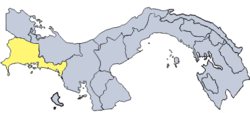
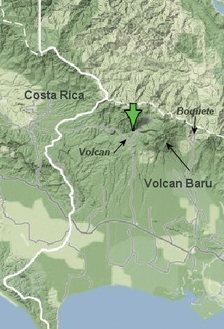
My husband and I are in the highlands of Panama, in Chiriqui province (in yellow on the first map) near the Costa Rican border. We are staying near the city of Volcan, on the western flank of Volcan Baru at about 1500 meters (5000 feet) . Chiriqui is the main coffee growing area in Panama. Boquete is on the other side of the volcano, but there are plenty of farms all around us, including Finca Hartmann and Carmen Estate, whose coffees we’ve both reviewed.

We have coffee shrubs growing on our rented property, and as it is harvest season here, the cherries are ripe. I tasted the pulp, and it’s very sweet, but sparse. I can now see how tenacious the mucilaginous coating on the beans is, and it really helps me understand the why and how of wet processing coffee. I’ll try to take a little video of I can. We plan on visiting at least one coffee farm, and I will also post photos of the area as I have the opportunity.

Solstice greetings from C&C

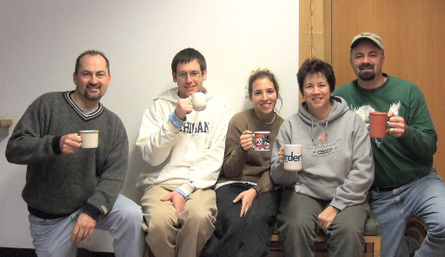
Warm wishes on the winter solstice, from the main jury members of the Coffee & Conservation tasting panel.

Mike (Risky Kingbird), Greg (Star[bucks]ling), Terry (Coal Tit), Julie (BirdBarista), and Darrin (Kingfisher).  Ordinary people!

Interactive roaster map!

One of my main goals here at C&C is not only to provide background information so that consumers can choose coffee that does not harm biodiversity, but to do some of the heavy lifting myself. I’ve been as conscientious as possible in researching roasters that carry sustainable coffees.  There is a drawback to mail ordering coffee, and that is shipping costs and, something that personally bothers me a lot, the environmental costs of the fossil fuel use required for the shipping.  This is especially onerous with coffee, because unless you buy green beans, you can’t buy much more coffee than you can drink in two weeks or so.  It just defeats the purpose to buy freshly roasted coffee and not drink it at peak freshness.

So, I’ve tried to research and try out roasters from far and wide.  Below is an interactive map to the roasters I’ve examined so far that meet the criteria described in a previous post; not every coffee from each roaster is sustainable, but all have at least a few offerings that come from biodiversity-friendly sources.  If there are multiple qualified roasters in the same city, I’ve only listed the ones I’ve tried, or that have the highest-rated coffee.

Hover over the markers for the name of the roaster, click on the markers for name, location, web site, and notes. If it’s an orange marker, a street address is given, and it’s a location you can visit (retail store or cafe), mail order only places are green.  If there are multiple locations, that’s noted, too (the note will say "retail" if the coffees are available at grocers, coops, etc.). You can zoom and pan.  You can also visit the map at Zee Maps, and click on "List" in the upper right corner for a color-coded list of names.

Explore and choose a roaster near you!  (I know I have quite a few readers in Europe and Australia…I’ll try to add some more roasters in those regions in the future.)