Plainspoken Coffee. A Coffee Review for Ordinary People by Ordinary People, #9.
 El Salvador is a small Central American country with a troubled past. It has been largely deforested, with coffee plantations providing most of the remaining “forested” areas in the country. As El Salvador grows mainly older types of coffee — mostly bourbons and pacas — they are typically grown in shade. This has been reinforced by the many years of civil war, now over, that squelched the spread of technified sun coffee in the country.
These shade coffee farms provide critical refuge for birds and wildlife in El Salvador. Very little primary forest remains in El Salvador, and shade coffee farms represent much of the rest of the “forested” land in the country. Coffee farms border one of the country’s most important parks, El Imposible, and they provide a a corridor to another park, Los Volcanes. Yet coffee plots may be abandoned or sold unless farmers can get good prices for their beans.
Examples of North American breeding birds that winter in El Salvador, and which studies have determined return to the same places each winter, include Painted Bunting (Passerina ciris, photo right), Wilson’s Warbler (Wilsonia pusilla), Tennessee Warbler (Vermivora peregrina), and Ovenbird (Seirurus auracapillus).
El Salvador has entered the specialty coffee market with a bang. At the end of the post, you can find a number of articles about the resurgence of El Salvadoran coffee. Here are a few reviews of some coffees for you to consider.
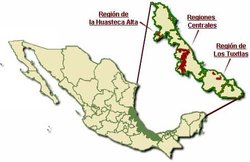
Counter Culture Finca Mauritania (PDF). Counter Culture is the exclusive roaster of this Bourbon varietal from Aida Batlle’s farm on the slopes of the Ilamantepec (Santa Ana) volcano; the Santa Ana region, the red dot on the map below, is the main coffee growing region in El Salvador. This farm has just been certified organic (it takes three years), and will be marketed as such next year.
Aida has two other farms on the volcano — Finca Kilimanjaro (PDF, which grows the popular Kenya SL28 bean) and Finca Los Alpes.
The beans had the most amazing, distinctive aroma — like opening a bag of candy. It was variously described by our tasters as smelling like butterscotch, toffee, or brown sugar. We kept closing up the bag and opening it up again for a whiff. One panelist took the bag and walked away with it; we found him pacing the hall with his nose buried in it!
Try as we did — French press, drip, Aeropress — we could not coax all those great aromas into the cup. Nonetheless, this was a fine classic coffee, with some of getting hints of honey and just general sweetness in the cup. It was thoroughly enjoyable, and scored 3.25 motmots. I think it might have scored higher had it not smelled so good. The aroma just hiked up our expectations too high. Read on, this was not the only El Salvadoran coffee that we experienced this with.
Mayorga Coffee Roasters El Salvador Santa Isabel. Rainforest Alliance certified. The package came labeled “Altamira,” and apparently these names are interchangeable. The Mayorga web site gives a brief profile of the Santa Isabel farm.
This was listed as a medium roast. It was fairly dark, with all beans showing oil. These were also very fragrant beans. The package sitting on my desk scented the air enough to make my mouth water. There was no roast date on the package.
The coffee did not live up to the intense, appealing aroma, either. It wasn’t bad, just unremarkable. It was full-bodied, hearty, a nice autumn or after-dinner coffee. A lighter roast may have brought out more interesting sweet, chocolate tones which we only found hinted at. This was one coffee that was nicer brewed than in a press. 2.75 motmots.
Liquid Planet Santa Julia — This was a 2005 CoE competitor, which ended up with a score of 84.31, with the jury describing it as “floral note, round, smooth mouthfeel, sweet, syrupy, grapelike, mellow.” The entire lot was purchased by the Roasterie for Liquid Planet, which is the exclusive distributor. The price of the lot was $4.10/lb green, a nice price well over fair trade, but does not seem to justify a retail of $25.95/lb.
Santa Julia is also in the Santa Ana region. The farm is not certified organic or shade grown, but this farm grows Bourbon variety only (which does best in shade) and lists their shade trees as “Pepeto Peludo [Inga punctata], Avocado, Pink apple tree, among others.”
The beans were roasted just past full city, with most or all showing some oil. A lot of us, myself included, started out this tasting process as dark roast fans, but have become lighter roast converts, so we had some trepidation. I did not find this to taste over-roasted, or even remind me of a darker roast, but Star[bucks]ling — although he liked it — said he would have liked to have tried it in a lighter roast. There was no roast date on the package, and we did not get a lot of fizz and “head” when we added the water to the press as we would expect with a very freshly roasted coffee.
The panel agreed on several adjectives: chocolately (including cocoa and bittersweet chocolate), slightly woodsy (especially the aroma of the beans) and full-bodied. The richness and lingering mouthfeel of this coffee (with hints of molasses), I think, is it’s most distinctive characteristic. I enjoyed the fullness of it (although it stayed on the tongue a bit too long, leaving a woolly rather than creamy feel). We decided this was another perfect coffee for a crisp autumn day. 3 motmots.
Read more about El Salvador coffees:
Photo of Painted Bunting from Wikipedia Commons.