Coffee regions

Vietnam planting more coffee

From Vietnam’s Thanh Nien News:

[Robusta] Coffee bean prices [recently] reached a 13-year high of … US$2.50 per kilo. As a result, the 434,000 hectares of coffee plantations in the Central Highlands, which produces 80 percent of Vietnam’s coffee output, is forecast to expand by more than 22,000 hectares this year.

The last peak [US$2.19 per kilo in 1995], also led to a boom in coffee farming in the Central Highlands. But a surplus of coffee sent prices to a record low of…US$0.25 per kilo four years later.

Indeed, this sad story has played out repeatedly over history. High coffee prices motivate farmers to plant more coffee, which takes three to five years to produce beans. Then the resulting glut in supply makes coffee prices plunge again.

Inevitably, not only does a substantial increase in coffee planting have the potential to depress prices, it can often mean the destruction of habitat and damage to the environment. The same article notes that expansion of coffee farming was threatening forests in the area. “Wherever coffee was grown, forests have disappeared,” said a former agricultural engineer.

This is tragic, as Vietnam is one of the most biologically diverse countries in Southeast Asia. The Central Highlands, with many important biodiversity hotspots, timber reserves, and watersheds, account for about 30% of Vietnam’s natural forest cover.  Forest cover in Dak Lak province in the Central Highlands went from 90% to less than 50% in the late 1990s, mostly from coffee production [1]. A portion of Dak Lak province is a designated Endemic Bird Area. Despite efforts to preserve land, Vietnam has been losing ground when it comes to protecting biodiversity.

Further, the article stated that local agricultural agencies have encouraged local people to stop expanding the coffee farming area and instead grow other drought-resistant crops, since coffee requires three or four times the volume of water of other crops — and the Central Highlands has experienced many droughts in recent years.

Much of what is being planted is low-quality seeds and seedlings, which will lead to low and poor-quality coffee yields. Vietnam has a chronic problem with quality, with 88% of the coffee rejected on the world market being from Vietnam. In response, the Vietnamese government developed new quality standards, which were set to go into effect in October 2007. The implementation was delayed, however, as the high world prices are expected to “override” quality concerns.

Where does this coffee go? This is overwhelmingly sun-grown robusta coffee; only 2.3% of Vietnam’s current production is arabica. This coffee is mainly used for low-quality blends and instant coffee; Nestlè buys 25% of Vietnam’s coffee. Other large buyers are Kraft and Sara Lee.

Discover Vietnam’s biodiversity through a slide show from American Museum of Natural History. Consider the fate of unique birds found only in restricted ranges of Vietnam’s coffee growing regions, like the endangered Collared Laughingthrush (right). Then decide if you really need to save a few minutes by purchasing instant coffee, or a few cents by purchasing cheap supermarket coffee (especially that not marked “100% arabica,” which contains this low quality robusta).

I think the choice is obvious.

Update, May 2015: In Vietnam, “Deforestation, monocropping and intensive pesticide use that helped create the boom now leaves coffee farms more vulnerable to climate change,” reports an article in The Guardian outlining the disastrous effects of drought on coffee in the country.

Another update: Nestlè is still buying a large percentage of Vietnam’s coffee.

[1] Thanh Ha, D. and G. Shively. 2008. Coffee boom, coffee bust, and smallholder response in Vietnam’s Central Highlands. Review of Development Economics 12:312-326.

Photo of a Vietnam coffee farm by Lanz.

Coffee growing on Hispaniola

Update: See this article on “A Story of Coffee, Conservation and Livelihoods in the Pico Duarte Region of the Dominican Republic.”

The two nations of the island of Hispaniola — the Dominican Republic (DR) and Haiti — tend to be forgotten lands in the minds of U.S. coffee drinkers. Each country has a long history of coffee growing, as well as periods of political and social turmoil. Both are working on improving their coffee quality and thus their market share of specialty coffee. And this is a land of full of unique biodiversity, where sustainable agriculture is critically important to the environment and the people. Let’s take a look at our Caribbean neighbors.

Geography
Haiti is the smaller country in the western third of Hispaniola, the DR occupies the eastern two-thirds. There are four major mountain ranges on the island where nearly all coffee is grown. From north to south and west to east, they are:

  • Cordillera Septentrional or Northern Range in the DR. Highest peak is 1250 m.
  • The Massif du Nord or Northern Range in Haiti continues across the border into the DR, where it is called the Cordillera Central or Sierra del Cibao. The highest peak (also the highest point on the island and in the West Indies) is Pico Duarte in the DR at 3100 m.
  • Haiti’s Montagnes Noires, Charne des Matheux, and Montagnes du Trou d’Eau continue into the DR as Sierra de Neyba or Neiba. The highest peaks are around 2280 m.
  • The two main highlands of the mountainous southern peninsula of Haiti are the Massif de la Hotte and the Massif de la Selle or Charne de la Selle, which extends into the DR as the Sierra de Bahoruco or Baoruco. In Haiti the highest peak is Pic la Selle at 2680 m (also Haiti’s highest point). The high point in the DR is 2300 m. The DR portion of this
    range includes the island’s largest tract of intact pine and broadleaf forest.

Biodiversity
Like many other Caribbean islands, Hispaniola is rich in species found nowhere else on earth. Over 1800 species of vascular plants are endemic, and there are nearly 200 endemic species of reptiles and amphibians. There are 30 species of endemic birds (six are endemic genera) on the island, and seven are threatened.  This includes the critically endangered Ridgway’s Hawk, now extirpated from Haiti and precariously hanging on in the DR. The entire island has been designated an Endemic Bird Area by BirdLife International.

In addition, Hispaniola is a critical wintering and stopover site for migrant birds that breed in North America. It was concerns about declining populations of these species (about half of all species that nest in North America) which kicked off the whole shade coffee movement. In particular, Hispaniola is crucial for the vulnerable Bicknell’s Thrush; 90% of the population winters there (right, courtesy Environment Canada).

All of the restricted-range bird species on the island are forest birds, as are many of the migrants. About 28% of DR is forested. In the 1970s, the DR began to seriously work on preserving habitat on the island, and deforestation rates have slowed. There are now 88 protected areas in the DR, but they face continued threats from logging, agriculture, and other encroachment.

The situation in Haiti, the poorest nation in the Western Hemisphere, is much more grim. The country suffers from extreme deforestation, and only about 1 to 3% of Haiti’s forest remains. The photo below, from NASA, dramatically shows the devastation of Haiti’s forests right up to the DR border.

I cannot emphasize enough how desperate the situation is in Haiti: for biodiversity, and for its people. I urge you to take a look at the following resources:

Sustainable agroforestry is important in the DR, and may be one of the only hopes to help stem the environmental crisis in Haiti. Coffee can play a key role.

The Coffee
Three of the four highlands are underlain with limestone; the Cordillera Central is granite-based. These soils are said to give coffees from the island a taste distinctive from that of coffees grown in volcanic soils such as those from Central America; the composition is different, and limestone in particular is not as acidic. Hispaniola doesn’t have well-defined dry and rainy seasons, so coffee has a long growing season with multiple harvests. It also ripens slowly, which is often credited with more flavorful beans.

Nearly all of the coffee on the island is typica; the DR also grows small amounts of caturra or other types. It is grown almost exclusively by small holders. In the DR, there are about 60,000 coffee growers, and 80% of them farm coffee on plots that are smaller than 3 ha. In Haiti, coffee is essentially a garden crop.  As such, coffee from the island is almost entirely passive or certified organic.  In the DR, coffee is grown under mixed shade. In Haiti, it is also shade-grown, but the shade is more often provided by fruit and food crops that can be used by the farmer.

DR coffees are washed, or wet processed. In contrast, Haiti’s coffees have traditionally been dry processed naturals. In fact, Haitians remove the pulp from completely dried cherries with the aid of a mortar and pestle. Haiti is now moving to washed coffees for export (see below).

Historically, DR coffee was consumed domestically. In Haiti, what was exported went mostly to France and Italy. Overall, there were quality problems. Quality issues have been tied mostly to processing and handling. Examples include mixing coffee from different altitudes, too many defects and unripes, and fermentation due to coffee not being dried long  enough before being bagged (sometimes in plastic bags in humid conditions).

Specialty coffee revival
DR coffee goes by many names. “Santo Domingo” is common, but coffee may be labeled corresponding with the six official growing regions. Four are within highlands that are part of the Cordillera Central: Cibao, Azua, Ocoa, and Bani. Barahona is in the southwestern portion of the country, near the town of the same name. Juncalito is in Santiago province in the north-central part of the country, and Bani is on the south-central coast. DR coffee can still be hard to find in the U.S. due to a strong domestic and tourist market. But recent efforts by the Dominican Specialty Coffee Association (ADOCAFES) and other organizations has resulted in a huge increase in specialty exports in the last several years.

Haiti has gone a big step further to distinguish its coffee. In order to help struggling farmers, international donors, including USAID, began a major effort to rejuvenate Haiti’s coffee industry and help it enter the specialty coffee market with the development of the Haitian Bleu brand, conceived in the mid-1990s. Washing and processing stations were constructed, and training and support services established to help the conversion to high quality washed coffee. Over 25000 farmers in 40 cooperatives came together to form the Federacion des Associations Cafeieres Natives, known FACN, which is  Fair Trade certified. FACN chooses a particular mix of zero-defect beans from microclimates in areas ranging from 800 to 1400 meters to produce a  characteristic coffee branded as Haitian Bleu. This coffee is only sold via multi-year contracts to a limited number of exclusive distributors who not allowed to resell the green beans. The Haitian Bleu project initially suffered some growing pains, but since 2001 has shown increased success. For a country with such desperate poverty,
this is extremely important.

Reviews:

More to come!

Coffee growing in Kenya

Kenyan coffees are distinctive in (at least) two ways.  They have a unique, wine-like flavor, and they are produced and marketed under a government-controlled auction system. Samples are available to bidders prior to the weekly auction, and the highest bidder gets the lot. This means quality is rewarded, and the careful consumer can also be rewarded with great coffee.

Most coffee in Kenya is grown on small farms, organized into co-ops. According to the Coffee Board of Kenya, as of 2005 there were 700,000 smallholders organized into nearly 600 co-ops, and nearly 3300 estates of 2 to 20 ha each. This plethora of tiny plots makes it difficult for consumers to pinpoint the source of their Kenyan coffee, which is often only labeled as “AA” — the highest grade sold at auction. Sometimes it may be labeled with a regional, estate, or co-op name, but finding information on these is nearly impossible for the average consumer. It has only been recently that direct relationships between growers and roasters has been allowed, and the information specialty roasters provide on their producers is a welcome source of crucial information for consumers.

The primary growing regions (included on the map) are those surrounding Mt. Kenya (Nyeri, Murang’a, Kirinyaga, Embu and Meru), Nakuru, Machakos, and Kiambu (mostly estates, includes towns and coffees labeled Ruiru, Thika, Juja and Makuyu).

Biodiversity in coffee areas
Some of these areas coincide with biodiversity hotspots. Mount Kenya is considered an Important Bird Area, and agricultural expansion and intensification is considered an important threat. The Kenya Mountains are also classified as an important Endemic Bird Area, with seven of the nine restricted range species being found on Mt. Kenya.

Forest covers only less than 2% of the land area in Kenya (around 5% counting modified forests), a loss of 80% of its original extent. These montane forests, in addition to being critical for birds and wildlife, are equally important to people: the forests on Mt. Kenya feed rivers that supply 40 to 50% of the country’s fresh water, which also produce 70% of its hydroelectric power. Around 8% of Kenya’s land is arable, and 4% of that is planted in coffee. Farmers of all types have been using more water for irrigation, creating shortages downstream.

I was frustrated in my attempts to find information on how coffee farming has impacted birds in the country. I was pleased to find a very recent paper on a related topic [1], but was surprised to read “Information on bird communities in Afrotropical agroecosystems is particularly scarce and, to our knowledge, only two studies have been conducted in eastern Africa.” I have no direct information, then, on how coffee growing has influenced biodiversity in Kenya. Coffee is obviously an important crop, grown in sensitive areas that are facing numerous pressures.

Environmental sustainability
The coffee varieties grown in Kenya are often Bourbon types with alpha-numerical names, all beginning “SL”. This stands for Scott Laboratories, the developer of the strains (SL28 and SL34 are high-quality names you may have heard). Despite the Bourbon heritage, usually a shade grown variety, most Kenyan coffee is grown in sun. The climate in the Kenyan highlands (cooler temperatures, humidity, even rainfall) often makes shade unnecessary. However, many farms did have shade trees, which were removed when coffee prices dropped in the 1980s and 1990s with the hope of increased yields. As we know, sun coffee requires more chemical inputs, and these expenses hampered rather than helped small farmers. Some are now replanting their shade trees. Photos of estates that I have seen, though, appear to still be acres of sun coffee, and look as if they have little or no habitat for native species.

There isn’t much certified organic coffee from Kenya. Although many small farmers can’t afford chemicals and may be passive organic, much of Kenya’s coffee is doused with pesticides [2]. And, given the pooled system, any untreated coffee will be mixed with chemically-grown coffee, and it will be nearly impossible to know what is what. As I’ve discussed elsewhere, this isn’t much of a risk to consumers, but harms the environment and the farmers themselves.

Most estates use pesticides, herbicides, and fungicides. I saw a slide in a presentation by the Coffee Board of Kenya shows the essentials of planting out young coffee trees: top soil, sub soil, manure, and furadan (carbofuran). Yikes!  Coffee rust (Hemileia vastatrix) is a common problem, and is treated with copper fungicides; copper builds up in soils after years of treatment. This can create toxic levels in other food crops planted with the coffee [3]. Pesticides have also been found in water supplies in coffee-growing communities [4].

Conclusions
I often feel uncertain considering coffee from Kenya, and my research hasn’t clarified too much for me. I certainly recommend avoiding generic “Kenya AA” coffee, and those grown on estates. Look for Kenyan coffee labeled with the name of a cooperative, not just a regional name. Even better, aim for a micro-lot or sub-lot of coffee from a particular cooperative; these will sometimes be labeled with the name of the co-op, and an auction lot number, or the co-op and the “factory” name (the mill or what would be called the beneficio in Spanish). Counter Culture Coffee has offerings such as this, and product descriptions include a link to a Google Map of the source.

With the liberalization of the Kenyan coffee market, more and more specialty roasters are buying small lots directly from farmers, often providing detailed information on the farms. This is a terrific best option. The only single-farm source I’ve seen is from Terroir Coffee Company — Mamuto Farm from the Kirinyaga region. It got an incredible — and well-deserved — 97 points from Coffee Review. It is one the best coffees I have ever tasted, and there is a link in the description to farm photos.

I’m excited about seeing more direct trade relationships between Kenyan farmers and roasters. It will vastly improve transparency, has the potential for really improving the lives of the farmers, and gives consumers a chance to motivate and encourage the production of coffee grown with fewer chemicals in conditions that favor the return of biodiversity to their land.

[1] Laube, I., N. Breitbach, and K. Bohning-Gaese. 2008. Avian diversity in a Kenyan agroecosystem: effects of habitat structure and proximity to forest. Journal of Ornithology 149:181-191.

[2] Nyambo, B. T., D. M. Masaba, and G. J. Hakiza. 1996. Integrated pest management of coffee for small-scale farmers in East Africa: needs and limitations. Integrated Pest Management Reviews 1(3):125-132.

[3] Loland, J., and B. R. Singh. 2004. Copper contamination of soil and vegetation in coffee orchards after long-term use of Cu fungicides. Nutrient Cycling in Agroecosystems 69:203-211.

[4] Mwanthi, M. W. 1998. Occurrence of three Pesticides in community water supplies, Kenya. Bulletin of Environmental Contamination and Toxicology 60:601-608.

Photo by 60mls; thanks for publishing under a Creative Commons license.

Coffee growing in Australia

Coffee in Australia?
Coffee was first grown in Australia over a century ago, without much economic success. The high cost of labor made commercial coffee growing unprofitable until mechanical harvesting became common in the 1980s.

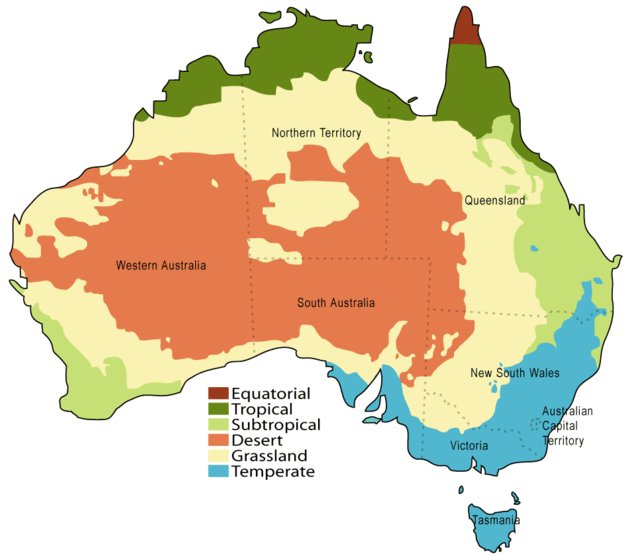
Today, coffee is grown mostly in the far eastern part of the country, corresponding to the light green subtropical regions on the map (click to enlarge). Two important areas are the Atherton Tablelands in northern Queensland outside of Cairns, with about 30 large growers on over 700 ha, and in northern New South Wales (NSW) just south of the Queensland border, where there are around 170 growers on 500 ha. If you have some sense from the vague atlas in your head that these areas are not high elevation, you’d be correct. Australian coffee is a rule breaker. Not only is the country outside the tropics, but coffee is typically grown at 200-400 meters, not infrequently lower, and rarely much above 900 meters.

Despite the low elevations, Australia grows arabica almost exclusively. The typica variety is grown, but also catuai, Mundo Novo (hybrid of bourbon and typica), and especially Kenyan varieties more suited to the drier Australian climate such as K7 and SL6. Coffee is processed every which-way: some wet processing, some semi-washed (pulped natural), some dry processed (full natural), and a unique method developed by the Mountain Top Coffee Company called “double pass.” This is where a full natural process bean (dried on the tree) is rehydrated before being pulped.

Australia currently produces 200 to 600 tons of coffee annually, half of which is exported, an amount so low it does not even get listed in the International Coffee Organization’s production statistics. It’s rarely seen in the United States, but there has been considerable investment in the specialty coffee industry in Australia along with increasing market presence.

Sustainability
I mentioned the advent of mechanized harvesting helping the Australian coffee industry turn the corner. Mechanical harvesting reduces or eliminates the need for workers to hand-pick beans, which can account for 50% of labor costs. It also requires coffee to be grown on flat land in rows in a monoculture. Thus, all the mechanized coffee in Australia (which is most of the commercial crop) is grown in full sun (an example here).

Mechanical harvesting also works best when the beans ripen simultaneously rather than over an extended period of time. The Australian climate, with pronounced dry seasons, lends itself to this as well. As in Brazil, coffee is irrigated after a dry period — sometimes water is deliberately withheld — in order to induce a bloom.

It’s often written that Australian coffee is grown without pesticides, as most of the usual coffee pests are not present Down Under. However, some have been recently introduced (e.g., green scale), and others are a problem as well (brown scale, avocado leaf-rollers, and mealy bugs). Insecticides are in fact used for these insects by some growers. Further, sun coffee usually needs a lot of fertilizer. I have had trouble finding any Australian coffee that is actually certified organic. The Australian Coffee Traders Association even notes, “There are many Australian brands which claim to be 100% organic but the certification is questionable.”

Habitat loss in Australian coffee-growing regions
According to the Australian Natural Resource Atlas (ANRA), 30-70% of subregional ecosystems are at risk in the coffee-growing areas of Australia, with higher instances in NSW. The major growing areas have different types of native vegetation. The major Queensland native type in the coffee-growing highlands is eucalyptus woodlands (pdf), and a good deal of it remains. The New South Wales north coast area is slightly different, with eucalyptus open forest (pdf), although far less native vegetation remains in this region. This loss of habitat contributes to the fact that the NSW coffee areas also have many threatened plant and animal species; it is considered one of the richest bioregions for birds in the country. Although traditionally the area with smaller coffee farms, it is the NSW region that is pushing for a major expansion in coffee production.

The map (click to enlarge) shows the change in breeding bird species reported during the last 20 years. The Queensland coffee area shows no significant change, but the NSW area has a significant decrease. The super-cool endemic Crested Tit-Shrike (Falcunculus frontatus, pictured) is considered an indicator species in both areas, as it is found in both characteristic types of eucalyptus forests. The Black-breasted Button-quail (Turnix melanogaster)
is an example of an endemic bird that is under severe threat from land-clearing due to agriculture; its range is restricted to coastal and near-coastal regions of southeastern Queensland and north-eastern NSW.

In contrast with researching how agriculture and coffee might impact biodiversity in some areas of the tropics, there is an abundance of information on habitats and threats in Australia (almost too much data to digest!), although nothing specific to coffee, given the relatively small footprint. You can read biodiversity assessments for the NSW North Coast and the Einasleigh Uplands of Queensland, which cover the important coffee-growing areas in Australia.

Bottom line
Overall, I was not left with a great feeling about compatibility of natural habitats and biodiversity and the coffee industry in Australia. Australian coffee is not common in the U.S., but the one bag we tried — from a leading Australian brand and a U.S. roaster with a very good reputation — was nothing special. In fact, nobody liked it. It was flat, and the most frequent adjectives were “ashy,” “tobacco,” and “coal.” Should we be able to taste a wider sampling, we will post some reviews, but I’m really not motivated or inclined to seek them out. There are plenty of great coffees from that part of the world that are grown more harmoniously with native ecosystems.

Kangaroo crossing sign by Casa de Queso; thanks for publishing under a Creative Commons license;
Climate map from Wikipedia; bird map from the Australian Natural Resource Atlas; Crested Tit-Shrike from the Australian Museum.