Coffee news and miscellany

The Coffee Conference

My husband and I attended the Coffee Conference at Miami University in Oxford, OH. I’ve now been to meetings that covered coffee from every angle: ecological (ornithological conferences), trade (SCAA annual meeting) and now the academic and scholarly. This event had a wide range of speakers on a variety of topics. The audience was also varied. As far as I could tell, there were perhaps 75 registered participants, including small roasters, academics from many disciplines (history, economics, literature), and representatives from producing countries and NGOs. Many Miami U. students also attended.

I will be following up with a more detailed post on what for me was the most interesting message I came away with: the fairly uniform negative attitudes toward certification agencies, ranging from distrust to disgust. Right now, I’ll just try to burnish my own legitimacy by doing some name dropping and showing you photos of famous coffee people.

Geoff Watts, left, of Intelligentsia gave a talk about Direct Trade relationships. In his discussion, Geoff noted that environmental sustainability has to be part of what is fostered and encouraged in direct relationships with farmers. He said that although a farm might be producing great coffee, if the land isn’t taken care of then it cannot continue to produce the same quality coffee over the years. Ecological integrity is part of the equation.

Geoff also offered a lot of the kind of insightful commentary on other talks, especially regarding Fair Trade, that only someone who has been intimately involved with producers can provide.

Ken Davids gave a great talk on interpreting the iconography and images of coffee through time. He grouped them by theme, such as the 1950s “Good Cuppa Joe” — coffee as every man’s luxury — or the “Safari in a Cup” adventure at exotic origins symbolism of the early specialty coffee movement. If  Ken hadn’t noted that his early background was as a novelist and college writing teacher, I would have guessed it by his presentation. It was creative, clever, and reminded me of the kind of deep interpretation of literature that I recall from my undergrad days. Very enjoyable — and I can’t imagine seeing a talk like this at any other kind of coffee conference.

At dinner, George Howell (center in front of laptop) showed off his new Extract MoJo software to Geoff Watts of Intelligentsia, David Waldman of Rojo’s Roastery in New Jersey, and yours truly.  Just listening to coffee guys talk about coffee was quite a learning experience. I was glad that I could keep up with a lot of it, and that I was able to make some contributions from a consumer and ecological viewpoint.

George and I, in fact, had several great talks about some of the pros, cons, and the future of various certifications, and he was very gracious about answering my questions. He gave a really lively presentation on the many points from crop to cup where quality can fall off. I was once again amazed that we ever end up with a decent cup of coffee, much less brilliantly delicious cups. And also again, I am sure that if more people know the many steps involved in bringing this crop to market, and the intense labor that goes into it, that they’d be willing to pay a lot more for it. As they should.

I asked Hacienda La Esmeralda’s Price Peterson some coffee-growing advice. I brought home some beans from Panama last winter, and have five little plants growing right now. A couple of them are looking a little anemic. Price was a bit stumped and was not sure exactly what to recommend. The guy can grow some of the most lauded and expensive coffee in the world, but didn’t know what to tell me about some mundane Caturra growing under lights at 193 meters in Michigan.

It was a really great conference, and all the other participants I talked to agreed. The small size allowed for a lot of interaction and discussion. Its interdisciplinary nature, and the varied backgrounds of participants made for a wide range of opinions as well more balance. There is a plan for a book derived from the proceedings which I look forward to. Kudos to the organizers, especially Robert Thurston. I’ll be incorporating more information from the conference into future posts, especially regarding the backlash against certifications.
Vietnam: Will replacing old coffee mean more deforestation?

A news report states that half of Vietnam’s coffee trees will have to be replaced in the next 5 to 10 years:

According to the Vietnam Coffee — Cocoa Association, the current 500,000ha of coffee comprises three kinds.

The first is coffee planted prior to 1988, totaling 86,400ha, accounting for 17.3% of the total area. These coffee trees are very old and need to be replaced.

The second is trees grown from 1988 to 1993 on 139,600ha, making up 27.9%. Many trees are growing old and their productivity is declining.

The third kind is trees planted after 1993, with around 274,000ha or 54.8%. These trees are yielding high productivity. In the next few years, Vietnam’s coffee output will depend on this section of coffee.

The article notes that despite warnings from experts and bank loan restrictions, farmers have planted more and more coffee, destroying forest to do so. This is almost all low-quality robusta sold to multinational roasters for grocery store blends.

Vietnamese agricultural authorities have tried to increase quality and discourage poor farming practices, without much success. This article again notes the recommendation to “put an end to the habit of  selling low-quality coffee in the international market” in an effort to move toward sustainability.

This can’t happen as long as the demand from multinationals — in other words, from consumers — remains high. Poor farmers will continue to clear land to plant more coffee. The resulting glut in supply 4 years down the road causes prices to plummet. Multinationals snap up the cheap beans. The cycle of poverty and deforestation continues.

Don’t contribute to this madness. Stop buying cheap, mass-produced coffee.

Update, May 2015: In Vietnam, “Deforestation, monocropping and intensive pesticide use that helped create the boom now leaves coffee farms more vulnerable to climate change,” reports an article in The Guardian outlining the disastrous effects of drought on coffee in the country.

Related posts:

Rainforest Alliance partners with the Coffee Quality Institute

A Problem
Judging by the enormous market shares of the Big Four corporate coffee multinationals, a lot of people don’t mind drinking lousy tasting coffee. However, plenty of people won’t do it. But more imporantly, if it doesn’t taste better, a lot of folks are not going to pay extra for certified coffee, and these coffees nearly always carry a premium. I’m not even willing to fork over more cash just for an eco-friendly label if the coffee is mediocre. If I can’t drink tasty, sustainable coffee, I just don’t drink it — although I’m as addicted as the next person. Unfortunately, I’m an exception.

Here’s the nasty truth: Even people who profess to caring about the environment tend to default to habitat-destroying, cheap coffee produced with tons of chemicals if there isn’t sufficient motivation to switch.  If they try a certified coffee and it doesn’t taste any better than the stuff they’ve been drinking, they don’t bother to buy it again.

A Partnership
That’s why it’s good news that the fastest growing and most familiar eco-labeller, Rainforest Alliance (RA), has inked an agreement with the non-profit Coffee Quality Institute (CQI). Among other things, this partnership will integrate CQI’s standardized coffee quality standards into RA’s tracking and traceability software and promote those standards within RA’s sustainable agriculture program. On a practical level, it means coffee buyers (importers, roasters, and consumers) will have some objective benchmark (the Q coffee score) indicating the quality of the coffee, as well as the flavor profile.

For the last five years, RA has had annual Cupping for Quality events and cupping competitions organized by CQI. These events and awards really help highlight the fact that sustainably-grown coffees can have amazing flavor, worthy of purchasing just for their taste alone. This partnership should really help buyer awareness and enhance interest in the quality of sustainable coffee.

A Conundrum
I’m not sure how RA will reconcile this commitment to quality — with an emphasis in this case on taste — with their partnerships with big corporate roasters like Kraft. Kraft’s Yuban coffee is 30% RA certified, and has been described by Ken Davids, one of the most respected coffee evaluators in the world, as “Cloyingly sweet, earthy/mildewed character with very distinct grassy notes.” This same review says that those who should drink Yuban are “on a budget with a commitment to organic growing principles that transcends the desire to drink decent coffee.” One could argue that the high-quality RA certified beans are being overwhelmed by the remaining 70%, mildewy, grassy, earthy, who-knows-where-they-come-from beans. But that certainly defeats the purpose. This odd dichotomy — fine work in environmentally and socially sustainable, high quality coffee, alongside helping corporate giants buff their green image by permitting their seal on products containing as little as 30% certified beans — produces not a small amount of cognitive dissonance among coffee lovers, myself included. This will eventually be the subject of its own post.

SCAA flavor wheel photo by AndyCiordia under a Creative Commons license.

"Best of" the SCAA conference

I have a lot to report on sustainability and certification issues from the SCAA conference, but it will be doled out over the coming weeks. Here, I thought I’d like to give some quick impressions of some of the most notable things we encountered.

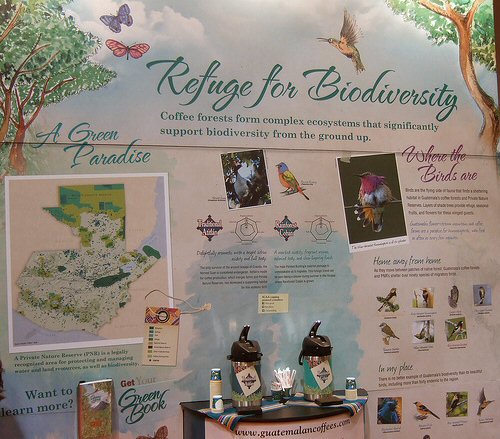
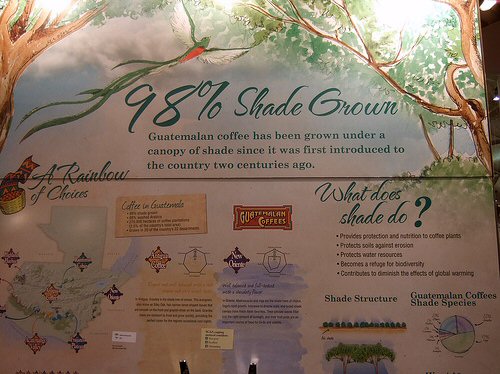
Best origin booth: Guatemala. Many origins had booths, most with green or brewed coffee samples and lots of literature. The biggest, most colorful, and most informative was, hands down, Guatemala’s. The display really focused on the fact that nearly all of their coffee is shade grown, and preserves biodiversity and birds. This information is duplicated in a terrific book available at the display called The Green Book. Here are a couple of the display panels.


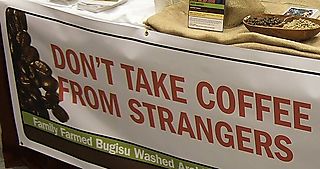
Best tag line: “Don’t take coffee from strangers” — Crop to Cup. That sums up a piece of advice every consumer should take to heart. Crop to Cup Coffee Company is a small coffee roaster with really direct relationships with farmers; on their web site you get very thorough information.

Coolest people I finally got to meet: Peter Giuliano and Kim Elena Bullock from Counter Culture Coffee. I’ve had so many good conversations and learned so much from the folks at CCC, it was a great pleasure to finally meet Peter and Kim in person.

Best coffee I tried: Mystery Coffee #103 from the Roaster’s Guild Coffee of the Year competition. Yesterday alone, I tried at least 20 coffees. And I don’t mean tasting and spitting out, I mean drinking. I can’t say I really recommend this strategy (I ended up both overtired and jittery), but it was interesting! The coffee I liked the best, as far as one I would like to drink daily, was #103 at the coffee of the year competition. Conference attendees got to sample and vote on the top ten finalists.

With all this coffee, perhaps this category deserves a couple of subcategories.

Best Coffee I Tasted Made on a Clover: Intelligentsia’s Organic Anjilanaka, Bolivia. There were three Clover coffee brewers at the show, and we tried coffees made on all of them.

Best espresso shot: Finca Vista Hermosa at the Barista Guild’s booth. Light roast and crazy citrus zing made this not your usual espresso.

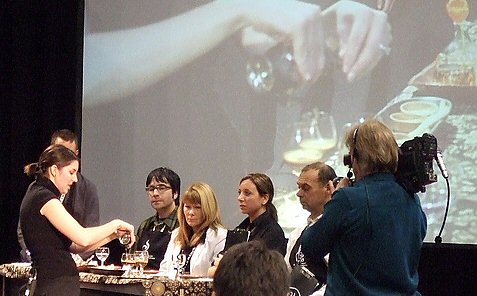
Most interesting thing that I didn’t think I’d care about: U.S. Barista Championships. Once you started watching baristas compete, it was kind of addictive. Beats watching a poker championship. This is Belle Batista of Aldo Coffee, the Mid-Atlantic Regional winner. She didn’t make the finals.

Best non-coffee product name: Two Leaves and a Bud. I used to be an avid tea drinker.

Best authentic character: Wicha Promyong, Doi Chaang Coffee (which we reviewed here). After posing for the shot, he whipped out a nice business card and spoke perfect English!

There will be more forthcoming on what I learned in the sustainability and agroecology lectures, additional sustainability and other awards, and more. It has been a great experience.