Coffee and the environment

EPA bans pesticide carbofuran on coffee imports

In May, the U.S. Environmental Protection Agency (EPA) announced its decision to ban any residue of the pesticide carbofuran on food. The rule becomes effective December 31, 2009.

Carbofuran (sold under the name Furadan) causes neurological damage in humans, is extremely deadly to birds and fish, and is highly toxic through ingestion and inhalation. It is used on numerous crops, including coffee. It tends to be used on various types of mealy bugs that infest the roots of coffee plants, coffee root nematodes, and on the coffee leaf miner (Leucoptera coffeella). Coffee leaf miners have natural enemies in Latin America, so carbofuran is used against them mainly in Africa.

Earlier in the process of reviewing carbofuran uses, the EPA rules allowed the importation of rice, coffee, bananas, and sugarcane with carbofuran residues. This final decision reverses that, and countries exporting coffee into the U.S. must stop using carbofuran on their crops. While little pesticide residue remains on green or roasted coffee, the direct threats to coffee workers, wildlife, and the millions of migratory and resident birds from the application of carbofuran to coffee make its use dangerous.

The Food and Drug Administration is responsible for enforcing EPA regulations on food imports. Carbofuran residue on food has been banned in the EU for some time, so testing protocols are established. Exporting countries, and coffee exporters and importers, often engage testing and certification labs to insure there are no violations that could lead to rejected shipments or, worse, a ban on imports.

FMC Corporation, the Pennsylvania-based company that manufactures Furadan, recently announced that they are challenging the EPA’s decision on some technical and administrative grounds. They have contended that the chemical is safe, despite well-documented impacts on birds, lions, hippos, other wildlife, and humans. Reports are still surfacing about illegal use of Furadan by poachers to kill vultures (which attract attention to illegal kills) and small birds which are then sold for human consumption.

Improper pesticide usage (whether unwitting or purposeful), export of domestically banned pesticides to other countries, and the fact that we are just beginning to understand the dangers of cumulative and synergistic effects of multiple pesticides in the environment to wildlife and humans, all argue for support of non-chemical-based pest management. And that includes growing coffee under diverse shade with its biodiversity-based pest control benefits.

Update: In 2010, courts ruled the EPA had to once again establish residue tolerances for imported foods, including coffee.
The water footprint of coffee

The water footprint of coffee and tea consumption in the Netherlands. 2007. Chapagain, A.K., and A. Y. Hoekstra. Ecological Economics 64:109-118.

This is not a newly published paper, but I found it well worth summarizing here.

“Footprint” evaluations — ecological, carbon, or water — determine the amount of a resource needed to produce a unit of a good. This paper calculated the water footprints per ton and per cup of tea and coffee, as well as “virtual” water imports into the Netherlands for each beverage. I’ll only summarize the water footprint of coffee here, but the paper can be downloaded from the publications list at the Water Footprint Network.

The authors measured coffee crop water requirements in different parts of the world. Some regions must irrigate (e.g., Brazil) while others rely on rainfall. Water used in processing, which also varies by region, was then factored in. Much of the world’s coffee (especially arabica) is wet processed, requiring a water source such as a river or groundwater to ferment and wash the coffee prior to drying the beans.

The calculations also took into account the shrinking weight of the product throughout processing — e.g., fresh cherries to pulped cherries to hulled beans, etc.– in order to keep the metric (cubic meters of water per ton of coffee) consistent.

Because of all the variability, from annual crop water requirements (they used FAO estimates) to the number of grams of ground or instant coffee used to make a weak or strong cup, this whole operation is somewhat of an inexact science. However, the authors appeared meticulous in their choices and inclusiveness, and the results seem to at least give us a relative picture between regions and methods, if not numbers that are actually well in the ballpark.

As it turns out, there was little difference whether coffee was wet or dry processed. The water used in wet processing made up only 0.34% of water used to grow the coffee. The summary tables provided figures for wet processing only.

The main results summarized the cubic meters of water used per ton of coffee (for each step from fresh cherry to roasted) for 25 countries.  The two countries with the highest totals were both robusta-producing nations: Togo (49341 m3/ton) and Ghana (47554). In fact, six of the top ten countries grew robusta either exclusively or in addition to arabica. The highest arabica-only country was Panama at 37660 m3/ton.

The average (weighted for world production) “virtual water content” was calculated at 20987 m3/ton. Lowest countries were Vietnam at 6054 and the U.S. (Hawaii and Puerto Rico, 9061). Other countries that grow primarily arabica which were ranked below-average were Ethiopia, Guatemala, Costa Rica, El Salvador, Bolivia, and Colombia.

Finally, the authors calculated that the “average” cup of coffee required around 140 liters of water; several variations were provided. The authors also estimated that if the price of coffee included the economic value of rainwater, it would increase about 20 cents per kilo. This cost increase does not include surface or groundwater used for processing or irrigation water, nor any environmental costs due to erosion or water pollution.

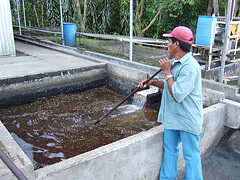
Coffee flotation in Chiriqui, Panama; photo by Darrin O’Brien, used with permission.

Chapagain, A., & Hoekstra, A. (2007). The water footprint of coffee and tea consumption in the Netherlands Ecological Economics, 64 (1), 109-118 DOI: 10.1016/j.ecolecon.2007.02.022

Climate change and coffee pests

Jaramillo, J., A. Chabi-Olaye, C. Kamonjo, A. Jaramillo, F. E. Vega, H.-M. Poehling, and C. Borgemeister 2009. Thermal tolerance of the coffee berry borer Hypothenemus hampei: Predictions of climate change impact on a tropical insect pest. PLoS ONE 4(8): e6487. doi:10.1371/journal.pone.0006487.

A paper just published in the journal PLoS ONE explores the impact of climate change on the life history and distribution of the world’s worst coffee pest, a minute beetle called the coffee berry borer (CBB), Hypothenemus hampei.

The study modeled potential changes in mortality, number of generations per year, and developmental rate, among other traits, under eight different temperature regimes. The model indicated that CBB successfully develop at 20-30°C, and the intrinsic rate of increase (rate at which a CBB population increases in size) is highest, and the population doubling time lowest, at about 25-26°C (around 77°F).

As mean seasonal temperatures in coffee-growing countries move toward the optimum development temperatures for CBB, these areas become more vulnerable to increasing pest pressure from CBB. This could be especially problematic in Colombia, where multiple flowering of coffee plants means nearly year-round availability of coffee cherries.

The predicted optimal temperature for CBB increase is higher than that which is best for arabica coffee, which prefers a temperature range of 18-21°C (above which yields are reduced), while robusta coffee thrives at temperatures several degrees higher. Climate change is already predicted to reduce area suitable for coffee production. This is probably an even more pressing threat to coffee than changing pest dynamics.

As far as mitigation of the effects of higher temperatures on CBB and coffee production in general, the authors state:

A proven strategy to alleviate the potentially negative effects of climate, especially warmer temperatures, on coffee production is the introduction of shade trees in coffee plantations.

They point out that shade trees can lower temperatures around coffee by up to 4°C at low altitudes (<700 m) and 2°C higher up (>1100 m), that shaded farms harbor more CBB enemies which can provide bio-control of these pests, and that coffee cherry weight and quality is higher when grown under shade, thus offsetting lower yields.

A number of the authors are associated with the International Center of Insect Physiology and Ecology.

Update, March 2011: James Hoffman did an overview of the CBB with some links to climate change research.
Update, September 2011: Further follow-up research by the authors is summarized here.

Photo of a female CBB entering an unripe coffee cherry, part of Figure 1 from the PLoS paper, photo by Gonzalo Hoyos of CENICAFE. Don’t discount small enemies.

Jaramillo, J., Chabi-Olaye, A., Kamonjo, C., Jaramillo, A., Vega, F., Poehling, H., & Borgemeister, C. (2009). Thermal Tolerance of the Coffee Berry Borer Hypothenemus hampei: Predictions of Climate Change Impact on a Tropical Insect Pest PLoS ONE, 4 (8) DOI: 10.1371/journal.pone.0006487

Carbon credits with coffee: a how-to guide

Last spring I posted about a lecture I attended at the SCAA conference on coffee and climate change. I focused on the climate module that Rainforest Alliance is adding to its certification. Part of this initiative was to create a methodology for measuring and verifying carbon stored on coffee farms and a mechanism for producers to receive payments for carbon credits.

Rainforest Alliance partnered with the International Finance Corporation (IFC), part of the World Bank Group; ECOM Agroindustrial Corp., the world’s third largest coffee trading company; and coffee farmers in Mexico and Nicaragua to develop and test these methodologies. They produced a document, “Guidance on coffee carbon project development using the simplified agroforestry methodology.”

The guide is in six parts, and I’ll paraphrase the introduction to outline what each is about:

  1. A general overview of forest and agroforest carbon projects to help the reader understand what a ”project” is and what it is not; what is needed to set a project apart from business as usual practice; and why such projects are important and have value.
  2. Preparation and design of a project, requirements for a Project Design Document which identifies and explains each of the project’s key activities, elements, and important data.
  3. Description of risks to carbon projects’ success and how to assess and lower or manage them.
  4. Explains the processes of independent third party evaluation.
  5. An overview of the financial and contractual arrangements associated with carbon projects.
  6. Glossary and resources.

It’s a pretty straight-forward and non-technical document, and if you are interested I encourage you to download it and give it a look. One of my first thoughts was that this is still well out of the realm of many very small producers who might be only marginally literate. Like all certification schemes, we (the consuming “North”) are imposing a lot of rules and erecting a lot of barriers on farmers to in essence prove they are managing their land in an environmentally-responsible manner so that they might be rewarded for it. I don’t think the average Juan Valdez is going to sit down by the light of his wood-burning stove with this guide and be on his way to selling carbon credits. It will require support and partnership, which in turn requires funding, and ultimately boils down to the need for consumers to be willing to pay more for a sustainably-grown cup of coffee. Which I’ve been saying all along.

Photo by DelosJ under a Creative Commons License.