Coffee and the environment

Uganda’s wild coffee

The Agricultural Biodiversity Weblog beat me to summarizing a recent peer-reviewed paper, Kibale Forest Wild Coffee: Challenges to market-based conservation in Africa (abstract). The paper outlined the (unsuccessful) attempt at creating a market for products based on wild robusta coffee growing in western Uganda’s Kibale National Park.

This nearly 800-sq-km park in the Rift Valley on the border with Congo protects lowland and mid-elevation evergreen and semi-deciduous rainforest. Areas surrounding the park have high human populations, many who rely on subsistence agriculture of mostly plantain, sweet potatoes, and sugar cane. The regional deforestation, save for the park, is evident in the satellite image.

Kibale is very biodiverse, with 11 species of primates, 325 species of birds, and at least 140 species of butterflies. This forested area was highly exploited in the 1970s. Agricultural encroachment destroyed roughly 17% of the area. When Kibale National Park was officially created in 1993, use of the park’s resources by local people were restricted, causing conflicts.

Two species of coffee grow wild in many parts of the park. Coffea eugenioides and C. canephora [1]. The former is widespread but not abundant, while the latter (known as robusta coffee and used commercially in many inexpensive grocery store coffee blends) is less ubiquitous but very abundant where it grows, covering 7800 ha in the park.

The goal of the project was to manage sustainable harvesting of the coffee and provide income for local communities. Ultimately, the harvested robusta would be blended with Ugandan certified organic arabica coffee and, through private sector partnerships, be marketed as Uganda or Kibale Wild Forest Coffee. Appealing enough. The proposed ratio was 10% Kibale robusta to 90% Ugandan organic arabica. This seems a bit low, in my opinion, to really capture the “authenticity” of the product, but was the best deemed feasible.

Things fell apart when the quality of the arabica was not up to snuff, and the harvest yield of the Kibale beans would have resulted in a blend that contained less than 2% wild robusta. That seemed less viable, so other coffee-derived products were considered, but funding ran out and without sales revenue to keep it going, the project withered. You can read more about other factors in the failure in the summary at the Agricultural Biodiversity Weblog.

The idea was a good one, and the concept of providing local communities with opportunities for sustainable use of the land, including agriculture, in the buffer zones of protected areas is not novel. It’s a typical management strategy in the biosphere reserves of Mexico. An example is the organic, shade-grown coffee produced in the buffer zone of the El Triunfo Biosphere Reserve in Chiapas, which by and large been a great success. While it was not without problems or detractors, a lot of this success can be attributed to the commitment in the region by Starbucks, which uses the coffee for its organic shade-grown Mexico variety. I wrote about the project and coffee in this post.

Thus, big buy-in from major players might be needed to truly get a project like this off the ground, and I think the investment is worth it for local people and the environment.

[1] Kasenene, J. 2002. Forest association and phenology of wild coffee in Kibale National Park, Uganda. African Jrl. Ecology 36:241-250.

 

Coffee and climate change: updated resources

Here are additional resources related to coffee and climate change, including how climate change may impact coffee production, how growing coffee under shade can buffer against climate change, and how shade coffee and habitat preservation on coffee farms can contribute to carbon sequestration.


Research: Shade coffee conserves bee diversity

Impacts of coffee agroforestry management on tropical bee communities. 2010. Jha, S. and J. H. Vandermeer. Biological Conservation 143:1423-1431.

Most people are aware of the importance of bees and other pollinators to functioning ecosystems and agriculture. This study took place in Sococusco, Chiapas, Mexico, and looked at what habitat variables were most important to the abundance and diversity of insect pollinators (bees, in this case). It looked at a number of variables — number of tree species, how many were in flower, canopy cover, etc. — and how important they were at different scales (100 m, 500 m, and 1 km). The study took place in small forest fragments and many small shade coffee farms (13 to 70% shade).

Researchers trapped 46 different bee species in these sites, including both social and solitary bees, and cavity-, wood-, and ground-nesting species. They found that habitat management on farms was more predictive of bee abundance than the forest cover in the surrounding landscape at all the three scales. On these farms, tree diversity — the number of tree species — was the best predictor of bee abundance and diversity. The number of tree species flowering and canopy cover were next.

These results are different than many other similar studies. Often, biodiversity in agricultural areas is dependent on the quality and extent of the surrounding landscape, which acts as a source and provides resources for fauna found on farms. Two factors could be influencing the results of the current study. First, this shade coffee region has farms with high structural diversity, and
low regional forest cover, so resources may be more available on farms
than in forests. Second, bee communities in the study area are small-bodied and thus have shorter foraging ranges. They may react more strongly to local resources.

This study indicates that coffee farmers in Chiapas — and in similar landscapes — can attract pollinators and bolster biodiversity by using diverse shade tree species, allowing trees to mature, creating
light gaps, and creating patches of flowering herbaceous plants. Farmers will also benefit from the ecosystem services provided by the bees which will pollinate supplementary crops on the farm in addition to promoting cross-pollination of their coffee (which improves yield).

The authors conclude that coffee farmers don’t need to rely just on the presence of landscape-level forests to provide pollinator resources. They note, “…most coffee cultivators can only implement land-use changes within their own farms… Our study indicates that local habitat factors, managed within agroforestry systems, can have strong impacts on local bee abundance and diversity.”

Augochlora bee, one of the common genera found in this study, by graftedno1 under a Creative Commons license.

Jha, S., & Vandermeer, J. (2010). Impacts of coffee agroforestry management on tropical bee communities Biological Conservation, 143 (6), 1423-1431 DOI: 10.1016/j.biocon.2010.03.017

New coffee species from Madagascar

Earlier this year, the news of the “discovery” of a caffeine-free species of coffee from the Cameroon created a bit of a stir. This species was actually first collected in 1983, but remained unstudied and not described to science until 2008 [1], at which point it made headlines when it made a 2009 top ten list of new species. I wrote about it here.

Similiarly, the Royal Botanical Gardens at Kew just announced some recent achievements, among which was the “discovery” of new species in the genus Coffea from Madagascar. Again, these species were not necessarily just discovered but were described in a paper published in 2008[2].  Coffea ambongenis, for example, was first collected in 1841 but not described, was rediscovered in 1999, and is now published as a new species.

There are 103 described species of Coffea in the world, and the Madagascar species are part of the Coffea subgenus Baracoffea, which now stands at 9 species. In addition to species in this subgenus being deciduous rather than evergreen like all other coffee species, some have unusual morphological characteristics. Here is a very brief run-down.

  • C. ambongensis and C. boinensi: Very large fruit, in C. ambongensis often larger than 2.5 cm long. C. boinensi was first collected in 1994.
  • C. bissetiae: Underside of leaves and fruit hairy.
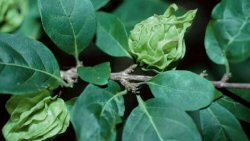
  • C. labatii and C. pterocarpa: Unusual winged fruit. C. labatii, first collected in 1992, has 12 to 18 “wings” per fruit. C. pterocarpa (first collected in 1954) has 16 to 20 wings, and is pictured at right in a photo by Aaron Davis from Kew; an informative accompanying article is here. One theory as to the function of the wings is that it helps the fruit float, and these species occur in regularly-flooded karst limestone habitats.
  • C. namorokensis: First collected in 2000, but not identified as a new species. Also has hairy fruit and leaves.

None of the new species have been tried as a beverage, and it is unlikely they will ever be commercialized.  All are rare: near-threatened to critically endangered, and Madagascar forests are among the most exploited and threatened in the world today.

[1] Stoffelen, P., M. Noirot, E. Couturon & F. Anthony. 2008. A new caffeine-free coffee from Cameroon. Botanical Journal of the Linnean Society 158: 67-72.

[2] Davis, A. P, & F. Rakotonasolo. 2008. A taxonomic revision of the baracoffea alliance: nine remarkable Coffea species from western Madagascar.
Botanical Journal of the Linnean Society, 158 (3), 355-390 DOI: 10.1111/j.1095-8339.2008.00936.x