Coffee and the environment

Pesticides used on coffee farms, part 2: Common coffee pests

Coffee is equipped with an excellent defense against herbivory: caffeine. Caffeine is one of many alkaloids that evolved in various plants to prevent them from being eaten by insects.  Evolution doesn’t stand still, however, and some insects have fought back. Coffee is attacked by several pests and diseases. Here are the most important, the ones that are most frequently combated with pesticides.

Coffee cherry/berry borer or “Broca” (Hypothenemus hampei). Native to Central Africa, but now found in many coffee-producing nations. The female of this tiny beetle (shown here on a green coffee bean) bores into the coffee cherry and lays about 15 eggs; the larvae feed on the developing bean. Usually, the cherry drops from the tree. The best defense is making sure there are no unpicked beans left on the trees or laying on the ground. Because they spend much of their life inside the cherry, controlling borers with insecticides can be difficult or downright ineffective.

Coffee leaf miner or “bicho mineiro” (Leucoptera coffeella). The leaf damage from the larvae of this small moth means less leaf surface is available for photosynthesis, resulting in stunted plants and reduction in yield. Native to Africa, but now found in many coffee-producing nations. This insect has developed resistance to insecticides in some areas.

Other insect pests include root nematodes (Meloidogyne spp.), green scale (Coccus viridis), and twig borers (Xylosandrus compactus).

Although not an insect, the next pathogen also prompts chemical onslaughts:

Coffee leaf rust (Hemileia vastatrix). A fungus that causes yellow spots on leaves, reduced photosynthetic ability, and eventually leaf drop. This causes a lack of nutrients going to growing shoots, and so can impact future growth of the plant. Spores require rain to germinate (high humidity is not adequate). Disease spreads more quickly in dense plantings and is less severe in shaded plantings, as the spores require a certain light intensity to germinate. Temperatures at farms at higher elevations are often too cool for the fungus.  Native to Africa, but now found in many coffee-producing nations. Some coffee cultivars have resistance, notably the catimor variety, and also catuai and mundo novo.

Next in this series: Common pesticides used on coffee farms.

Coffee berry borer on bean photo by P. Greb.
Coffee growing and climate change

Coffee (Coffea sp.) requires quite specific growing conditions.  It grows in subtropical regions that have distinct wet and dry seasons.  Although plants can live and produce fruit for decades, drought or heat in summer can diminish production and quality.  And while coffee requires a dry period in the spring, heavy rains in this season can disrupt flowering.

This sensitivity to climatic variables means that global climate change is likely to have profound impacts on coffee growing and production.  An upcoming article in the journal Climatic Change (1) modeled what could happen to coffee production in Veracruz, Mexico if observed trends in climate change continue and coffee prices remain steady.  The report concludes that coffee production will not be economically viable in Veracruz by 2020 due to lowered yields and many current areas becoming unsuitable for coffee growing.

Although there is some work being done on breeding coffee varieties that are more heat-resistant, it will do little to prevent losses due to the climatic instability brought on by global warming (droughts and floods, unusual cold spells) or the pests whose ranges will also change as temperatures rise.

Farmers will be left with few choices.  Areas at higher latitudes (which although too cool now to grow coffee will become warmer) could be used. However, most small holders do not have the money or credit to buy property, even if it is available to purchase; most land is already under ownership that is passed down in families.  If land upslope is turned into coffee farms, it means some conversion and clearing of existing forest, and the old coffee farms will be converted to other crops, none of which is likely to be as environmentally friendly as shade coffee.  This means a loss of biodiversity, and the deforestation of new and old coffee farms will exacerbate and accelerate warming trends, since trees help sequester carbon and buffer temperature changes.

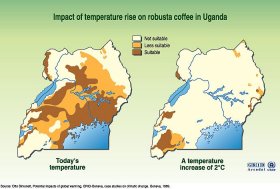
We all have a great deal at stake as the planet warms. Unfortunately, the poor in developing countries, such as coffee growing nations, often bear a large burden.  Even growers of more heat-tolerant lowland robusta coffee, where it is indigenous, stand to lose their livelihoods, as this graphic illustrates.

The authors of the Veracruz report recommend supporting farmers to move into specialty coffee to help to provide some financial security. Purchasing shade coffee and providing incentive for farmers to plant trees rather than cut them down will also help.  As the Fresh Cup article notes,

In the past several decades, roughly half of the world’s coffee plantations have cut down their trees, or cut down forest to plant unshaded coffee. This decreases the ability of vegetation to counteract global warming by absorbing carbon dioxide, and it also raises local temperature.

All the more reason to stay away from corporate technified sun coffee, and enjoy the superior taste of environmentally-friendly coffee.  I’ll be following the research on climate change and coffee, and report further news and suggestions.

(1) Gay, C., F. Estrada, C. Conde, H. Eakin, and l. Villers. 2006. Potential impacts of climate change on agriculture: case study of coffee production in Veracruz, Mexico.  Climate Change 79:259-288.

Cerulean Warblers and shade coffee

The Cerulean Warbler (Dendroica cerulea) is a bird in trouble. It breeds in the eastern U.S. and winters in South America, and populations have been on the slide in recent decades — faster than any other eastern warbler.  It is on the Audubon WatchList and is listed as vulnerable by BirdLife International.  Primary threats are loss of habitat both on the breeding grounds as well as their wintering areas in the tropics, where an estimated 64% of its habitat has vanished.  For more information on on the importance of coffee fincas to Cerulean Warblers and other migrants, read the excellent article from the National Wildlife Federation  called “The Case of the Disappearing Warbler.”

The American Bird Conservancy (ABC) is partnering with the American Birding Association to help coffee growers preserve critical wintering habitat around the new 500-acre Cerulean Warbler Bird Reserve in the Rio ChucurÁ­ basin of Santander, Colombia (click map to enlarge for range of the warbler and location of reserve).

The area, one of the last natural remnant forest fragments in the region, shelters high populations of wintering Cerulean Warblers. The reserve also contains three Critically Endangered bird species: the Gorgeted Wood-Quail, Colombian Mountain Grackle, and Chestnut-bellied Hummingbird, along with many other threatened and endemic birds. A new species of bird, a very colorful brush-finch (below) was recently discovered just outside the reserve, which emphasizes the importance of protecting the area from deforestation due to growing technified coffee.

I dug around for farms that were located in the Santander area. Beans from this region are usually marketed under the name Bucaramanga after the capital city of the department. Coffees from this area are said to be milder and fuller-bodied than other Colombians, and remind some people of Sumatran coffees.

The well-known finca Mesa de Los Santos is located here, which produces organic shade coffee certified by both SMBC and RA.  Paramito is another farm in the area, RA certified, that was the only farm from Santander to place in the 2006 Colombia Cup of Excellence competition.

Another conservation project in a coffee-growing area, the El Dorado Nature Reserve on the northwest slope of the Sierra Nevada de Santa Marta, was preserved by ABC, Conservation International, and FundaciÁ³n ProAves. This summer, two critically endangered frogs were rediscovered there.

In a country where 60% to 70% of the coffee is technified “sun” coffee, it is important to support both the conservation of areas as reserves, and to look for coffee grown in small holdings that preserve biodiversity.   I will be on the lookout for farms that will be working with these two bird organizations on the habitat preservation project.

~~

Cerulean Warbler portrait on a notecard by John Sill, available at Acorn Designs.  Brush-Finch photo from ProAves.

Is promoting shade-grown coffee really a good conservation strategy?

In 2003, a number of important researchers debated the conservation value of promoting shade-grown coffee in the pages of the journal Conservation Biology.

First Rappole et al. [1] wrote that if the result of promoting shade coffee resulted in the conversion of sun coffee to shade coffee, they would have no qualms about the whole shade coffee campaign.  However, they felt that the more likely outcome of the added incentives and profit of an increased demand for shade coffee would be

  • that farmers considering converting from shade to sun coffee would decide not to do so (a good thing),
  • and/or more primary forest would be converted to coffee (a bad thing), albeit shade coffee (still not as good as natural forest).

This conversion of primary forest to coffee would most likely occur, the authors wrote, on slopes that are too steep to grow sun coffee, representing new exploitation of the land. They were especially concerned with higher elevation pine-oak forests, important endangered tropical habitats.  Coffee is one of the only crops that can be grown in these forests, and providing financial incentives through shade coffee promotion might convince farmers to begin cultivation in these areas.  Removal of the oak layer, which presumably would occur even in shade coffee management, would have profound impacts on the endangered Golden-cheeked Warbler, a migrant that depends on the oaks in the winter.

In general, the authors felt that endorsing shade coffee plantations as refuges of biodiversity was a “lowering of the bar” in terms of conservation goals.  They argued that diversity only measures numbers of species, which does not tell us anything about how ecologically equivalent two communities may be.  A shade coffee plantation may have 50 open-country species whereas the primary forest may also have 50 species, but they would be forest specialists which would be lost when the area was converted to coffee.  Finally, the authors were concerned that the consumer might not realize there are many variations in the way shade coffee is grown, and not all are good for biodiversity.

Philpott and Dietsch [2] replied, making the point loss of species richness in highly shaded coffee farms is minimal compared to the huge losses from other forms of agriculture. They argue that financial incentives that prevent farmers from converting their farms to sun coffee, cattle pasture, or illegal crops is beneficial.

Primarily, the authors argue for rigorous shade-certification programs to prevent premiums from going to farms that do not truly preserve biodiversity, and strong linkages between organic, shade-grown, and Fair Trade certification.  Further, to discourage conversion of primary forest to coffee, certification could be withheld for new farms, for a specified period, so that farmers are not rewarded for clearing forest.

The original authors [3] came back to say that there were a lot of “ifs” in Philpott and Deitsch’s vision of how shade coffee can advance conservation goals.  They felt certification programs had a long way to go, were uncoordinated, and that the promotion of shade coffee was outstripping certification efforts.  They end by saying that they feel the conservation value of coffee is hypothetical, dependent upon assumptions, especially considering certification, that have yet to be realized.

All the points in the papers are valid.  The lesson to consumers is that we have to be diligent in our choices by purchasing certified Fair Trade, organic, truly shade grown coffee.  Certainly, if we are going to purchase and drink coffee, we won’t be doing the environment any good by buying cheap coffee from a corporate giant that pays little to farmers and buys most of its coffee from sun plantations.

The primary goal of this blog is to continue to keep up with current research on biodiversity in coffee plantations, and current issues and debates on the conservation value of coffee to help consumers make informed choices.

[1] Rappole, J. H., D. I. King, and J. H. Vega Rivera.  2003.  Coffee and conservation.  Conservation Biology 17:334-336.

[2] Philpott, S. M. and T. Dietsch.  2003.  Coffee and conservation: a global context and the value of farmer involvement.  Conservation Biology 17:1844-1846.

[3] Rappole, J. H., D. I. King, and J. H. Vega Rivera.  2003.  Coffee and conservation III: reply to Philpott and Dietsch. Conservation Biology 17: 1847-1849.