
Climate change

Rainforest Alliance introduces carbon module

In my post “Coffee farms and carbon sequestration,” I discussed the potential of carbon credits in helping coffee farmers earn extra income, and provided some statistics and references on carbon sequestration on coffee farms in and other tropical agroforestry systems.

As it turns out, Rainforest Alliance (RA) will be adding a carbon module to their certification for farms (coffee, and presumably other crops they certify). This announcement was first made in May at their Sustainable Coffee Breakfast at the SCAA annual conference in Minneapolis. The details are not final, but here is what RA’s Gretchen Ruethling explained to me regarding RA’s past experience and future plans:

We are working with other organizations to help farmers get paid for providing environmental services such as storing carbon and protecting watersheds and biodiversity. The Rainforest Alliance is a registered verifier for leading carbon offset programs including the Climate, Community & Biodiversity Alliance and the Chicago Climate Exchange. We have verified carbon offsets on coffee farms through projects organized by Plan Vivo in Mexico. We verified an ambitious project in Aceh, Indonesia developed by Fauna & Flora International that will reduce deforestation on 750,000 hectares of rainforest. We verified a reforestation project in the highly endangered Atlantic Forest of Brazil as a carbon offset for Jacques Vabre, a coffee brand in France. (That project is managed by a coalition of Brazilian NGOs and led by the Nature Conservancy.)

We are working to offer more incentives to coffee farmers to encourage them to plant more trees. One exciting idea is developing a system that would allow coffee companies to buy carbon from farmers along with their coffee beans — through the existing supply chains. Companies could pay a small carbon premium. In order for this to work, we need a simple, low-cost yet rigorous and highly credible method to estimate the carbon on a coffee farm and verify that it remains year after year. This could be done by auditing the carbon as part of the annual farm inspection by members of the Sustainable Agriculture Network.

I’m thrilled RA is pursuing this concept — it’s a win-win-win situation for the farmer, biodiversity, and the planet.
Coffee farms and carbon sequestration

In my post, “Why certifying shade coffee is so complex,” I ended with a comment regarding the upside-down nature of shade (or organic) certification. That is, the burden of certification costs are on the producers who are doing the right thing, rather than on the producers who are damaging the environment. Small producers, who are more likely to preserve forests and grow coffee under diverse shade (both of which enhance biodiversity) and are less likely to use chemicals, are the least able to afford certification.

I’ve been ruminating about this ever since, and wondered if some sort of “cap and trade” system might be helpful. What I had in mind were “credits” for forest or habitat preservation and enhancement small eco-friendly farms could “sell” to naughty sun coffee growers. This was inspired by a similar system: carbon credits. So while I let this idea simmer, it’s worthwhile to briefly discuss the role of carbon credits themselves, and their potential to generate income for farmers practicing sustainable agriculture, including shade coffee.

Quick primer on terrestrial carbon sequestration
Trees (and other plants) sequester carbon by removing it from the atmosphere through photosynthesis and incorporating into their tissues. Existing forests are carbon sinks (or ”carbon storage units”) and contain over half of the terrestrial carbon in the world. Carbon remains stored in plant tissues until released, in this case most often by burning and decomposition.  Agroforestry systems, including shade coffee farms, that preserve forest are therefore acting as carbon sinks.

Reforestation also contributes to the sequestration of carbon, although the rate in which carbon is taken up and stored by plants varies among species, as well as where they are grown and if and how they are managed. This means that sun coffee farms converted to shade in which the appropriate tree species are planted and managed have the potential to effectively sequester carbon.

Carbon is also stored in leaf litter and other organic matter in the soil. Sustainable coffee agrosystems frequently rely on fallen leaves from their shade trees as well as the application of coffee skins and other organic matter for soil moisture retention and fertilization, providing another means in which these farms can contribute to carbon sequestration.

How much carbon can coffee farms store?
Although measuring carbon storage is difficult due to the multiple variables involved (even plots in the same region with similar tree species composition can vary in their storage capacity depending on microclimate, soil types, etc.), recent research has revealed some encouraging facts. A few examples:

  • In the tropics, potential carbon sequestration rates for smallholder, sustainable agroforestry systems range from 1.5 to 3.5 megagrams (tonnes) per hectare per year, or 2.1 billion megagrams annually worldwide.
  • It has been estimated that each hectare of sustainable agroforestry in the tropics could potentially offset 5 to 20 ha of deforestation.
  • Models have estimated a 5-year-old coffee farm shaded with two common Latin American tree species (Erythrina poeppigiana and Cordia alliodora) could sequester 5.3 megagrams per hectare.
  • Soil carbon stocks in shade coffee were 60% of that expected in primary forest in Sumatra, versus 45% for sun coffee.
  • In El Salvador, carbon sequestration values for various types of shade coffee management were estimated (in tons per ha per year): 174 for rustic shade to 77 for shade monoculture.
  • A study of carbon stocks in Costa Rican coffee farms calculated aerial (above ground) carbon stocks ranging from 11 megagrams per ha for simple shade (one heavily pruned shade species) to nearly 32 for diverse shade.
  • Using these figures, a farmer with 10 ha in diversified shade coffee could receive a one-time $3000 payment (based on previously carbon transactions for the country), as well as a reduction in expenses from chemical inputs and have timber and fruit for additional income. The payment is over three times greater than would be obtained for the carbon stocks in simple shade coffee systems.

The non-profit TechnoServe is exploring the use of carbon credit trading for promoting sustainable agroforestry, using a Guatemalan coffee cooperative (more here). Small holders in Oaxaca and Chiapas, Mexico, are gaining access to carbon credit funds to pay for sustainable agroforestry there, where a great deal of coffee is grown (more here).

It appears sustainable coffee agroforestry can play a role in helping to mitigate global climate change through carbon sequestration, and in the process also provide additional income and further incentive to growing shade coffee. I have a feeling we’ll be hearing much more about this in the future.

More reading, including sources for the figures above:

  • Smallholder agroforestry projects: Potential for carbon sequestration and poverty alleviation. O. J. Cacho, G. R. Marshall, and M. Milne. 2003.  ESA Working Paper No. 03-06. Agricultural and Development Economics Division, The Food and Agriculture Organizationof the United Nations.
  • Carbon sequestration in tropical and temperate agroforestry systems: a review with examples from Costa Rica and southern Canada. M. Oelbermann, R. P. Voroney, and A. M. Gordon. 2004. Agriculture, Ecosystems and Environment 104: 359-377.
  • Carbon sequestration: An underexploited environmental benefit of agroforestry systems. F. Montagnini and P. K. R. Nair. 2004. Agroforestry Systems 61:281-295.
  • Carbon stock assessment for a forest-to-coffee conversion landscape in Sumber-Jaya (Lampung, Indonesia): from allometric equations to land use change analysis. M. van Noordwijk, S. Rahayu, K. Hairiah, Y. C. Wulan, A. Farida, and. B. Verbist. 2002. Science in China (PDF here).
  • Carbon sequestration in coffee agroforestry plantations of Central America. 21st International Conference on Coffee Science, 2006.
  • Sustainability in the coffee sector: exploring opportunities for international cooperation. U.N. Conference on Trade and Development. 2003. (PDF here)
  • Carbon Storage in Coffee Agroecosystems of Southern Costa Rica: Potential Applications for the Clean Development Mechanism. C. Polzot. 2004. M.S. thesis, York University, Toronto.  Includes excellent cited information on the mechanisms of carbon sequestration in agroforestry systems, and Costa Rica’s Payment for Environmental Services programs.

Coffee growing and climate change

Coffee (Coffea sp.) requires quite specific growing conditions.  It grows in subtropical regions that have distinct wet and dry seasons.  Although plants can live and produce fruit for decades, drought or heat in summer can diminish production and quality.  And while coffee requires a dry period in the spring, heavy rains in this season can disrupt flowering.

This sensitivity to climatic variables means that global climate change is likely to have profound impacts on coffee growing and production.  An upcoming article in the journal Climatic Change (1) modeled what could happen to coffee production in Veracruz, Mexico if observed trends in climate change continue and coffee prices remain steady.  The report concludes that coffee production will not be economically viable in Veracruz by 2020 due to lowered yields and many current areas becoming unsuitable for coffee growing.

Although there is some work being done on breeding coffee varieties that are more heat-resistant, it will do little to prevent losses due to the climatic instability brought on by global warming (droughts and floods, unusual cold spells) or the pests whose ranges will also change as temperatures rise.

Farmers will be left with few choices.  Areas at higher latitudes (which although too cool now to grow coffee will become warmer) could be used. However, most small holders do not have the money or credit to buy property, even if it is available to purchase; most land is already under ownership that is passed down in families.  If land upslope is turned into coffee farms, it means some conversion and clearing of existing forest, and the old coffee farms will be converted to other crops, none of which is likely to be as environmentally friendly as shade coffee.  This means a loss of biodiversity, and the deforestation of new and old coffee farms will exacerbate and accelerate warming trends, since trees help sequester carbon and buffer temperature changes.

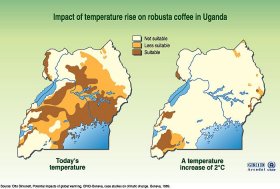
We all have a great deal at stake as the planet warms. Unfortunately, the poor in developing countries, such as coffee growing nations, often bear a large burden.  Even growers of more heat-tolerant lowland robusta coffee, where it is indigenous, stand to lose their livelihoods, as this graphic illustrates.

The authors of the Veracruz report recommend supporting farmers to move into specialty coffee to help to provide some financial security. Purchasing shade coffee and providing incentive for farmers to plant trees rather than cut them down will also help.  As the Fresh Cup article notes,

In the past several decades, roughly half of the world’s coffee plantations have cut down their trees, or cut down forest to plant unshaded coffee. This decreases the ability of vegetation to counteract global warming by absorbing carbon dioxide, and it also raises local temperature.

All the more reason to stay away from corporate technified sun coffee, and enjoy the superior taste of environmentally-friendly coffee.  I’ll be following the research on climate change and coffee, and report further news and suggestions.

(1) Gay, C., F. Estrada, C. Conde, H. Eakin, and l. Villers. 2006. Potential impacts of climate change on agriculture: case study of coffee production in Veracruz, Mexico.  Climate Change 79:259-288.