Know Your Coffee Birds series

Know your coffee birds: Horned Guan

The Horned Guan (Oreophasis derbianus) holds a near-mythical status for birders. It is large –almost the size of a turkey — and bizzare-looking, with a red horn projecting from its head, the exact function of which is unknown. It is rare, a critically endangered species with a population of  fewer than 2000 individuals. It is found in the cloud forests from 1200 to 3500 meters (primarily 2000 to 3000 m) in the Sierra Made de Chiapas of Mexico and in west-central Guatemala. Even a guided journey to accessible areas is described as “grueling,” “brutal,” and “a death march.” Thus, the Horned Guan is one of the most sought-after birds in the world: even Sports Illustrated ran an article about searching for the guan; the group included George Plimpton.

The Horned Guan is the sole member of its genus, and a member of the cracid family. This is the same family as the Jacu I wrote about in a previous post, the bird that eats and craps out coffee in Brazil and the source of “Jacu coffee.” Unlike other cracids, though, Horned Guans spend most of their time in trees rather than on the ground. The Horned Guan’s diet is comprised nearly exclusively of  fruit of several dozen species, but also some orchid flowers and leaves. By dispersing the seeds of a large variety of plants, the guans perform an important ecological function maintaining the health of forest diversity.

Horned Guans were discovered in 1844, but the species is so rare and difficult to locate that the nest and eggs were not first observed until 1982 [1]. Its rarity is a result of deforestation over the past century which been caused mostly by farming, much of which is coffee. Horned Guans are also hunted, and this pressure has increased as forest has been converted to agriculture. Now, populations are very small and fragmented.

The core areas of the El Triunfo Biosphere Reserve are some of the guan’s most important population centers. Biosphere reserves consist of core areas where no human activity is permitted, surrounded by buffer zones where activities of low ecological impact are practiced. One of the most critical activities is organic shade coffee farming. While Horned Guans are unlikely to occur within the coffee farms themselves, they have been recorded in some of the habitat set-asides in the buffer zones. Overall landscape characteristics have significant influence on biodiversity, especially for species which require large amounts of forest habitat, so the health and preservation of the buffer zones is an integral part of guan conservation.

Because of the communal land ownership in the area, community involvement in buffer zone management at El Triunfo is critical. It wasn’t until the mid-1990s that the first organic coffee farm cooperative was formed. Help from various aid, environmental, and coffee organizations has made organic coffee farming a success for both the communities and conservation. Starbucks has worked extensively here and sources their Shade Grown Mexico offering from these farmers. You can read more about their involvement and the coffee in a previous post.

Ecotourism is also important to communities in the buffer zones and elsewhere in areas where Horned Guans are found. Coffee farms and guan searches are often part of the same tourism projects, and provide income and incentive to preserve habitat for the abundant biodiversity in this region.

The continuing decline of Horned Guan populations has lead to the initiation of captive breeding programs. Fewer than 100 guans are present in a few zoos which are working to understand dietary needs and how to successfully breed the birds in captivity. Even if these projects succeed in raising new generations of guans, if their habitat is gone they can never be released. Their survival as a species in the wild depends on the preservation of their habitat.

Strictly speaking, Horned Guans are not found on shade coffee farms. But in a practical sense they depend on our support of ecologically-responsible activities near their forest homes, the most critical of which is shade coffee growing.

1. Gonzalez-Garcia, F. 1995. Reproductive biology and vocalizations of the horned guan Oreophasis derbianus in Mexico. Condor 97:415—426.
Horned Guan painting by Marco Pineda courtesy of CONABIO. Photo of Horned Guan by Stormtrooper under a Creative Commons license (bird at St. Louis Zoo).

Know your coffee birds: Black-and-white Warbler

The Black-and-white Warbler (Mniotilta varia) is a small, zebra-striped bird that is unique among our warblers. It is the only representative of its genus, and also the only one whose typical mode of foraging is clinging to and climbing up and down tree limbs and trunks in search of prey found in bark crevices. Black-and-White Warblers breed across much of central and eastern Canada and the eastern U.S. in forested habitats. They winter in Florida and the Gulf Coast, the West Indies, southern Mexico, Central America, and northern South America.

On their tropical wintering grounds, Black-and-White Warblers are frequently found on shaded coffee farms. They were one of the most commonly encountered North American migrants in shade coffee farms of Chiapas, Mexico. In Venezuela, they were found foraging in the coffee understory as well as in the canopy of shade coffee farms. In Jamaica, Black-and-white Warblers were among the birds found on shade coffee farms that preyed upon coffee berry borers, a major coffee pest.

In the Dominican Republic, 65% of Black-and-White Warblers maintained winter residence on shade coffee farms, all of which were smaller than 9 ha. This site persistence indicates that there were adequate resources on these farms for the birds. An amazing 40% of warblers returned to the same farm in which they were originally captured and marked a year or more later. Most small songbirds, especially those that make twice-annual long-distance migrations, have very short lifespans, so this return rate is impressive. It also underscores that migratory birds rely on finding their winter habitats intact when they return from nesting in order to survive.

Since 1973, researchers have been monitoring overwintering migrant birds in Puerto Rico, where Black-and-white Warblers are one of the most common species. They have documented a distressing decline in this species, which now occurs at less than 20% of its original abundance. While the study does not take place on coffee farms, it supports North American Breeding Bird Survey data, which has documented a significant decline of around 1% annually for breeding populations over the same period.

Black-and-white Warblers are still one of the most familiar New World warblers. Yet the studies cited above, as well as others, indicate that even abundant and adaptable species like this one are vulnerable to habitat loss and alteration. Plenty of research has shown that shade coffee farms are important wintering habitat for Black-and-white Warblers. Let’s make sure that when they make their annual sojourn to the tropics, they continue to find these farms for their winter homes.

See more in the “Know your coffee birds” series.

Photo of Black-and-white Warbler banded at the Rouge River Bird Observatory by Julie Craves. All rights reserved.

Range map from Cornell’s All About Birds.

Faaborg, J., K. M. Dugger, and W. J. Arendt. 2007. Long-term variation in the winter resident bird community of GuÁ¡nica Forest, Puerto Rico: lessons for measuring and monitoring species richness. Journal of Field Ornithology 78:270—278.

Greenberg R., P. Bichier, and J. Sterling. 1997 Bird populations in rustic and planted shade coffee plantations of eastern Chiapas, Mexico. Biotropica 29:501-514.

Johnson, M., J. Kellermann, and A. Stercho. 2010. Pest reduction services by birds in shade and sun coffee in Jamaica. Animal Conservation 13:140-147.

Jones, J., P. Ramoni-Perazzi, E. H. Carruthers, and R. J. Robertson. 2002. Species composition of bird communities in shade coffee plantations in the Venezuelan Andes. Ornitologia Neotropical 13:397-412.

Wunderle, J. M. Jr., and S. C. Latta 2000. Winter site fidelity of Nearctic migrants in shade coffee plantations of different sizes in the Dominican Republic. Auk 117:596—614.

Know your coffee birds: Rufous-capped Warbler

The Rufous-capped Warbler (Basileuterus rufifrons) is found through much of Central America, north through Mexico. This species is occasionally found in the southwestern U.S., when it creates a sensation among birders.

This warbler is a common resident of shade coffee farms all year long, where it can be the dominant foliage-gleaning species. This is a foraging method where birds pick off insects from the upper and undersides of leaves. Many birds that occupy coffee farms make the most use out of remaining forested patches, the canopy trees, and associated epiphytes — thus the importance of shade-grown coffee to birds. Rufous-capped Warblers are in the minority in that they also forage within the coffee layer as well.

Two of my former Rouge River Bird Observatory student volunteers co-authored a paper on Rufous-capped Warbler foraging habits on a shade coffee farm in Chiapas, Mexico [1]. They knew from previous research that many resident species like the warbler that use shade coffee move to other habitats once wintering migrants from North America arrive, perhaps to reduce competition. Rufous-capped Warblers stay put, but shift from their foraging in all the layers of vegetation to focusing on the coffee and shrub understory in the winter. This is also likely due to competition for resources, since many North American migrants prefer to forage in the canopy layer.

This shift to lower foraging heights was in evidence when we visited Finca Esperanza Verde in Nicaragua, where we caught multiple Rufous-capped Warblers in the coffee production area, including the one photographed above.

This is just another example of the complex interactions between resident and migratory birds in the tropics, an intricate dance coordinated over thousands of years of evolution. The Rufous-capped Warbler has adapted well to shade coffee production. Let’s drink shade-grown coffee, and keep them around.

[1] Seasonal shift in the foraging niche of a tropical avian resident: resource competition at work? Jedlicka, J., R., Greenberg, I. Perfecto, S. M. Philpott, and T. V. Dietsch. 2006. Journal of Tropical Ecology 22:385-395.

Photo by Darrin O’Brien, all rights reserved, used with permission.

Know your coffee birds: Wood Thrush

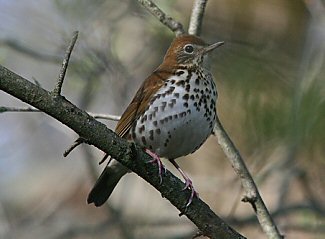
The Wood Thrush, a relative of the familiar American Robin, is often considered a symbol of the population declines of birds that nest in North America and winter in the tropics. This species has been declining since the mid-1960s, and is on the National Audubon Society’s 2007 WatchList of declining birds.

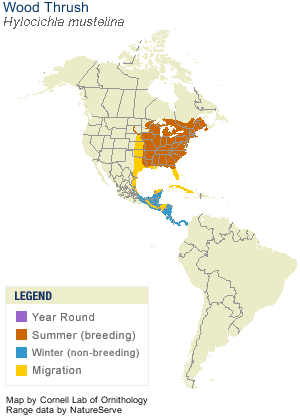
Wood Thrushes nest in forests over much of the eastern U.S. Like most other songbirds, they migrate at night. These thrushes travel an average of 2200 km between their nesting areas and wintering grounds in Central America.

In the winter, Wood Thrushes are most common in primary and mature second growth forests, and they can be a familiar site on polyculture shade coffee farms from Mexico to Panama. For instance, they are the most commonly banded species at the gorgeous shade farm Finca Esperanza Verde in Nicaragua — we caught and saw a number of them when we were there in March 2009.

One reason for Wood Thrush declines may be tropical deforestation. At least one study has found a correlation between reduced numbers of Wood Thrushes and reduction in forest cover in the northern portion of their wintering range [1].

Wood Thrushes will choose and defend a territory in the winter, much as they do when they are nesting. However, as forests are destroyed in the tropics (including for sun coffee), Wood Thrushes are forced to become nomadic — a case of too many Wood Thrushes and other species, and not enough space. These thrushes must move from place to place, or settle in habitat that is low quality. These birds are less likely to survive the winter than individuals who have territories in a good forest patch [2].

Here in North America, habitat fragmentation is considered another cause of Wood Thrush population declines. As in the tropics, Wood Thrushes can be found in small woodlots or low quality habitat, but their chances of successfully raising a brood are greatly diminished in these situations. In fragmented forests, predators are more common, as are Brown-headed Cowbirds, which lay their eggs in the nests of other birds, often targeting Wood Thrushes. These factors contribute to dramatic rates of nest failure in some locations.

The Wood Thrush and coffee connection is so iconic that this bird has been found on the coffee packages or web sites of Birds and Beans, Coffee for the Birds, Audubon Coffee, and Counter Culture Sanctuary Coffee, to name a few. Wood Thrushes are considered “area sensitive,” needing good, intact forests throughout their annual cycle. High-quality shade coffee plantations represent essential habitat for this species, and your choice of coffee has a direct impact on the survivorship of Wood Thrushes and other birds that rely on tropical forests.

Wood Thrush photo by Eddie Calloway under a Creative Commons License.

[1] Rappole, J. H., G. V. N. Powell, and S. A. Sader. 1994. Remote-sensing assessment of tropical habitat availability for a nearctic migrant: the Wood Thrush. In Miller, R. I. (ed.). 1994. Mapping the diversity of nature. Chapman & Hall, London, England.

[2] Deinlein, M. 1998. A “Sing”-ular Sensation. Wood Thrush: Bird of the Month. Smithsonian Migratory Bird Center.