Know Your Coffee Birds series

Know your coffee birds: Malabar Barbet

The Malabar Barbet (Megalaima malabarica) is a bird that is endemic to India. Once considered a subspecies of Crimson-fronted Barbet, Megalaima rubricapillus, which has a broader range, the Malabar Barbet is found in only the Western Ghats from Goa south to Kerala and western Tamil Nadu. There, it inhabits evergreen and moist deciduous forests, generally below 1200 m, and is often found in high quality shade coffee plantations.

Coffee plantations cover about 6% (around 830,000 ha) in the Western Ghats, and while all the coffee is grown under shade, the quality of the shade varies. A diverse mix of native shade trees is the highest quality, and it has been found that these types of farms have similar diversity of birds and other wildlife as is found in nearby forests — the same situation is true in Latin America. However, various laws and restrictions on cutting native trees (which could provide value to wildlife and as harvestable timber, for example) are much more strict in India. This, in part, has led to the widespread planting of silver or silky oak (Grevillea robusta), a fast-growing tree native to Australia.

Western Ghats in pink and purple; purple portion is approximate range of Malabar Barbet.

Although Grevillea has flowers that can be attractive to nectar-feeding birds, it does not have fleshy fruit, important to many birds. Because it is harvested for timber, the areas where it is planted are subject to periodic disturbance and alteration. One study* found that in shade coffee farms in the Ghats, an increase in the proportion of silver oak from 33% to 55% was associated with 91% reduction in the abundance of the Malabar Barbet. This is more evidence that certifications that merely require shade as a percent of canopy cover will not help enhance or preserve biodiversity — “shade” certification should also include a mix of shade tree species and a requirement that a percentage of them be native species.

Barbets in general are small-to-medium, stout birds with short tails, big heads, and strong, thick bills. They are found all over the world in tropical regions. Barbets eat primarily fruit, and Malabar Barbets, like many other species, forage in the forest canopy (perhaps one reason there are few good photos of this species!). Ficus trees and their fruits are especially important. While many small fruit-eating birds swallow fruits whole, Malabar Barbets will also sit and pick on fruits too large to swallow. Ficus are often used as shade trees in shade coffee farms in India.

Barbets are related to woodpeckers, and like them nest in tree holes. Malabar Barbets typically use holes that they excavate themselves which are located on the underside of small branches, where they raise one or two young per nest. Thus, it is important for them to have trees with dead branches in their territories for nesting — something that isn’t too typical on a shade coffee farm where Grevillea is harvested.

There are nearly many species of birds found only in the Western Ghats. A number of them use shade coffee farms either directly, or as corridors that connect more suitable forest habitat.


Photo of the Malabar Barbet taken in the Wayanad Wildlife Sanctuary, Kerala, by Sandeep Gangadharan under a Creative Commons license.

*Anand, O. M., J. Krishnaswamy, and A. Das. 2008. Proximity to forests drives bird conservation value of coffee plantations: implications for certification. Ecological Applications 18:1754-1763.

Know your coffee birds: Scarlet Tanager

Many birders have a “spark bird,” a species that captured their attention and inspired lifelong interest in birds. For me, it was the Scarlet Tanager (Piranga olivacea). As a young girl I was given a copy of The Bird Guide: Land Birds East of the Rockies by an elderly neighbor, a vintage book even back then. In studying the illustrations, I could not believe that a bird as bright and stunning as the Scarlet Tanager could be found in Michigan; if so, it surely could not be as brilliant as the book portrayed. It was some years before I finally saw a male Scarlet Tanager, as they tend to be canopy dwellers. I have handled and seen countless others since then. Each time, like the first, I still marvel at their brilliance.

I banded this male Scarlet Tanager at the Rouge River Bird Observatory in Dearborn, Michigan.

There are over 240 species of tanagers in the New World, and frankly they include some of the world’s most beautiful birds. They are really a tropical family, with only four species having evolved to migrate to North America to breed (a fifth is a rare breeder in the deep southwest). All of them retreat to the tropics to spend the winter.

The Scarlet Tanager breeds in large, mature, deciduous forest tracts over much of the eastern U.S. and southern Canada, save for the deep south, and spends the winter in northwestern South America, where they are most common in Ecuador, Bolivia, and the Peruvian Andes. During the nesting season, Scarlet Tanagers prefer to utilize the interior of large tracts of forest. Their sensitivity to fragmented habitats categorizes them as an “area sensitive” species. In small or fragmented woodlots, they suffer from predators and parasitism by cowbirds (which lay their eggs in the nests of other bird species, usually at the expense of their hosts). If a forest is too small (<10 ha), the tanagers will not attempt to nest at all.

Female and young Scarlet Tanagers are much more modestly colored than breeding males. In winter, males look similar to females, but with darker wings.

After their breeding season, the tanagers molt into their more somber winter plumage. The males go from scarlet to  bright olive with black wings. Females are a duller olive with dusky wings — the same color they are year round. This change from eye-catching to cryptic coloration is not unusual. Flashy colors are good ways to advertise for mates and let other birds know a territory is occupied, but are a little too conspicuous to predators the rest of the year. For North American migrant birds that share their wintering areas with many year-round resident birds in the tropics, it’s probably also a good strategy to be a little more modest.

Few species of North American migrant birds make it as far south in winter as the Scarlet Tanager. Their habits during winter are not well known, as they tend to be inconspicuous and spend most of their time in the canopy. While in the breeding season, Scarlet Tanagers eat insects almost exclusively, they also eat fruit in the winter.  They have been recorded on shade coffee farms in Central America (Panama and Nicaragua) during migration, as well as in winter. As canopy dwellers, they utilize the shade trees and do not find sun coffee appropriate habitat.

Two of the other North American breeding tanagers, Western Tanager (P. ludoviciana) and Summer Tanager (P. rubra) are also found on shade coffee farms.

Perhaps few North American breeding birds remind us so strongly that they are not really “our” birds, but tropical species on loan for a few short months in the summer. When we contemplate that fact, it reminds us that habitat on the wintering grounds — such as shade coffee farms — are truly critical for their survival. Support shade-grown coffee, so that future generations can open a field guide, become inspired by a vivid tanager, and discover that they really do exist.

Female-plumaged tanager photo by Jamie Chavez under a Creative Commons license.


Know your coffee birds: Hispaniola’s Palm-Tanagers

Black-crowned Palm-Tanager. Photo by Pat Johnson, taken during field work he performed with the Vermont Center for Ecostudies. VCE has done incredible work in Hispaniola.

There are two species of palm-tanagers (Phaenicophilus) found on Hispaniola, the island comprised of the Dominican Republic (DR) and Haiti.  One is the widespread Black-crowned Palm-Tanager (P. palmarum). The other is the only species of bird unique to Haiti: the Gray-crowned Palm-Tanager (P. poliocephalus). The latter is restricted primarily to the Tiburon Peninsula, the long arm of land in that forms the southeast coastline of the island, where it replaces the Black-crowned. At one time, the peninsula was separated from the rest of the island by the sea, allowing many endemic species to evolve. It is believed this is when the Black-crowned and Gray-crowned Palm-Tanagers diverged into two species. The two species are similar, with the Gray-crowned having (as you may have guessed) a gray rather than black crown, less white on the throat, and some smaller physical features.

Both of these resident species will use many kinds of forest habitats, from humid deciduous to pine, from sea level to upper montane elevations over 2000 meters. They will also use well-vegetated gardens and farms. In many regions, this adaptability would provide the birds with some habitat security. However, deforestation has been so severe on Hispaniola that in many places wooded areas, including agroforests, are so fragmented, degraded, or just plain uncommon that many forest bird species are struggling. The situation is particularly precarious in Haiti, where it is estimated that only 1.5% of the original forested areas survive.

The palm-tanagers forage on insects, often found in dead leaves or under bark, and some fruit. During the non-breeding season, Black-crowned Palm-Tanagers are typically found alone or in pairs, while Gray-crowned Palm-Tanagers are often found in groups of four to six birds.

Portrait of a Gray-crowned Palm-Tanager on a Haitian postage stamp.

Gray-crowned Palm-Tanagers (known locally as “Kat Je Sid” or “Cuatro Ojos”) really deserve special mention. They are locally common on the Tiburon Peninsula, especially in Pic Macaya National Park — little is known about their current status outside this tenuously-protected area. In fact, recent research has not revealed conclusive evidence that they occur east of a line extending south from Port-a-Prince, but historical reports indicate that their range may extend closer to the DR border.

A combination of reforestation and agroforestry crops such as shade coffee would certainly facilitate the conservation of this species. Coffee is produced in the Pic Macaya region. At one point it was roasted and sold by Barrington Coffee Roasting (see our review), Irving Farm Coffee, and Wicked Joe, but I could not find it available at the time of this writing.

However, shade coffee is currently being produced and exported by the Cooparative des Planteurs de Café de l’Arrondissement de Belle-Anse (COOPCAB) based in Thiotte, close to the DR border. This is a group of seven cooperatives representing 5000+ members. It is typica coffee grown at 1300-1350 m in mixed pine forest near Gras Cheval, north of Thiotte, and is usually branded as Blue Forest coffee. It is being most widely promoted and distributed by La Colombe Torrefaction. La Colombe is assisting COOPCAB in getting Rainforest Alliance certification.

The pine forests are critical for endangered Hispaniolan Crossbill, Loxia megaplaga, an island endemic. This bird, once considered a subspecies of the White-winged Crossbill of northern coniferous forests, feeds exclusively on the seeds of Hispaniolan pine (Pinus occidentalis). Forested areas in Haiti and the DR are also essential to North American migrant birds, especially the rare Bicknell’s Thrush. Birds do not represent the only important or unique species that rely on Haiti’s dwindling habitats. The country is host to many other endemic species, including one of the smallest frogs in the world.

The importance of income-producing, habitat-restoring agriculture to Hispaniola’s people, flora, and fauna cannot be underestimated. Given its history and potential, shade coffee is an excellent candidate.

Learn more:

Literature:

McDonald, M. A., and M. H. Smith. 1994.  Behavioral and morphological correlates of heterochrony in Hipaniolan Palm-Tanagers.  Condor 96: 433-446.

Sly, N. D., Townsend,  A. K., Rimmer, C. C., Townsend, J. M., Latta, S., and I. J. Lovette. 2010. Phylogeography and conservation genetics of the Hispaniolan endemic Palm-tanagers (Aves: Phaenicophilus). Conservation Genetics 11: 2121-2129.

Rimmer, C. C., Townsend, J. M., Townsend, A. K., Fernandez, E. M., and J. Alamonte. 2005. Avian diversity, abundance, and conservation status in the Macaya Biosphere Reserve of Haita. Ornithologia Neotropical 16:219-230.

Townsend, J. M. 2009. Gray-crowned Palm-Tanager (Phaenicophilus poliocephalus), Neotropical Birds Online (T. S. Schulenberg, Ed). Ithaca: Cornell Lab of Ornithology; retrieved from Neotropical Birds Online: http://neotropical.birds.cornell.edu/portal/species/overview?p_p_spp=46132

Know your coffee birds: Wilson’s Warbler

The tiny, bright yellow bird that John  James Audubon called “Wilson’s Flycatching Warbler” breeds in a large swath all across northern North America. Wilson’s Warblers winter in much of Central America, and so pass through most of the continent at some point during the year. Molecular studies have shown that certain breeding populations winter in specific geographic areas. For instance, the most northerly-breeding birds of the western population winter the furthest south in Central America.

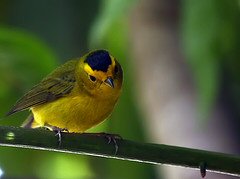
Females have duller caps.

One of the original names of Wilson’s Warbler was “Pileolated Warbler” after the male’s striking black skullcap, or pileum. As one of the warblers that has a flattish bill bordered by specialized feather “whiskers” to aid in the capture of small insects, the descriptor of “flycatching” or “flycatcher” was added to its name several times through history. Because he was the first to formally publish a description, ornithologist Alexander Wilson is now honored in the common name.

In the breeding season, the typical habitat of Wilson’s Warblers is dense thickets, especially moist ones in riparian areas. In the winter, however, it can be found in a much wider variety of habitats, which are often more open than nesting habitats. It is most abundant in tropical forests, cloud forest, pine-oak forest, and forest edge habitat, and is frequently found on coffee farms.

While many bird species tend to be somewhat set in their behavior at certain times of the year, wintering Wilson’s Warblers may be solitary, either roaming through a locality or forming a territory, or found in mixed flocks of other birds.  In addition to insects and some fruit, nectar is also consumed in winter. This flexibility in habitat requirements, behavior, and food resources has no doubt contributed to the success of Wilson’s Warblers, which remain one of our most common warblers. Yet recent population trends indicate numbers have declined 2% a year in the U.S., and over 4% a year in the eastern U.S. in recent decades. This is a well-studied species, but we need to know more to understand how to best conserve them. Unfortunately, we often neglect to take action with common species until serious problems are evident.

We have found Wilson’s Warblers common on coffee farms we visited in Panama and Nicaragua. We are about to travel once again to Nicaragua, where we will spend time at Finca El Jaguar in Jinotega, and once again visit to Finca Esperanza Verde in San Ramon, Matagalpa. You’ll be hearing more about our trip soon!

Top male Wilson’s Warbler photo by David Hofmann, female by Jean-Guy Dallaire, and bottom male by Pablo Leautaud, all under a Creative Commons license.