JulieCraves

New award for biodiverse coffee farms

A new award for coffee farmers is being initiated by Cooper Ecological Monitoring, Roast Magazine, and Birder’s Exchange (a program of the American Birding Association). The Coffee Conservation Award will be presented annually to recognize farms making a significant contribution to global biodiversity preservation. The award is a $1000 cash prize, to be used to further meaningful, science-based conservation practices on the winning farm.

This award is intended to not only to reward and encourage producers to grow coffee in a sustainable manner, but to help document and promote the benefits of these types of agroforestry systems to birds and wildlife.

Coffee certifications, for instance, often only measure the potential for biodiversity preservation by assessing the elements required for bird and wildlife habitat. The criteria for the Coffee Conservation Award will focus on actual wildlife use of the farms, and preservation of existing forests will be emphasized over tree-planting in production areas. Target wildlife species will be developed for various regions — the current application (PDF) lists target species for Honduras, Guatemala, Nicaragua, and El Salvador. The bird list includes both Neotropical migrants (birds that breed in North America which winter in the tropics) like the brilliant and declining Painted Bunting (above), and rare or endemic tropical species like the Azure-rumped Tanager. The application also requests information on monkeys and frogs.

ominations each year will be restricted to a particular country, and the 2010 award will go to a producer in El Salvador. This is a great choice to start with, as coffee plantations provide so much of the of the remaining “forested” areas in the country. Judges will include the award partners and sponsors, as well as representatives of local conservation organizations, if possible. The 2010 award local partner is SalvaNatura, El Salvador’s excellent conservation organization. Their director of conservation science, Oliver Komar, is an old friend of mine and has written numerous papers on shade coffee and Neotropical bird conservation.

In addition to the cash prize, the Coffee Conservation Award includes promotion of the farm in trade publications (both coffee- and nature-related) and in the marketplace. The 2010 award is being sponsored by Cafe Imports, and the deadline for submissions will be December 31st, 2009. The winner will be announced in May 2010 in the May/June 2010 issue of Roast Magazine.

Painted Bunting photo by Francesco Veronesi under a Creative Commons license.

The bird pictured in the logo of the award is a White-eared Ground-Sparrow (Melozone leucotis), a restricted-range Central American species.

Update on eco-friendly coffee market share

UPDATE: A thorough report with detailed breakdowns of producing and consuming countries, certified roasters and importers, major retailers, and other information is now available on the SMBC web site.

The Smithsonian Migratory Bird Center announced that sales of Bird-Friendly coffee in 2008 were $3.5 million, with 61% being sold in the U.S.[1]

For the 2007-2008 crop year, 6 million pounds (2700 metric tons) of Bird-Friendly certified coffee was produced. This certification is at the farm level, with 1400 farms and 5000 ha (12,000 acres) under certification [2].

Nearly all Bird-Friendly certified farms are in Latin America, since the research that led to the launching of the certification took place there and was developed for Neotropical habitats. Peru, Guatemala, and Mexico account for 77% of Bird-Friendly coffee, with Peru producing 39% of the total.

More recently, Bird-Friendly standards have been adopted for Africa, and now about 5% of Bird-Friendly certified coffee comes from Ethiopia. Efforts are continuing to expand criteria and certification to other areas, including other African countries, Papua New Guinea, and Indonesia (certified coffee from Sumatra should be available within the next year, according to the report).

You can find a current list of certified farms on the SMBC site.

Growth in other certification schemes
All Bird-Friendly coffee is certified organic, and organic coffee market share has also been growing. North American sales of organic coffee reached $1.3 billion in 2008, up from $1 billion in 2007.  This represents 89 million pounds (40,000 metric tons) versus 84 million (38,000 MT) in 2007.

Rainforest Alliance reports that their certified coffee sales in 2008 totaled 62,296 metric tons (137 million pounds), up from around 40,000 metric tons 89 million pounds) in late 2007. I’ve not found corresponding figures for the number of Rainforest Alliance certified farms/acreage, but when I last reported these figures they were 200,000 ha of coffee on nearly 17,000 farms as of late 2007.

Despite the growth in eco-friendly coffee certifications and sales, this is still a very niche market. Total world production in 2008 was 7.6 million metric tons, making these certified coffees only about 1% of the total produced. U.S. imports of coffee in the first quarter of 2008 were 387,000 metric tons, which means organic coffee imports were under 10% of the U.S. market.

[1] This figure represents coffee actually sold as certified but not all coffee produced under any given certification gets sold as such. Some may be blended with non-certified coffee, the buyer may be interested in other attributes besides the certification and purchases it without intending to market it as certified, or other reasons. In 2006, only about 6% of coffee produced on Bird-Friendly certified farms was sold as such. This situation also occurs with organic, Fair Trade, and other certifications.

[2] When I calculated these figures from the SMBC web site in May 2008, I came up with 28 producers growing on 7200 ha, with production of approximately 3100 metric tons.
Know your coffee birds: Wood Thrush

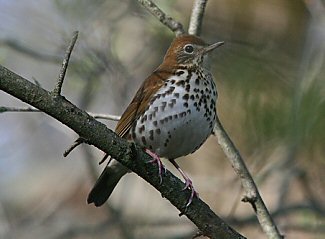
The Wood Thrush, a relative of the familiar American Robin, is often considered a symbol of the population declines of birds that nest in North America and winter in the tropics. This species has been declining since the mid-1960s, and is on the National Audubon Society’s 2007 WatchList of declining birds.

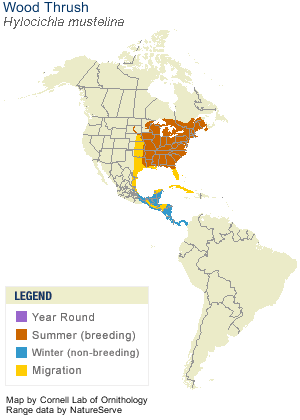
Wood Thrushes nest in forests over much of the eastern U.S. Like most other songbirds, they migrate at night. These thrushes travel an average of 2200 km between their nesting areas and wintering grounds in Central America.

In the winter, Wood Thrushes are most common in primary and mature second growth forests, and they can be a familiar site on polyculture shade coffee farms from Mexico to Panama. For instance, they are the most commonly banded species at the gorgeous shade farm Finca Esperanza Verde in Nicaragua — we caught and saw a number of them when we were there in March 2009.

One reason for Wood Thrush declines may be tropical deforestation. At least one study has found a correlation between reduced numbers of Wood Thrushes and reduction in forest cover in the northern portion of their wintering range [1].

Wood Thrushes will choose and defend a territory in the winter, much as they do when they are nesting. However, as forests are destroyed in the tropics (including for sun coffee), Wood Thrushes are forced to become nomadic — a case of too many Wood Thrushes and other species, and not enough space. These thrushes must move from place to place, or settle in habitat that is low quality. These birds are less likely to survive the winter than individuals who have territories in a good forest patch [2].

Here in North America, habitat fragmentation is considered another cause of Wood Thrush population declines. As in the tropics, Wood Thrushes can be found in small woodlots or low quality habitat, but their chances of successfully raising a brood are greatly diminished in these situations. In fragmented forests, predators are more common, as are Brown-headed Cowbirds, which lay their eggs in the nests of other birds, often targeting Wood Thrushes. These factors contribute to dramatic rates of nest failure in some locations.

The Wood Thrush and coffee connection is so iconic that this bird has been found on the coffee packages or web sites of Birds and Beans, Coffee for the Birds, Audubon Coffee, and Counter Culture Sanctuary Coffee, to name a few. Wood Thrushes are considered “area sensitive,” needing good, intact forests throughout their annual cycle. High-quality shade coffee plantations represent essential habitat for this species, and your choice of coffee has a direct impact on the survivorship of Wood Thrushes and other birds that rely on tropical forests.

Wood Thrush photo by Eddie Calloway under a Creative Commons License.

[1] Rappole, J. H., G. V. N. Powell, and S. A. Sader. 1994. Remote-sensing assessment of tropical habitat availability for a nearctic migrant: the Wood Thrush. In Miller, R. I. (ed.). 1994. Mapping the diversity of nature. Chapman & Hall, London, England.

[2] Deinlein, M. 1998. A “Sing”-ular Sensation. Wood Thrush: Bird of the Month. Smithsonian Migratory Bird Center.

Holiday gift guide for sustainable coffee lovers

In case you don’t come across enough holiday gift guides this season, I’m highlighting some of my favorite items, many of which you can find year-round in the Coffee & Conservation store.

The two best coffee books are Uncommon Grounds The History Of Coffee And How It Transformed Our World and God in a Cup: The Obsessive Quest for the Perfect Coffee. Here is my review of God in a Cup.

Another book I have not yet read is Ivette’s Natures Matrix: Linking Agriculture, Conservation and Food Sovereignty, which includes a chapter discussing coffee. Authors Ivette Perfecto and John Vandermeer are University of Michigan professors who have done so much of the pioneering work on biodiversity and shade coffee. More on this book here.

Three excellent low-tech coffee brewing devices are the Chemex Classic Glass Coffee Maker; the AeroPress Coffee and Espresso Maker, which is excellent for travel; and my favorite press pot, the Planetary Design Table Top Stainless Steel French Press. I reviewed its smaller cousin the travel French Press mug, and the same praise applies to the larger models.

I also like to recommend gold coffee filters to reduce the use of paper filters.

I’m pretty blown away by the remarkable art of Andrew Saur and Angel Sarkela-Saur, who use coffee to produce stunning watercolors. Take a look at their gallery at Coffee Art; prints start at only $10.

Earlier this year I screened the three-part documentary Black Coffee. It was extremely well done and traces the impact of coffee through history. Readers may also be interested in the story of Ethiopian coffee in the well-known powerful film Black Gold.

Finally, if you’d like to spread cheer directly to coffee-growing communities, please consider a donation to the Cafe Femenino Foundation, Grounds for Health, or Kiva micro-loans to coffee farmers. This is really what holiday giving is all about.