JulieCraves

My year in beans: 2009

Last year I kept track how much I paid for coffee over the course of 2008. This year, I kept even more precise numbers. Here are my 2009 stats:

  • 81 bags of coffee totaling 63 pounds; I probably gave away or shared 5 to 8 pounds.
  • Total retail price = $1031. I purchased very few bags locally, so I also spent $129 on shipping, for a grand total of $1160 for the year.
  • This still works out to only $0.45 per six-ounce cup.

This isn’t even a good example of how little you have to spend to drink great, sustainably-grown coffee, because I’m pretty self-indulgent. I drink a lot of fine coffees, with 13 in 2009 retailing over $20/lb. The most expensive was a Bolivian Flor de Mayo from Terroir Coffee, which was the equivalent of $55.90/lb. All but 6 of the coffees were single-origin, and they came from 19 countries and 20 roasters. I know I’m not a typical coffee drinker.

Let’s say you order from Birds & Beans, which only sells organic, SMBC Bird-Friendly certified coffees, and donates a portion of profits to bird research and conservation. Their coffees retail for $19.95 for 2 pounds. If you drink (and gift) as much coffee as I do, that’s $618 a year in coffee. They charge a flat rate of $8 for shipping, so even if you order twice a month (they have a handy subscription service so no matter what you want or how often you want it, you don’t even have to think about it), that’s
another $192, for a total of $810 a year, or $0.31 per six-ounce cup. Amber at Birder’s Lounge decided to keep track of her shade-grown coffee consumption last year, too, and only spent $0.40 a cup.

For most people, it’s a myth that environmentally-friendly, sustainably-grown coffee is too expensive. And given the number of great roasters providing subscription services similar to the one described above, it’s also a myth that environmentally-friendly, sustainably-grown coffee is too hard or inconvenient to get.

I’ll conclude my New Year’s crusade against cheap coffee with the words of Geoff Watts, which appeared in a comment in a post at Hungry Magazine (which may now be defunct). Geoff is Vice President of Coffee and the green coffee buyer for Intelligentsia Coffee, spending the bulk of his year on coffee farms with producers. My emphasis added.

“The mainstream first-world consumer has held stubbornly to the idea that coffee is a cheap luxury, that  the $1.00 bottomless mug is somehow a right or a deserved privilege. It is this very attitude that will continue to ensure that the modern smallholder coffee farmer has little hope of escaping a life of extreme poverty. Cheap coffee (and by ”cheap” I mean low cost, which typically equates to low quality) is one of the many forces shackling the developing world and suppressing opportunity for advancement for a huge chunk of the planet’s population who depend on coffee to make a living.

And while of course it makes sense to be thrifty in difficult economic times, we still need to realize that the decisions we make will have an impact further down the line. For a consumer the choice to purchase cheaper coffee has ramifications that extend far beyond the personal sacrifice of taste in favor of lower cost. It impacts the way coffee is produced, the way it will be produced in the future, and the ability of those who produce it to earn a living wage from their efforts.”

How can you not afford to drink environmentally-friendly, sustainably-grown coffee? Make this your resolution for 2010.

New coffee species from Madagascar

Earlier this year, the news of the “discovery” of a caffeine-free species of coffee from the Cameroon created a bit of a stir. This species was actually first collected in 1983, but remained unstudied and not described to science until 2008 [1], at which point it made headlines when it made a 2009 top ten list of new species. I wrote about it here.

Similiarly, the Royal Botanical Gardens at Kew just announced some recent achievements, among which was the “discovery” of new species in the genus Coffea from Madagascar. Again, these species were not necessarily just discovered but were described in a paper published in 2008[2].  Coffea ambongenis, for example, was first collected in 1841 but not described, was rediscovered in 1999, and is now published as a new species.

There are 103 described species of Coffea in the world, and the Madagascar species are part of the Coffea subgenus Baracoffea, which now stands at 9 species. In addition to species in this subgenus being deciduous rather than evergreen like all other coffee species, some have unusual morphological characteristics. Here is a very brief run-down.

  • C. ambongensis and C. boinensi: Very large fruit, in C. ambongensis often larger than 2.5 cm long. C. boinensi was first collected in 1994.
  • C. bissetiae: Underside of leaves and fruit hairy.
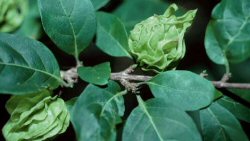
  • C. labatii and C. pterocarpa: Unusual winged fruit. C. labatii, first collected in 1992, has 12 to 18 “wings” per fruit. C. pterocarpa (first collected in 1954) has 16 to 20 wings, and is pictured at right in a photo by Aaron Davis from Kew; an informative accompanying article is here. One theory as to the function of the wings is that it helps the fruit float, and these species occur in regularly-flooded karst limestone habitats.
  • C. namorokensis: First collected in 2000, but not identified as a new species. Also has hairy fruit and leaves.

None of the new species have been tried as a beverage, and it is unlikely they will ever be commercialized.  All are rare: near-threatened to critically endangered, and Madagascar forests are among the most exploited and threatened in the world today.

[1] Stoffelen, P., M. Noirot, E. Couturon & F. Anthony. 2008. A new caffeine-free coffee from Cameroon. Botanical Journal of the Linnean Society 158: 67-72.

[2] Davis, A. P, & F. Rakotonasolo. 2008. A taxonomic revision of the baracoffea alliance: nine remarkable Coffea species from western Madagascar.
Botanical Journal of the Linnean Society, 158 (3), 355-390 DOI: 10.1111/j.1095-8339.2008.00936.x

EPA bans pesticide carbofuran on coffee imports

In May, the U.S. Environmental Protection Agency (EPA) announced its decision to ban any residue of the pesticide carbofuran on food. The rule becomes effective December 31, 2009.

Carbofuran (sold under the name Furadan) causes neurological damage in humans, is extremely deadly to birds and fish, and is highly toxic through ingestion and inhalation. It is used on numerous crops, including coffee. It tends to be used on various types of mealy bugs that infest the roots of coffee plants, coffee root nematodes, and on the coffee leaf miner (Leucoptera coffeella). Coffee leaf miners have natural enemies in Latin America, so carbofuran is used against them mainly in Africa.

Earlier in the process of reviewing carbofuran uses, the EPA rules allowed the importation of rice, coffee, bananas, and sugarcane with carbofuran residues. This final decision reverses that, and countries exporting coffee into the U.S. must stop using carbofuran on their crops. While little pesticide residue remains on green or roasted coffee, the direct threats to coffee workers, wildlife, and the millions of migratory and resident birds from the application of carbofuran to coffee make its use dangerous.

The Food and Drug Administration is responsible for enforcing EPA regulations on food imports. Carbofuran residue on food has been banned in the EU for some time, so testing protocols are established. Exporting countries, and coffee exporters and importers, often engage testing and certification labs to insure there are no violations that could lead to rejected shipments or, worse, a ban on imports.

FMC Corporation, the Pennsylvania-based company that manufactures Furadan, recently announced that they are challenging the EPA’s decision on some technical and administrative grounds. They have contended that the chemical is safe, despite well-documented impacts on birds, lions, hippos, other wildlife, and humans. Reports are still surfacing about illegal use of Furadan by poachers to kill vultures (which attract attention to illegal kills) and small birds which are then sold for human consumption.

Improper pesticide usage (whether unwitting or purposeful), export of domestically banned pesticides to other countries, and the fact that we are just beginning to understand the dangers of cumulative and synergistic effects of multiple pesticides in the environment to wildlife and humans, all argue for support of non-chemical-based pest management. And that includes growing coffee under diverse shade with its biodiversity-based pest control benefits.

Update: In 2010, courts ruled the EPA had to once again establish residue tolerances for imported foods, including coffee.

Happy holidays from C&C!

The highly-caffeinated main tasting panel at Coffee & Conservation wishes you a happy holiday and many excellent, sustainable coffees in the New Year! Standing are Mike, my better half Darrin, and Rick; yours truly is seated with our newest regular panelist Dana on my lap. Honest, I did have a coffee mug in my other hand!