JulieCraves

Counter Culture Coffee transparency report

Counter Culture Coffee has just released its first annual Transparency Report, covering 2009. Simple, straightforward, five pages describing each of CCC’s Direct Trade coffees, including the date of the last farm visit by a CCC employee and how much they paid for each coffee in 2009. This, IMHO, is the future of coffee: roasters providing all the information a consumer could want or need to choose their coffee wisely and with a clear conscience.

First Coffee Conservation award announced

A few months ago I wrote about the announcement of new award for coffee farmers initiated by Cooper Ecological Monitoring, Roast Magazine, and Birder’s Exchange (a program of the American Birding Association). The Coffee Conservation Award will be presented annually to recognize farms making a significant contribution to global biodiversity preservation. The award is a $1000 cash prize, to be used to further meaningful, science-based conservation practices on the winning farm.

The award will focus on a particular country each year. The inaugural country was El Salvador, and the winning producer is Finca El Porvenir.

El Porvenir is actually a group of three properties between 1,000 to 1,600 m in elevation on the slopes of Cerro El Tigre (13.44998, -88.42947), part of the isolated Sierra Tecapa—Chinameca range in eastern El Salvador, in the department of UsulutÁ¡n. This is the orange region on the map below (click to enlarge). This El Porvenir should not to be confused with former Cup of Excellence winner El Porvenir, located in the Apaneca-Ilamatepec mountains, in green.

El Porvenir covers 54 ha, which includes 16 ha of protected forest. Coffee varieties grown are pacamara, bourbon, and typica, and the last two crops have been exported to Germany and Italy. It is Rainforest Alliance certified, and also certified under Starbucks C.A.F.E. practices. The owner, Agroindustrias Homberger, S.A. de C.V., also owns and/or manages over 550 ha of additional adjacent coffee farms. These include another 100+ ha of protected land. Some of the farms have been in general manager Mauricio Homberger’s family for decades.

Biodiversity claims made in the nomination process for the Coffee Conservation award must be verified on the ground by partner organizations. A bird survey was performed at EL Porvenir in spring 2010 by SalvaNatura, one of the first inventories taken in this region. SalvaNatura found some bird species that have restricted ranges in northern Central America, including the Green-throated Mountain-Gem (Lampornis viridipallens), a large hummingbird; Bushy-crested Jay (Cyanocorax melanocyaneus), Rufous-browed Wren (Troglodytes rufociliatus), and Bar-winged Oriole (Icterus maculialatus).

El Porvenir plans on using the award funds for a biologist-led conservation course at the local school, along with an art contest for students with the theme ”Forest Conservation.” In addition to the cash prize, a pair of binoculars was also awarded, and will be used to help farm personnel participate and share in birding tours.

This award was sponsored by Cafe Imports, and Skyscrape Foundation/Mark Cappellano supported SalvaNatura to do the biological inventory. Congrats to El Porvenir.

Scenes from SCAA

Every so often there needs to be a break from the serious and educational for something a little more fun and personal. Here are some photos from the recent Specialty Coffee Association of America (SCAA) event.

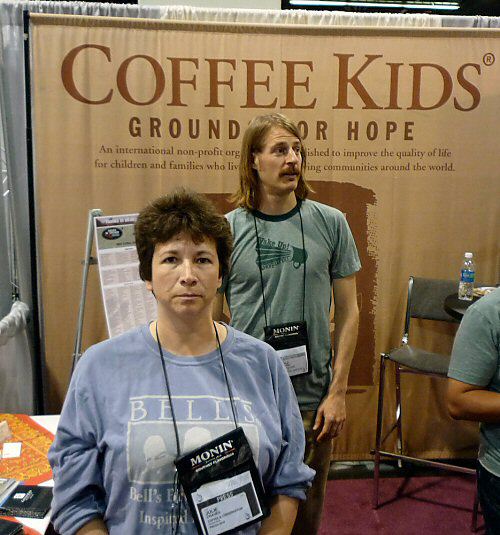
First off, we had to stop and visit our friend Kyle, at the Coffee Kids booth. This is an awesome charity, and Kyle is awesome as well. In fact, this photo has a backstory. Check it out.

Andy Sprenger is the roaster at Caffe Pronto in Annapolis, MD. Andy is a birder and former field biologist, and we’ve been in touch for years now. Yet, we’d never met. He tracked us down when he recognized the slogan on my husband’s Rouge River Bird Observatory t-shirt! Julie: “A light-roast Central is best before a spring bird walk.” Andy: “No way. A blend with some Peru boosts your flycatcher ID skills.” [Stand off.]

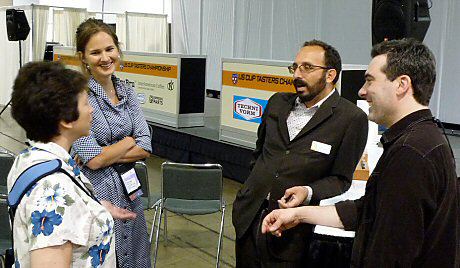
Andy competed in the U.S. Cup Tasters Championship, where he came in third place (second last year). This is a fast, fun competition where people have to pick the odd coffee out of eight flights of three cups. We found it more enjoyable to watch than the U.S. Barista Championship, which is much slower and more serious.

I’m in the odd position of not being in the coffee industry, but counting among my coffee friends some of the VIPs of coffee. I can’t tell you how much I’ve learned from Counter Culture Coffee’s sustainability and producer relations manager Kim Elena Bullock, Counter Culture director of coffee and co-owner Peter Giuliano and Intelligentsia’s VP of coffee and green coffee buyer Geoff Watts. They’ve been incredibly generous with their knowledge, and I’m very grateful!

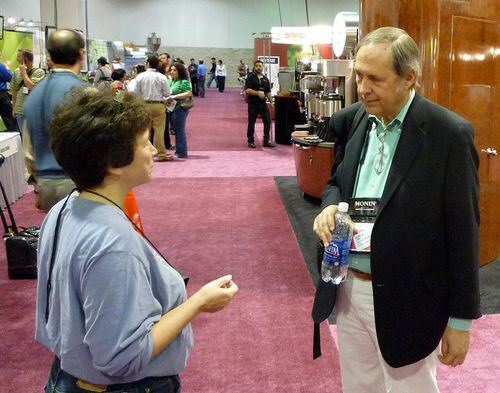
If only George Howell of Terroir Coffee had been in the previous photo. Another VIP of specialty coffee who has been thoroughly patient and kind in answering my questions. I always enjoy catching up with him at these events.

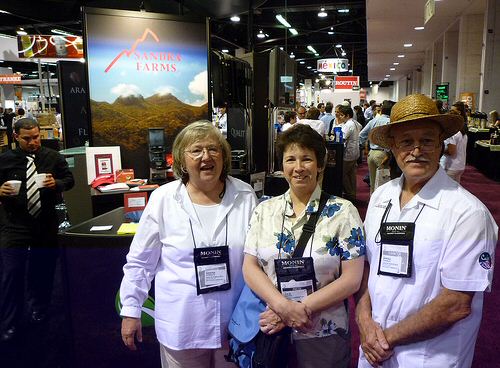
Meeting producers is a highlight of SCAA events. This is Sandra and Israel Gonzalez of Sandra Farms in Puerto Rico. They are the in-laws of one of my University colleagues and a supplier to Michigan roaster Rowster Coffee, so I have long wanted to meet them. What an incredibly charming couple! You’ll be hearing more about them and Sandra Farms in the future, because I know we will visit the farm when we go to Puerto Rico within the next couple of years.

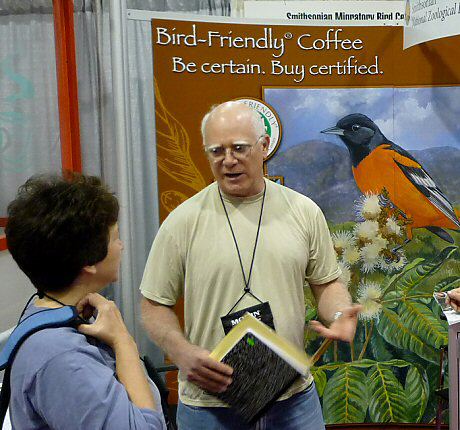
Of course, we have to stop by the Smithsonian Migratory Bird Center booth and say hi to our friend Dr./Mr. Robert/Bob Rice (inside joke), who runs the Bird-Friendly certification program. Aside from Andy Sprenger, there aren’t too many people at these events with whom we can talk coffee AND birds.

We were invited to a cupping of some Utz Certified Latin American coffees…

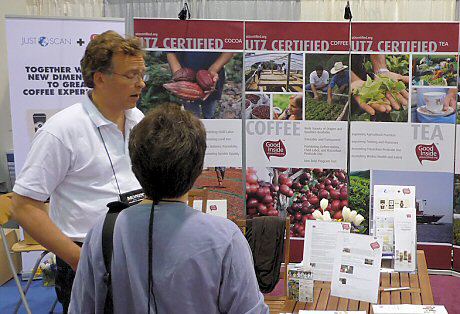
…and we got to spend more time talking with folks from Utz (Graham Mitchell here) about their certification. They have modified their standards since I last wrote about them, and I now have a better understanding of their goals and achievements. I’ll be writing more about them in future posts.

And we also spent time with the good folks from Rainforest Alliance, like Petra Tanos, who has been great about getting me information. RA rolled out an excellent implementation guide for Latin American coffee farmers, which I’ll be writing about, and told me about a couple of other upcoming initiatives that I am excited about — in spite of what the expression on my face might suggest. Believe it or not, there is a worse photo of me from this conversation!

We spent some time with folks from S&D Coffee. S&D supplies some McDonald’s and other restaurants and retailers, in addition to have several of their own coffee lines. I was impressed with their concern with sustainably-grown coffee, as evidenced by my conversation with two representatives from the importer Sustainable Harvest, who were at the S&D booth making deals. I am learning more about the import/export side of specialty coffee, as well as about the larger roasters and suppliers. Expect more on these topics as I incorporate this knowledge into my posts.

The foot soldiers of the specialty coffee industry are the roasters. Here I am talking trash (at the garbage bin next to the Barista Guild brew bar) with Chattanooga’s finest roaster, Bryan Dyer. Bryan is one of the funniest and sweetest coffee guys we know. We’ve met and befriended so many excellent people at SCAA events that we no longer wander around like aimless outsiders, but now have a full social schedule!

Aside from hob-nobbing, we attended several lectures every day on sustainable coffee issues, tasted a lot of great coffee, watched talented baristas do their thing, pondered many coffee-related products, and generally had a good time. I was invited to be on a panel on eco-certifications next year in Houston, and I hope we will be able to work it into our schedules. There’s this little conflict with spring bird migration and my day job…

Caribou Coffee: All Rainforest Alliance by 2011

Caribou Coffee recently announced that it will be sourcing all of its beans from Rainforest Alliance certified farms by the end of 2011.

Caribou has been working towards this goal since mid-2006. Many of its coffees contain varying levels of Rainforest Alliance certified beans; Rainforest Alliance allows use of their seal on packages containing a minimum of 30% certified beans, so long as the percentage is displayed on the seal. That made me wonder if this announcement meant that every variety of coffee at Caribou would have RA-certified beans, or that every variety would consist of 100% RA-certified beans.

At the recent Specialty Coffee Association of America (SCAA) event, I verified that every variety of coffee at Caribou would consist of 100% RA-certified beans. This certification doesn’t necessarily mean it is shade-grown coffee, but meets a variety of environmental and social criteria.

Caribou Coffee is the second largest coffeeshop operation, behind Starbucks, with over 530 stores in 16 states as well as outside the U.S. It currently has seven varieties which are 100%  RA-certified: Colombia TimanÁ¡ (my personal favorite), Guatemala El ParaÁ­so, Sumatra Samosir Batak, La Minita Peaberry, Costa Rica Sombra del Poro, Lacuna (a blend of Guatemala, El Salvador and Ethiopia), and Lakeshore Blend (Guatemala, Costa Rica and Ethiopia). Including other coffee offerings which are at least 30% RA-certified, Caribou currently sources about 17 million pounds of coffee a year from RA-certified farms.