JulieCraves

Endangered coffee

I previously discussed the important species and varieties of coffee. An understanding of these varieties can be of great help to consumers looking for sustainable coffee, as different types are typically grown under shade or sun conditions.  The species and varieties of coffee familiar to consumers, however, are just a tiny part of the coffee family tree.

Rather astonishingly, no comprehensive monograph on the taxonomic status of coffee has been published since the 1940s.  That was recently remedied by a lengthy paper published in the Botanical Journal of the Linnean Society.* It details 103 species in the genus Coffea: 41 species in Africa, 59 in Madagascar, and three in the Mascarene Islands; no naturally-occurring Coffea species are found outside of these three areas, and no species is shared between the three areas.

While most of the paper is of interest only to botanists, one aspect is quite striking.  Over 70% of coffee species can be categorized as threatened using World Conservation Union (IUCN) Red List definitions:

  • 14 species (13.6%) are Critically Endangered,
  • 35 species (33.9%) are Endangered, and
  • 23 species (24.2%) are Vulnerable.
  • An additional 13 species (13.7%) are Near Threatened.

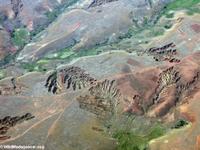
The majority of the most threatened species are from Madagascar, an island with a high level of endemism and deforestation. The authors note there is virtually no in situ preservation of coffee genetic resources, and there are difficulties in conserving coffee genes ex situ because of its general lack of suitability for placement in seed banks (see also my post on The value of wild coffee). Habitat loss is the single most important threat to rare coffee species. The photo shows dramatic erosion on deforested areas in western Madagascar, courtesy of Rhett Butler’s excellent Wild Madagascar web site, where you can read more about this country’s environmental issues.

*Davis, A. P., Govaerts, R., Bridson, D. M., and Stoffelen, P.  2006. An annotated taxonomic conspectus of the genus Coffea (Rubiaceae). Botanical Journal of the Linnean Society. 152:465-512.

Coffee Review reviews supermarket coffees

The latest at Coffee Review is a look at mainstream supermarket coffees.  Reviewing prepackaged, pre-ground coffees is a departure for Kenneth Davids’ site, which is the best source on the web for reviews of specialty coffees. Davids was honest, perhaps even courageous, giving a couple of coffees fair scores. However, his overview states that “the mainstream supermarket coffees reviewed here offered mainly mediocrity, bracketed by a couple of excursions into pretty good and more than a couple into sheer repulsiveness.”

Just because a few coffees scored “pretty good” should not encourage people to stick with these cheap beans, for reasons described below. He reviews 14 coffees available in major supermarkets, which include a couple I’ve never heard of (regional?) and some “crossover” products such as Peet’s and Starbucks.  You should certainly read the whole article, but I’d like to mention two points he makes about the big corporate coffees. He reviews Maxwell House and two Yubans (all owned by Kraft); four by Folgers (owned by Procter & Gamble); and MJB Premium (owned by Sara Lee).

All of these commodity brands share a similar heritage.  Davids writes:

Most of the robustas in the cans appeared to have been steamed to remove the sewery taints these coffees acquire through being dried inside the fruit in rotting heaps. The result is a neutral, cloyingly sweet, woody, vaguely nut-like cup, usually with a slight residual hint of rot. All of the standard branded, canned blends shared a similar steamed-robusta-heavy profile, with only minor differences.

Aside from the lousy taste, the corporate (and public) thirst for cheap robusta beans is what precipitated the coffee crisis, driving thousands of small farmers who grew quality arabica beans out of business. This is most often framed as a serious humanitarian crisis — and it is — but it has also been an ecological disaster. Plummeting prices led farmers to sell their farms, or convert them to less environmentally-friendly crops (including drugs) or to sun coffee. Please read more here.

Davids discusses what inexpensive coffees mean to farmers, even the theoretically beneficial types like the Rainforest Alliance certified Yuban blend (which I discussed in depth here). He notes, “mainstream supermarket coffees generally fail to provide much option for those of us who want to recognize and reward coffee growers as our colleagues rather than exploit them as unacknowledged drones in the vast global commodity hive.”

One coffee he reviewed, which got a decent score, was Wal-Mart’s Great Value 100% Arabica, which was also incredibly cheap (“someone got shafted..at the coffee-tree end of the supply chain.”) The importance of a retail giant like Wal-Mart in the coffee business deserves a post of its own, which will be forthcoming.

KLM to serve Rainforest Alliance coffee

KLM Royal Dutch Airlines joins Asiana Airlines (Korea) and ANA (Japan) in pledging to serve Rainforest Alliance certified coffee on all its flights.  KLM serves 22 million cups of coffee annually.

This is a step in the right direction, but only a step.  First, the commitment is for "at least 30%" of the coffee it buys to be RA certified. This is the minimum level allowable by RA for a product to carry the RA seal.  It’s a familiar figure…remember the Yuban ad campaign?

According to the press release, the certified bean portion of KLM’s coffee comes from shaded coffee farms in the highlands of Colombia and the cerrado region of Brazil. I’m sure the Brazilian coffee isn’t shaded, since cerrado is savannah, not forest, and RA standards call for "Farms in areas where the original natural vegetation is not forest must dedicate at least 30% of the farm area for conservation or recovery of the area’s typical ecosystems."  I have yet to find a Brazilian coffee I am comfortable with, because the cerrado area is so unique, biodiverse, and endangered that I am reluctant to encourage any further expansion of coffee agriculture there.

I can understand the charges of greenwashing reported in the press, as environmentalists correctly point out that airlines produce massive emissions that contribute to global warming. An industry spokesman made a great point when he said, ”While this is not a directly hypocritical move and it’s great that sustainable coffee is being used, it does not make KLM an ethical company.” 

I tend to think that any move in the right direction is a good one, which I believe is the outlook taken by RA when they are criticized for what appears to be aiding large corporations green their images.  If RA required 40% of beans to be certified to allow use of their seal, would that really thwart some companies from participating? Could they require a phased approach, with increasing volumes over time as a requirement?  Frankly, it looks like there needs to be a "next step" beyond these first steps.

Coffee and biodiversity hotspots

The image above (click to enlarge) is from the May 2002 issue of Scientific American (“Rethinking Green Consumerism” pdf) and shows the overlap of coffee growing areas and biodiversity hotspots (defined as spots housing 44% of all vascular plant species and 35% of all land-dwelling vertebrate animal species). I think this handily illustrates the importance of encouraging — through our purchasing power — coffee farms that preserve habitat, do not use harmful chemicals, and cultivate coffee in a way that is as close as practical to nature.

In 2007, resolve to buy coffee that protects and and cherishes the health of the people who grow it and the environment in which it is grown.  Happy New Year.