Wal-Mart and Sam’s Club coffee
In my post summarizing Coffee Review’s look at supermarket coffees, I mentioned that Wal-Mart’s coffee deserved special attention. I was unable to find out exactly where Wal-Mart sources its ”Great Value 100% Arabica” but I can tell you where it sources its Sam’s Club’s Member’s Mark: Café Bom Dia, a huge Brazilian coffee roaster and importer. Because Wal-Mart prefers to (has to) work with large suppliers, and because the Great Value coffee contains beans from Brazil, I’m sure this is a major source for the Great Value as well as the Member’s Mark.
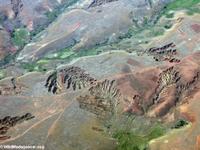
So, when you buy coffee from Wal-Mart or Sam’s Club (including the Café Bom Dia and Marques de Paiva brands), here is where your coffee comes from:

The photo is from the Café Bom Dia web site (since removed). The coffee is grown in the Mata Atlantic Forest region in the southern Brazilian state of Minas Gerais, one of the world’s biodiversity hotspots. Only 7.3% of the original forest remains, having been cleared for agriculture, with coffee being the major crop. In the Mata Atlantic, 40% of the plant species are found nowhere else on earth, and there are 30 critically endangered vertebrate species, including 15 birds.
Café Bom Dia has 3 million coffee trees on over 741,000 acres. Although deforestation from coffee cultivation has occurred since the beginning of the 19th century, I do not want to buy coffee grown in this manner, nor do I want to encourage this type of production or expansion of these farms. Sustainably grown coffee mimics, at least to some degree, the natural forest system. High production coffee is its antithesis, a factory system geared towards efficiency, uniformity, and low cost. Economies of scale dictate that when you buy coffee from large retailers and corporations, you are not supporting biodiversity and with your dollar are voting against the environment.
It is astonishing to me that Member’s Mark brand is Rainforest Alliance (RA) certified. I’m guessing that once again this means that the coffee includes only the minimum 30% certified beans, but I am writing RA for clarification. Frankly, I don’t understand how RA can justify encouraging purchase of coffee from companies which obtain most of their coffee from giant monocultures. We’ll see what they say.
More information:
- Biodiversity Hotspots: Atlantic Forest. Conservation International.
- Atlantic Forest of Brazil. Nature Conservancy.
- Ecosystem profile, Atlantic Forest in Brazil. Conservation International.
- For Wal-Mart, Fair Trade May Be More Than a Hill of Beans — Story on sourcing from Café Bom Dia. Washington Post, June 2006. And a response to this article from the Organic Consumers Organization.
Update: Wal-Mart’s trustworthiness regarding organic food labeling is discussed in this new BusinessWeek article, which links to photographs taken by the Cornucopia Institute showing misleading labeling.
Further update (2008): Fact check on Walmart’s false claim about Sam’s Choice Rainforest Alliance certified coffee.