Green Mountain climate change grant finalists

Last month, Green Mountain Coffee Roasters announced a request for proposals for four $200,000 grants to organizations working on climate change. The grants will be awarded in each of four categories: transportation-related emissions, threats to coffee-growing communities, building political will, and empowering individual action.

They’ve just announced the finalists in each category. While I’m disappointed that a proposal by the Smithsonian Migratory Bird Center (developers of the Bird-Friendly shade coffee criteria) didn’t make the cut, I see that another great organization did. The American Bird Conservancy is one of five finalists in the Threats to Coffee Growing Communities category. Here is a summary of their proposal:

[We] will determine the additional carbon load held by shade coffee plantations over sun coffee plantations, and calculate the income differential per acre for coffee production for shade and sun  growers. We will then test a system to stream carbon offsets credit funding incentives to shade growers to compensate for the difference in income between the two systems. If it can be shown that shade coffee can be economically beneficial due to its additional carbon load (from both a sale of credits and/or consumer interest), then this project stands to benefit farmers across millions of acres of the Andes and could be the land management driver that saves the Cerulean Warbler the fastest declining songbird in North America on its wintering grounds. The project will have multiple additional benefits for famers and local communities in terms of the protection of watersheds and traditional farming techniques which are currently threatened by conversion to sun coffee.

ABC does excellent bird conservation work at home and internationally, and does so very cost-efficiently. They are very familiar with Latin American shade coffee issues. I’ve written about their Cerulean Warbler campaign, which has included working with Colombian partners and shade coffee farmers to preserve wintering habitat for this declining songbird. ABC has continued to work on reforestation projects in South America which includes shade coffee farms. I’ve also written about the potential for coffee farms to provide carbon sequestration services, and think the ABC proposal is very worthy of support.

For the next week, the public can vote for and comment on proposals at JustMeans.

Nicaraguan shade coffee: Finca Esperanza Verde

Last winter, I spent some time in Chiriqui, Panama, and visited some coffee farms. I summarized what I found in my post “What shade coffee looks like.”

I’ve just returned from Nicaragua, where I spent a week at Finca Esperanza Verde doing bird and insect surveys, and especially bird banding. FEV is located near San Ramon in the central highlands of Nicaragua’s Matagalpa department. It consists of about 106 ha, of which 10 are in active coffee production; a handful cover the organic garden, small coffee washing facility, and eco-lodge; and the rest are in native forest, forest restoration, and fallow shade coffee.

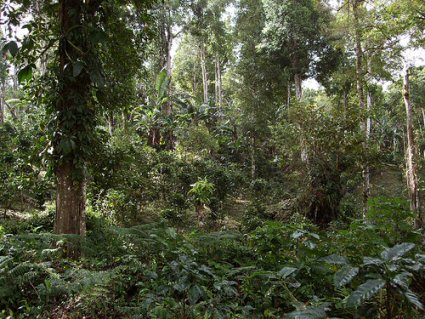
We were participating in the fifth year of a banding project initiated by the North Carolina Museum of Natural Sciences, and the research was done entirely in the coffee production area, shown above.

In the shade continuum from rustic to shaded monoculture described in my introductory post “What is shade-grown coffee,” the production areas I saw fell into the highly desirable traditional polyculture category. Recall that one reason certifying shade coffee can be so complex is that coffee is often grown in a matrix of different crops and land uses and varying levels of shade management depending on location within a farm.  Yet every area I visited at FEV had the same lush growth and diverse shade.

FEV is certified organic, and is being actively courted by Rainforest Alliance for certification and use as a model farm. I believe FEV also qualifies for Smithsonian Bird-Friendly certification, and that is being looked into as well. More on that in a future post.

Leaves from the shade trees provide a thick, natural mulch for the coffee, and help curtail soil erosion and moisture loss while offering nutrients.

Even more so than the areas we visited in Panama, Finca Esperanza Verde and other shade coffee farms are critical to birds and other wildlife in Nicaragua. We were stunned at the deforestation. It’s not due to human development, but to agriculture (mostly non-commercial) and (especially) cattle grazing. Shade coffee farms appeared to be one of the only land uses that preserved a lot of native trees.

During our brief stay, we counted well over 100 bird species, including nearly two dozen species of migratory songbirds that breed in North America. Over 30 species of migrant songbirds have been recorded at the finca, and the overall bird list is approaching 300 species. We observed or banded several species new to the finca ourselves.

You can read more about the migratory bird species we encountered at the Rouge River Bird Observatory’s blog Net Results. I thought I would cover some of the resident species here, focusing on a few of the species that we banded. Bird banding is an excellent complement to bird surveys — some of the most common bird species we saw were rarely captured, and we rarely observed many of the species we captured.

Crimson-collared Tanagers (Ramphocelus sanguinolentus) favor areas of dense shrubs in second growth, but will also come to trays of fruit placed at feeding stations.

White-breasted Wood-wren (Henicorhina leucosticta) is a forest species that favors dense tangles, especially around fallen trees.

Cocoa Woodcreeper (Xiphorhynchus susurrans) prefers gallery forest and older second growth, and forages on large trees by probing the bark, epiphytes, mossy clumps, and vines — which wouldn’t be left on trees in intensively managed coffee farms.

I was happy to band several Black-headed Nightingale-Thrushes (Catharus mexicanus), since they are closely related to the species that I research at home. These shy, elusive birds prefer thick cover and forage mostly near the ground or in the leaf litter, conditions they would not find on a sun coffee farm.

Not only is this farm great for biodiversity, it produces fantastic coffee. It placed 10th in the 2007 Nicaraguan Cup of Excellence. Coffee from Finca Esperanza Verde is sold exclusively to Counter Culture Coffee, where it is the main component of their Cafe San Ramon.

Bird-Friendly coffee now available in Europe

I’m back from Nicaragua — and yes, I did see Emerald Toucanets at two different shade coffee farms. I’ll be writing about my trip soon.

Meanwhile, news from the Smithsonian Migratory Bird Center. Certified Bird-Friendly coffee is finally available in Europe. Simon-LÁ©velt Coffee and Tea is offering it through its stores in The Netherlands and Belgium. Their web site is in Dutch, but I see that they do offer online ordering, so perhaps folks in other countries will have access as well.

National Geographic Terra Firma coffee

(Note: As of 2013 it appears that this coffee has been discontinued.)

The National Geographic Society is getting into the coffee business. They are rolling out a line of specialty-grade coffees called “Terra Firma.” They are all be single-origin coffees, from six countries: Brazil, Ethiopia, Sumatra, Kenya, Colombia, and Costa Rica. Net proceeds from Terra Firma coffee will support programs of the Society. Initially, it will only be available in the U.S., to both retail and food service users.

It’s not shade coffee
According to their press release, this coffee is “crafted to emphasize environmental and cultural sustainability in coffee-farming communities.” Further motivation apparently stemmed from results of a survey NatGeo contracted which indicated “being environmentally friendly” influenced the purchasing decisions of a majority of American. Yet although the coffees will be Fair Trade certified, none are certified organic or shade grown (Rainforest Alliance or Smithsonian Bird-Friendly). You’ll have to wait for one of those; there are plans to release an organic or Rainforest Alliance certified coffee in the future.

With all of Nat Geo’s emphasis on the environment, not to mention their long commitment to science, the lack of organic and/or shade certification for the Terra Firma coffees is bound to stick in the craw of educated consumers. The press release states that Fair Trade certification “guarantees…environmental stewardship,” which it does not.

On the plus side, at least we know who is roasting their coffee.
The Terra Firma coffee will be sourced and roasted by the Brazilian firm Café Bom Dia. Americans perhaps best know them as the source of the coffee sold at Sam’s Club and WalMart under the Member’s Mark and Marques de Paiva brands.

Since I last wrote about Café Bom Dia, their web site has had an overhaul and there is additional information about their sustainability efforts, which are certainly the most impressive of any of the large coffee roasters. Their main roasting facility is in Varginha, Minas Gerias, Brazil, where the roasters run on biomass (“sustainably forested eucalyptus” and wood from coffee trees taken out of production). This facility has zero net carbon emissions and is certified CarbonNeutral. This is where the Terra Firma coffee will be roasted.

Specific sources
Café Bom Dia owns and manages farms in Brazil, but also has a network of 4800 producers in all the Terra Firma countries of origin except for Kenya, which will be a new relationship for Café Bom Dia. Because large plantations and family-owned farms do not qualify for Fair Trade status, the Brazilian beans will not come from Café om Dia farms, but from Fair Trade cooperatives in southern Minas Gerias. The specific sources for the beans from other origins will depend on harvests and availability — the usual criteria for large-volume efforts that depend on a particular flavor profile and price point. I was told by that for this initial line of Fair Trade coffees, source cooperatives will not be chosen specifically for their environmental practices.

National Geographic drops the ball
I obviously have a preference for (and encourage people to seek out) coffee in which the specific origins — and therefore growing methods — can be easily traced and explored. In my opinion, the problem with the Terra Firma coffee isn’t that NatGeo partnered with Café Bom Dia. In fact, I commend Café Bom Dia for always being responsive and straightforward with me, and for what I believe to be a more sincere effort to run an eco-friendly business than any other large roaster. Café Bom Dia can and does source organic and Rainforest Alliance certified coffees — it’s what they sell at Sam’s Clubs and WalMart, where their Rainforest Alliance coffees are even 100% certified beans. What is remarkable is National Geographic did not choose these sustainable coffees for their initial offerings.

In preparing this post, I first wrote to Café  Bom Dia with questions about this choice. Café Bom Dia provided much of the information above, including the fact that organic or RA certified selections were planned for the future. I followed up with NatGeo specifically asking about the choice not to initially include more eco-friendly selections. Here is their reply:

While you do raise some interesting questions, we have to defer to Café Bom Dia on the finer points of their coffee production methods.

In keeping with our mission to “inspire people to care about the planet,” we do our best to promote sustainability through our mission-oriented projects, editorial endeavors and licensed products. There are many factors that are taken into account when choosing a new partner: we chose Café Bom Dia because of the company’s commitment to sustainability and its pedigree as a certified Fair Trade supplier.

In recent years, NatGeo has licensed their brand on a wide range of disparate products, including digital music, apparel, and home furniture. Given the serious impacts of coffee growing on the environment, coffee seems like a better fit than many of the other items that display the NatGeo logo. It presents a fantastic educational opportunity — the power of National Geographic to inform consumers about coffee sustainability issues is tremendous. The Society has 8.5 million members, but its reach and respect go far beyond those numbers. It would have sent a strong message if they had chosen to market and promote certified, eco-friendly coffees. Actually, the fact that they did not sends an equally strong one.