Five great charitable donations related to sustainable coffee

Looking for a holiday gift idea related to sustainable coffee? Here are my five top picks of where to direct your charitable giving. These organizations either directly help coffee farmers or their communities, or support bird research in coffee growing areas. Happy holidays.

  1. Coffee Kids — International non-profit organization established to improve the quality of life for children and families who live in coffee-growing communities. Now operating under a larger foundation.
  2. Smithsonian Migratory Bird Center — Establishing criteria and certifying Bird-Friendly coffee is not the only function of the SMBC. They have many other very important and worthwhile research projects. The donation form directs funds to the parent organization, Smithsonian’s National Zoo and Conservation Biology Institute.
  3. MoSI — Sponsor a bird banding station in the tropics. The Institute of Bird Populations (IBP) coordinates a series of bird research stations across the American tropics, many of which are on or near coffee farms. They provide absolutely vital information on how birds use these habitats in areas where this kind of research is still uncommon and underfunded. MoSi comes from the Spanish “Monitoreo de Sobrevivencia Invernal” or Monitoring Overwintering Survival. You can support the research either by joining IBP at various membership levels, or adopt an entire station for only $300.
  4. TechnoServe — This organization helps people in developing countries launch and build businesses that create income, opportunity, and economic growth. They have an entire agriculture sector that has done solid work specifically on coffee projects, often working with farmers and co-ops, in Nicaragua, El Salvador, and other countries.

Tim Hortons coffee and the environment

If you are Canadian or live in a U.S. border state, you know Tim Hortons. This coffee and donut/fast food shop completely dominates the carry-out coffee market in Canada, with over 2,700 locations serving around 3 million cups of coffee a day, leaving Starbucks a distant second. Tim Hortons is such a Canadian cultural icon that there is even a store in Kandahar, Afghanistan, serving Canadian troops. There are also 345 stores in the U.S. with a goal of 500 by the end of 2008. Tim Hortons was acquired by Wendy’s International in 1995, but divested and spun it off late in 2006, so Tim Hortons is once again an independent company.

Is Tim Hortons coffee sustainable?

The coffee
The one-sentence summary is this: Tim Hortons does not sell organic coffee, does not sell Fair Trade coffee, and does not disclose the source of its green beans.

On their web site, the company explains, “we decided against buying fair trade coffee” and instead developed a program that works directly with the growers. This program, initiated in 2005, is called the Sustainable Coffee Partnership, and is implemented and managed by the outside organization EDE Consulting, of the Neumann Kaffee Gruppe, Hamburg, Germany. The Partnership will focus on three-year projects. These will provide technical assistance and investment in infrastructure to improve productivity and quality, aid in crop diversification (such as bananas), address the needs of families, and emphasize  “the need to respect and
protect the environment.”

The 2006 Tim Hortons annual report notes that part of the purpose of the Sustainable Coffee Partnership is to “fight against poverty among the people who provide one of the Company’s most important products, and to play a meaningful role in providing for the future supply of quality green coffee.” Therefore, the sites of the projects presumably give an indication of where Tim Hortons sources some its coffee. The first project was in Guatemala, with 750 producers in the communities of Zacapa, Chiquimula and Jutiapa near the Honduran border. Other projects are with 200 producers in Colombia in northern Huila, and in Brazil.

Colombia and Brazil are two of the biggest producers of technified “sun” coffee in the world, but there is no information on how much coffee they source from which countries or how it is grown. Their annual report merely says they have “many suppliers and alternate suppliers for coffee.”


Waste

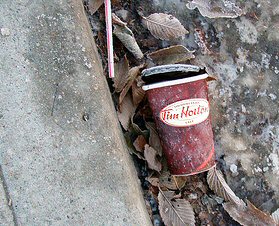
I found that one couldn’t research Tim Hortons without coming across a lot of material on the ubiquity of disposable Tim Hortons coffee cups. They evidently paper Canada. An article in Macleans quoted a Sierra Club representative who said, “The Tim Hortons cup is easily the No. 1 recognizable item of litter in the country.” One often-cited statistic is that 22% of the litter in the province of Nova Scotia was from Tim Hortons.

Of course, it’s not really the company’s fault if people don’t properly dispose of their, and the company has started some anti-litter campaigns. Nonetheless, Tim Hortons cups contain no recycled material and are not recyclable. The company objected to a proposed tax on non-recyclable cups in Toronto, saying “We’re not a waste-management company. Our product is very price-sensitive.” They have recycling at some of their locations, but I’m unclear on whether it includes the cups. Tim Hortons apparently also offers a discount for bringing your own mug, but this customer (scroll to the bottom) discovered that the employee used a paper cup to fill the customer’s mug. I have had this happen myself on more than one occasion at different establishments, although not Tim Hortons.

Updated addition: Tim Hortons also objects to having its drive-through lanes be subjected to an anti-idling ordinance in Ontario.

Frankly, I’m not impressed with the sustainability efforts of Tim Hortons, or their products.

Photo of store by Thiesen.
Photo of cup in gutter by Kevin Steele.

"Fortified" coffee: flim-flam alert

Spava Coffee [which went out of business after this post was published] is organic coffee “fortified” with natural ingredients to “enhance wellness.”  There are currently five varieties, such as “Calm” and “Clarity.” It’s amazing to me the number of news sites and blogs (with the exception of TheShot) that have reported on this, regurgitating press releases and not critically assessing this product. Let’s take a look.

The supplemental ingredients are added to coffee by first being powdered and added to directly to ground coffee, or dissolved in water or propylene glycol and then sprayed on whole beans, according to the patent application.

The nutrition information on the packages indicates that the quantity of the supplements in the coffee are very small, a practice known as “angel dusting.” The labels specify these amounts are as packaged. In other words, before the coffee is prepared. Even if you received the full 20 mg of ginkgo per serving in the “Clarity” coffee, for example, this is far below the dose of greater than 120 mg (used daily for extended periods) that two studies suggested may be effective (although not for mental clarity in healthy adults).

“Fortifying” coffee in this way also assumes that the ingredients are delivered in the form that preserves the potency and properties of the biologically-active compounds (which may not be ground-up powder), that chemical properties of the ingredients remain stable through the coffee brewing process, and that these compounds are not altered by the potent chemical properties of coffee and caffeine itself.

Finally, you have to believe that these supplements actually “enhance wellness.” The health benefits of most of them have little peer-reviewed science behind them. Vitamin B6 has not been proven to help depression as suggested by Spava for their “Calm” coffee, and the 150 micrograms per serving is 9 times less than the 1.3 milligrams or more recommended dietary allowance. Echinacea, an ingredient in the “Immunity” coffee, is unproven in helping bolster the immune system. The other ingredient, Siberian ginseng, is derived from the plant Eleutherococcus senticosus, which is a cheap alternative to Panax ginsengs. It contains none of the active compounds in Panax species that have been scientifically studied.

And so on. Spava Coffee is a feel-good product not from a literal perspective, but a psychological perspective.

Perhaps this is a benign, clever marketing tool, although Spava’s parent company Voyava Republic has received criticism for its plan to improve the nutrition of Mexican children by giving them fortified coffee. The company and the local coffee co-operative, La Selva, believe they can deliver adequate doses of folic acid and iron via coffee, which they say the kids drink anyway. As discussed above, this is dubious to me. If the company wants to help, why not just do the obvious and provide standardized, accepted nutritional supplements? Presumably because under the current deal, Voyava profited by selling La Selva its technology and equipment, and La Selva got a deal where 10% of Voyava’s fortified coffee must be from Chiapas. I also have to wonder if Mexican children typically suffer from folic acid deficiency, given that some of the best sources of folic acid are common foods in tropical regions:  beans, eggs, and citrus fruits in particular.

Update: In a recent announcement, Spava revealed the amount of folic acid in their coffee will be 80 micrograms. This is a third of the RDA, and 20 micrograms less than the amount used in fortified flour. Even the amount in flour has been criticized as being far too little to help prevent birth defects, the reason for flour supplementation. Read more in this New York Times piece.

Overall, the concept of fortified coffee just leaves a bad taste in my mouth.

Kenya producing more organic coffee

A recent article notes that more producers in central Kenya are turning to organic coffee in order to take advantage of price premiums. This is welcome news, as over the last 15 years or so, Kenya has been one of the heaviest users of pesticides on its export crops, with around 60% of its pesticide use on coffee (primarily the large estates). The FAO reports that in 2001 (last year full data is available) Kenya used 303 metric tons of insecticides on its crops (215 of which were nasty organophosphates) versus 153 in Ethiopia and 69 in Rwanda.

Inadequate training, sanitation, and protective gear meant workers and the environment suffered from contamination. Less than 1% of Kenya’s total agricultural area is now organic, but organic agriculture stakeholders have formed the Kenya Agriculture Organic Network to support the successful growth of the sector.