Research: Sumatran coffee weak on preserving forest biodiversity

Philpott, S. M., P. Bichier, R. A. Rice, and R. Greenberg. 2008. Biodiversity conservation, yield, and alternate products in coffee agrosystems in Sumatra, Indonesia. Biodiversity Conservation 17:1805-1820.

The vast majority of field research on biodiversity conservation in coffee agrosystems has taken place in Latin America. For that reason, there has been some criticism that using “shade coffee” for conservation may not apply to coffee growing regions in other parts of the world. So this paper, by well-known coffee researchers currently or formerly associated with the Smithsonian Migratory Bird Research Center, is a welcome addition to the literature.

This study took place in and around Bukit Barisan Selatan National Park in Lampung province, southwestern Sumatra. Last year, the World Wildlife Fund reported that 30% of the park has been lost to illegal agriculture, mainly coffee which was documented as having been purchased by Kraft and other large roasters (this post summarizes the report’s findings; more on the status of these farms later in this post).

This study looked at differences in vegetation, ants, birds, and crop characteristics between forest in the park, and coffee plots both within and outside the park. These farms all cultivate robusta, not arabica, coffee. Robusta is typically grown in full sun, but it has been shown to benefit (via higher yields) from some shade, especially in poor soil conditions.

Not surprisingly, and consistent with other studies, coffee plots, whether inside or outside the park, had fewer species of trees, ants, and birds than the forest. The forest had far more canopy cover, denser canopy thickness, taller trees, and more epiphytes than any of the coffee plots.

The Oriental White-Eye (Zosterops palpeborsus) was one of the most commonly encountered species in forest, but it was not found in coffee plots either within or outside the park.

Various metrics between coffee plots within or outside the park were actually quite similar, including amount of canopy cover (around 32%), and number of species of trees, ants, and birds. However, although the number of species was similar, there was very little similarity in the species composition of all taxa between coffee plots and forests. This is in contrast with studies looking at the same variables in Chiapas, Mexico, which found much higher similarity between forests and coffee plots. It indicates that these robusta coffee farms in Sumatra do not maintain most forest species.

There are some contributing factors that make coffee farms in this area poor reserves for biodiversity. Sumatran coffee farms use very few species of shade trees, including the non-native Gliricidia sepium, which may not provide proper resources for native fauna. In general, the farms had very poor soil conservation practices, no use of organic fertilizers or compost, and minimal ground cover. Farmers will need help in sustainable agriculture management to help alleviate these problems.

This will be challenging enough for the legal farms outside the park. As for the ones inside, some of the 15,000 families which have illegal plots in the park have been there for up to 20 years, and there is little place in the surrounding landscape for them to farm if they are removed — even if they are provided incentives for farming outside the protected area. Sadly, other studies have indicated that even if they are removed, forest recovery is slow in this area and expensive restoration efforts would likely be required in order to rehabilitate agricultural encroachments.

It sounds like the bulk of this coffee is sold to the large multinational roasters for grocery store blends, who could well afford to assist in developing sustainable agricultural in the area that supports biodiversity and farm family income. These results also suggest to me that consumers should be looking to buy sustainably-grown arabica coffee from Sumatra, purchased via roasters who have relationships with their farmers.

Photo by Lip Kee under a Creative Commons license.
Walmart’s deceptive coffee claim

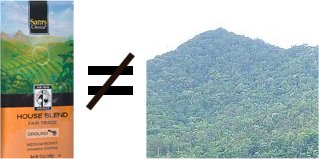
Walmart claims that if every Walmart shopper bought a bag of Sam’s Choice Rainforest Alliance (RA) certified coffee, it would preserve 135,000 acres of land.

And that’s complete bull.

In researching another article, I came across Walmart’s “Sustainability Substantiation” page. It lists a number of their “earthy-friendly” products, and the supposed impact if every Walmart shopper bought one of that particular item.

The claim for Sam’s Choice Rainforest Alliance (RA) certified coffee is that if every Walmart shopper bought a bag, it would preserve 135,000 acres of land. Here’s how they calculated it:

200,000,000 = the number of Wal-Mart shoppers
0.000675 = acres of land every 12oz bag of Rainforest Alliance certified coffee helps preserve
135,000 = acres of land that 200,000,000 12oz bags of Rainforest Alliance certified coffee helps preserve

The math is correct, but the premise is completely wrong. I don’t know where they got the figure that each bag of coffee “preserves” a fraction of an acre of land, but it really doesn’t matter. The fact is that buying RA certified coffee doesn’t preserve anything. RA doesn’t take a portion of each sale and go out and purchase land and create nature preserves, and coffee farmers don’t take their small extra profit from the sales of certified beans and go purchase land to “preserve” (if anything along these lines, they’d plant more coffee, perhaps clearing land to do so). The land is already “saved,” no matter how many bags of coffee from these farms is purchased.

Further, the majority of the land (or “tropical forest”) this coffee purports to preserve (or “help preserve,” “protect,” or “save” — different terms and calculations are used on the page as well as the web page of the coffee itself), is not pristine forest or forest at all, it’s COFFEE! Some farms do include land set aside for conservation, but the bulk of certified land is planted in coffee under varying degrees of shade. As I write about here all the time, it’s better than sun coffee, but not as good as forest for biodiversity.

The ridiculousness of this claim is illustrated by playing along with Walmart’s math. What if every Walmart shopper bought one bag of Sam’s Choice RA certified coffee once a week for a year, a reasonable level of consumption? That’s 10,400,000,000 bags of coffee, resulting in 7,020,000 acres of land “preserved.”  (Let’s ignore the fact that RA certifies only a million acres of farmland worldwide — including all other crops they certify). The entire country of Brazil, the source of Sam’s Choice coffee, has about 2.3 million hectares (5,681,000 acres) planted in coffee. Look! In less than a year, Walmart shoppers can “preserve” the entire coffee production area of Brazil, the world’s largest producer of coffee!

You get the point.

Don’t get me wrong. I’m not knocking the purchase of Rainforest Alliance certified coffee, from Walmart or anyplace else. I encourage it!  And arguably Walmart can expose more people to the concept of and issues around sustainable coffee than any other retailer in the world, which is terrific. I appreciate this effort at education, but abhor the obvious implication that each purchase contributes to the creation or true preservation of actual forested land. It’s misleading to consumers and does nothing to help those of us who know better to trust Walmart’s sustainability efforts.

Buying Sam’s Choice RA certified coffee doesn’t “save” or “preserve” land. It can encourage, through higher sales and more profit for the producing farms, other farms to become certified. This should result in improved environmental conditions on these farms, such as the addition of shade trees or upgraded water treatment methods — if the farms needed to make improvements to become certified, versus obtaining certification for existing sound practices.  This is a good thing. Why can’t they just say so?

Coffee growing in Colombia

Some background
The marketing of Juan Valdez and “fine Colombian coffee” has been so pervasive for so long, if you ask the average consumer where coffee come from, and they may well say “Colombia.” The country produces about 10% of the world’s arabica coffee, second only to Brazil, with the current output around 12 million 60-kg bags. Ninety percent is exported.

Despite this large volume, coffee growing in Colombia is not characterized by huge plantations. Instead, there are nearly 600,000 producers, of which nearly all (96%) grow coffee on small plots of less than 5 ha. Nearly all represented by the National Federation of Coffee Growers (Federacion Nacional de Cafeteros de Colombia, or FNC), the creator of Juan Valdez. This organization is extremely strong, and has managed to organize these tens of thousands of small producers, get their beans to mills and central processing points, and deliver fairly uniform, though often mediocre, coffee in large volumes. This is what has made Colombian coffee so popular and ubiquitous with the large corporate roasters.

Therefore, this profusion of many small farms mixing all their crops together has made it difficult to find sustainably-grown Colombian coffee, or coffee of very high quality. This is now changing. The FNC has entered the specialty coffee market. Small roasters are developing direct relationships with individual farmers or small cooperatives, seeking out exceptional lots. Since 2005, Colombia has participated in the Cup of Excellence. These efforts have made it easier for consumers to find great examples of the very pleasing coffees this country can produce.

Shade coffee in Colombia
Various sources [1,2,3] indicate that the proportion of coffee grown under traditional shade ranges from 16 to 40%. That means the bulk of it is grown under full sun, or sparse sun interspersed with other crops such as plantains and bananas. To be fair, there are some high-altitude areas in the country where clouds provide the shade, and planting coffee under a tree canopy would be counter-productive. Some of these farms preserve important forest fragments outside their coffee plots.

Rainforest Alliance now certifies nearly 200 5000 farms in Colombia covering 51,000 ha*. There are only three Bird-Friendly certified producers in Colombia; one is the widely available Mesa de los Santos (but check current producers, as they change when up for renewal). So it can still be a challenge to find eco-friendly, great-tasting Colombian coffee.

Birds and biodiversity in Colombia
A remarkable 1870 bird species are found in Colombia, a fifth of the world’s species in a country eight times smaller than the U.S. and more documented species than any other country on earth. While many species of North American migrants winter closer to home in Central America, a number of species make the long trip to South America. One of the most important is the Cerulean Warbler, which has been discussed in a number of other posts. Other species include American Redstart, Blackburnian Warbler (shown top right), Canada Warbler, Mourning Warbler (bottom right) Swainson’s Thrush, Prothonotary Warbler, Northern Waterthrush, and Bay-breasted Warbler.

In fact, individuals of all those species have been found to return to the exact same wintering areas in Colombia on successive years — including a Mourning Warbler and Swainson’s Thrush to a shade coffee farm in Antioquia. I will add that a Swainson’s Thrush banded at my study site in southern Michigan was found two months later near Bucaramanga, another coffee-growing region. This is amazing!

Birds are just an example of the enormous biodiversity of Colombia. There are 55,000 plant species (a third endemic), 697 amphibians (2nd most in the world), and 517 reptiles. Yet Colombian forests and rich diversity they contain are under threat. One major driver is the illegal farming of coca, the raw ingredient for cocaine. Colombia is the world’s largest producer of coca.

Coca/cocaine and the coffee connection
Farmers grow coca because it provides more cash than any other crop. Since 2000, the U.S. has cooperated and helped fund a coca eradication program centered around aerial fumigation with the herbicide glyphosate (RoundUp, made by Monsanto, the folks that gave us Agent Orange). This non-selective herbicide kills all plants, including native species and food crops. Not only does it destroy vegetation, but it has resulted in farmers moving into more remote areas to grow coca, clearing primary forest to do so. Many other adverse environmental and health effects result from this ineffective practice.

When coffee prices dropped in the 1990s, many farmers turned to coca. Encouraging specialty coffee, with its corresponding higher prices and good stewardship of the land, is one tool to help reduce coca production and the deforestation and loss of biodiversity that goes with it. In fact, a recent report noted,

“The head of the United Nations Office on Drugs and Crime (UNODC) is urging comprehensive, large-scale and ecologically-friendly agriculture and forestry schemes in coca growing areas, after a new survey shows a ‘marked increase’ in cultivation in the Andean region.”

There are projects in Cauca and the Sierra Nevada de Santa Marta regions focused on replacing coca with coffee that have met with success. In future posts, we’ll explore the development of specialty coffees in Colombia, and take a look at what’s available and the roasters bringing these coffees to you.

*Updated figures from the 2012 report “Protecting Our Planet“, which outlines Rainforest Alliance’s 25 years of impacts.

[1] COLOMBIA: Working Toward a Sustainable Ecosystem. 2000.- “Ask Juan,” Colombian Specialty Coffees, National Federation of Coffee Growers.

[2] Colombia Coffee Sector Study. 2002. Centro de Estudios para el Desarrollo Econamico (CEDE) de la Universidad de los Andes. Daniele Giovannucci with Jose Leibovich, Diego Pizano, Gonzalo Paredes, Santiago Montenegro, Hector ArÁ©valo and Panos Varangis.

[3] Millenium Ecosystem Assessment. 2004. Colombia sub-global assessment report. Ecological function assessment in the Colombian Andean coffee region.

Photo of a Blackburnian Warbler by Gavan Watson; photo of Mourning Warbler by yours truly.

Rainforest Alliance introduces carbon module

In my post “Coffee farms and carbon sequestration,” I discussed the potential of carbon credits in helping coffee farmers earn extra income, and provided some statistics and references on carbon sequestration on coffee farms in and other tropical agroforestry systems.

As it turns out, Rainforest Alliance (RA) will be adding a carbon module to their certification for farms (coffee, and presumably other crops they certify). This announcement was first made in May at their Sustainable Coffee Breakfast at the SCAA annual conference in Minneapolis. The details are not final, but here is what RA’s Gretchen Ruethling explained to me regarding RA’s past experience and future plans:

We are working with other organizations to help farmers get paid for providing environmental services such as storing carbon and protecting watersheds and biodiversity. The Rainforest Alliance is a registered verifier for leading carbon offset programs including the Climate, Community & Biodiversity Alliance and the Chicago Climate Exchange. We have verified carbon offsets on coffee farms through projects organized by Plan Vivo in Mexico. We verified an ambitious project in Aceh, Indonesia developed by Fauna & Flora International that will reduce deforestation on 750,000 hectares of rainforest. We verified a reforestation project in the highly endangered Atlantic Forest of Brazil as a carbon offset for Jacques Vabre, a coffee brand in France. (That project is managed by a coalition of Brazilian NGOs and led by the Nature Conservancy.)

We are working to offer more incentives to coffee farmers to encourage them to plant more trees. One exciting idea is developing a system that would allow coffee companies to buy carbon from farmers along with their coffee beans — through the existing supply chains. Companies could pay a small carbon premium. In order for this to work, we need a simple, low-cost yet rigorous and highly credible method to estimate the carbon on a coffee farm and verify that it remains year after year. This could be done by auditing the carbon as part of the annual farm inspection by members of the Sustainable Agriculture Network.

I’m thrilled RA is pursuing this concept — it’s a win-win-win situation for the farmer, biodiversity, and the planet.