Know your coffee birds: Jacu
When I conceived the “Know Your Coffee Birds” series, I made up a list of birds often found in shade coffee farms. There was one that was not included that I feel compelled to write about already because it’s being used in a unique way to market coffee: the Jacu bird.

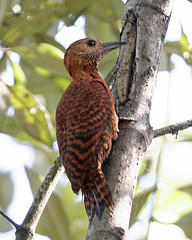
The Dusky-legged Guan, a.k.a. “Jacu”, has found a new career as a coffee picker and processor.
“Jacu” is the Brazilian name given to a group of birds, actually — the guans. Guans are the largest group in the bird family Cracidae — primitive, vaguely chicken-like forest birds found in much of Latin America. There are 15 species of guans in the genus Penelope. All guans are strictly forest birds, preferring primary forest. Due to deforestation and hunting pressure, cracids in general are among the most endangered groups of birds in the Neotropics.
Guans are primarily vegetarians, eating mostly fruit and berries, some flowers and buds, and a few insects. Guans are very important in tropical ecosystems because of their role in dispersing seeds in the forests in which they live. It is this frugivorous diet that leads us to the Jacu’s coffee connection.
Guans eat ripe coffee cherries. While they are unlikely to venture onto sun coffee plantations, they will live in or near coffee farms where coffee is grown in forest-like conditions and/or adjacent to intact forest. Like nearly any animal that eats fruit, guans prefer fully ripe fruit, and that includes coffee cherries. One might imagine this habit would draw the ire of coffee farmers. But at least one enterprising producer is using the philosophy, “If life gives you lemons, make lemonade.” Or in this case, “If life gives you bird crap with coffee beans it it, make coffee.”
In the spirit of kopi luwak, produced from coffee beans collected from the feces of civet cats in southeast Asia, comes Jacu coffee, produced from beans collected from the droppings of guans.
 This coffee is currently being offered by Camocim Estate (two farms: Camocin and Alatalia) in Pedra Azul, Brazil. Pedra Azul is in the southern part of the Atlantic state of Espirito Santo. Two species of guan may be found there: Rusty-margined Guan (Penelope superciliaris) and Dusky-legged Guan (P. obscura).
Fazenda Camocim encompasses 500 hectares in total, with 50 planted in coffee, and the rest re-planted in a forest-rejuvenation project. The farms are certified organic and biodynamic, and utilize fruit and nut trees in the coffee plantings, and native habitat patches as well. All of which no doubt provides habitat and other food for the guans.
Supposedly, some of the ”unique” characteristics of kopi luwak come from the civet’s digestive process, which according to tests leach out proteins which cause bitterness. But a bird’s digestive system is different than that of a mammal.
The digestive enzymes in mammals and birds are similar. But while some cracids do have gizzards in which ingested grit helps crack and grind seeds, it is not well developed in guans. So the beans are not getting a lot of deep scratches that would allow for added absorption of chemicals that might alter the properties of the bean. Most importantly, food passes very quickly through birds. Birds typically pass the seeds of fruit within an hour, or at most a few hours. It’s very inefficient for a bird to have their small digestive tracts loaded up with a lot of seeds — especially large ones like coffee beans. I cannot imagine there is any physical reason why they should taste much different than the rest of the crop that is harvested by humans and processed in a more traditional manner.
 However it tastes, I love the idea of this coffee. It means the beans are coming from a forested area, from producers that care about working with and preserving — rather than fighting and eliminating — native wildlife. And that’s especially important in this case, because Espirito Santo is smack in the Atlantic Forest biome, one of the most exceptionally biodiverse and endangered habitat types in the world. Large bird species have been severely reduced or extirpated in many of the remaining forest fragments of the Atlantic Forest. This has dire consequences, as up to half of the native tree species require birds, including guans, which have large enough mouths to swallow and disperse their fruits. Rusty-margined Guans are tolerant of disturbed habitats and have been considered important for their role in seed dispersal in these forests and have been suggested for use in conservation efforts.
One day, I wouldn’t mind reviewing some jacu coffee. I’ve seen it offered green at Sweet Maria’s in the U.S. and roasted from Hasbean in the U.K. I’d especially like to try it side-by-side with the more typically-processed organic from Camocim. When I find a U.S. source where I can get both, roasted, I’ll be on it like a duck on a june bug. Or a jacu on a coffee cherry.
Update: Here’s an interesting article on Jacu coffee in Modern Farmer in 2013.
References:
Cardoso da Silva, J. M. and M. Tabarelli. 2000. Tree species impoverishment and the future flora of the Atlantic forest of northeast Brazil. Nature 404: 72-74.
Munoz, M.C. and G. H. Kattan. 2007. Diets of cracids: how much do we know? Ornitologia Neotropica 18:21-36.
Pizo, M. A. 2004. Frugivory and habitat use by fruit eating birds in a fragmented landscape of southeast Brazil. Ornitologia Neotropica 15:117-126.
Photo of Dusky-legged Guan by Jose Claudio GuimarÁ£es.