
Attention: Nicaragua

The situation and the role of coffee: Nicaraguan coffee made recent news, with a story on how organic coffee is losing its appeal to Nicaraguan coffee farmers. About 10% of the country’s coffee exports are organic, but producers feel there isn’t enough of a price premium to make the lower yields and extra effort (and certification costs) to produce organic coffees worthwhile.  Higher demand and increased volume of organic coffee worldwide has lowered prices, and according to the article, farmers are sometimes only receiving $1.05/lb for organic beans.

Nicaragua has suffered through civil war and natural disasters.  In 1998, Hurricane Mitch devastated the region and displaced many coffee farmers.  Coffee is an extremely important export crop, and 200,000 Nicaraguans depend on the industry.

Birds in coffee-growing regions: Organic and shade coffee are crucial for biodiversity in this country. Many of North America’s breeding birds — such as Blue-winged Warbler, Least Flycatcher, and the endangered Golden-cheeked Warbler — winter in Nicaragua.

In addition to migratory birds, coffee-growing areas of Nicaragua are critical to resident birds. They are included in the North Central American Highlands Endemic Bird Area (EBA).  EBAs are designated by BirdLife International as areas which have a high percentage of species with restricted ranges.  This EBA is given urgent conservation priority, and the account states, “The montane forests are especially affected at 1,000-1,800 m by the growing of coffee without shade trees.”

About Nicaraguan coffee: Coffee in Nicaragua is often grown under dense shade.  Coffee is usually wet-milled at the farm. The profile of coffee from this country is best described as very approachable, clean, and with good balance. Kenneth Davids of Coffee Review considers Nicaraguans “subtle, suave, and lyric.”

The C&C tasting panel and I have tried several organic Nicaraguan coffees: from Heine Brothers, Great Lakes Roasting Company, and the Counter Culture Matagalpa Cafe San Ramon listed below.  These coffees are classic coffees, friendly and subtle,  medium-bodied and straight-forward. They are not especially complex, and serve as great all-day coffees that would be excellent introductions to tasty, sustainable coffee for your Folger-swilling friends.

My favorite Nicaraguan is the Counter Culture; note that they also market the Matagalpa San Ramon as one of their shade-grown Sanctuary coffees, available at retail outlets such as Whole Foods. There are delicious hints of chocolate in this coffee, which is especially good in any kind of immersion brewer, such as a french press.  Counter Culture has a strong relationship with growers in this region through the Sister Communities of San Ramon. The farm, Finca Esperanza Verde, has an ecolodge and a butterfly farm, and like the rest of the area, is a great birdwatching destination.  The Counter Culture involvement is a perfect model of relationship coffee.
Northwest Shade Coffee Campaign update

Update: As of 2013, the NSCC is no longer functioning. This post is informational only.

In March 2006, I posted about the Northwest Shade Coffee Campaign, a Seattle Audubon Society project whose mission is “to protect habitat for wintering neo-tropical migratory birds in Latin America and the Caribbean by increasing consumer demand for shade-grown coffee,”  pretty much the same thing C&C is here to do (although the C&C scope is broader, birds, biodiversity, and coffee worldwide). In addition to their own educational activities, member roasters display the NSCC seal on their coffee.

My only reservation at the time was that the membership criteria were a little unclear (basically “carry at least one offering that is documented as shade-grown, educate its customers about shade coffee, and contribute yearly dues…”) and the seal did not mean any of the coffee sold by the member is certified shade grown, or that all coffees by the members are shade grown.  I felt this could lead to consumer confusion.

NSCC has revamped their whole web site, and clarified these points. Members have to agree to the Conservation Principles for Coffee Production, which are now provided on the site. The member application(PDF) is also on the site, and criteria are now clearly outlined.

As of late 2007, NSCC has discontinued its membership program.

The last newsletter was produced in mid-2009, although the site doesn’t say they have stopped publishing them.

As of early 2010, NSCC no longer updates its news room (but refers people here to Coffee & Conservation).

As of 2013, the NSCC is no longer functioning. This post is informational only.

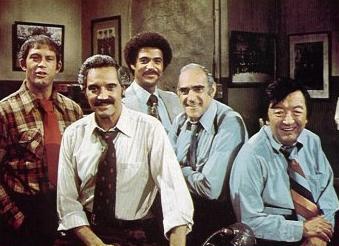
Barney Miller coffee quotes

C&C is about great, sustainable coffee. Really crappy coffee, brewed daily by Det. Nick Yemana, played by Jack Soo (far right) was featured on the old TV show “Barney Miller.”  I was reminded of this during an email exchange with Counter Culture’s Mark Overbay, when I was remarking that I thought of this show whenever I poured a cup of hot coffee in my hot kitchen and went out to sit on my hot patio in the hot sun to drink it.  In one episode, Det. Fish wondered how Yemana could drink hot coffee during a heat wave.  I think Yemana justified it by saying something like, “It makes you sweat.”  This sent me on a search of coffee quotes from the show, and here are my favorites:

  • Yemana asks Barney if he would like some coffee, and a guy in the cell asks if he could have a cup, too. Barney: “This is a police station, not a coffee shop!” Yemana: “And we’ve got the coffee to prove it!”
  • Yemana offers coffee to a victim in distress. Woman: “Don’t you have anything stronger here?” Yemana: “There’s NOTHING stronger ANYWHERE!”
  • Yemana is taking a statement from a dignified older woman, and he gives her a cup of coffee. Yemana: “How’s the coffee?” Fancy woman: “It tastes like pencils.” Yemana: “That’s not the coffee…that’s the cup.”
  • Barney (holding “fresh” cup of coffee, with Yemana beside him holding the pot): “I would hesitate to call our coffee a crime. A shame, maybe. (Drinks) Oh…that’s a crime!”
  • A woman has just overdosed in the squadroom. Wojo gets off the phone with the paramedics and says, “They’ll be here in 10 minutes, but in the meantime we have to get her to empty her stomach. Yemana: “Yeah, I know. Give her some coffee”. Barney: “Just keep pouring it down her.” Wojo: “Two cups ought to do it.”
  • Yemana finally gets fed up with the comments about his coffee: “If you can’t say something good, don’t say anything at all.” The squad members each take a sip of their coffee, say nothing, and after a long period of silence, Yemana says, “Very funny!”
  • Somebody other than Yemana has made the coffee, and it tastes just as bad as it usually does. Yemana: “All these years…I thought it was me.”

Supposedly, Jack Soo’s last words to Hal Linden, who played Barney Miller, as he was being wheeled into the operating room before his death were, “It must have been the coffee.”

Research: Bat diversity in different types of shade coffee

Garcia Estrada, C., A. Damon, C. Sanchez Hernandez, L. Soto Pinto, and G. Ibarra Nunez.  2006.  Bat diversity in montane rainforest and shaded coffee under different management practices in southeastern Chiapas, Mexico.  Biological Conservation 132:351-361.

Southeastern Chiapas is Mexico's primary coffee-producing region.  Very little of the original montane rainforest remains.  Originally, coffee was grown under polyshade, or trees of various species found in the original forest.  Incentives have resulted in many farms using Inga trees for shade; these are native, hardy, fast-growing, deep-rooted, and fix nitrogen (however, production is not increased with Inga, there tend to be more weeds and soil erosion, so replacing forest with Inga doesn't offer many advantages).

This study looked at the diversity of bat species in shade coffee farms that use polyshade; or monoshade (Inga or Inga and bananas) with high, low, or no chemical inputs.  While unaltered montane rainforest had the highest number of species (37), all the others had 23-27 species.  Species composition was different, though, with more fruit and nectar eating bats found in farms with high chemical inputs, which had fewer insect-eating bats.  Application of pesticides decreases insect diversity for these species, especially insect families important to rare bat species.