Coffee Review: Whole Foods (Allegro) Honduras San Marcos

Plainspoken Coffee. A Coffee Review for Ordinary People by Ordinary People, #16.

The two major natural foods markets, at least in our region, are Trader Joe’s and Whole Foods.  There are more TJ’s close to me, but I’ve always been a bit frustrated by their coffees.  Determining origin on most of their self-branded beans is difficult, if not futile.  Some of their offerings are okay (the Organic Bolivian is decent), but even Coffee Review found most to be average (notice also the lack of origin info on most). More on TJ’s in this post.

Whole Foods, on the other hand, is much more transparent. Although they carry several additional brands (varies regionally), including Intelligentsia and Counter Culture’s Sanctuary line of shade coffees, Whole Foods features coffees roasted by Allegro Coffee Company in Colorado. Allegro is a wholly-owned subsidiary of Whole Foods, acquired in 1997.  The Allegro web site has a page where you can download their social responsibility scorecard and coffee sourcing report.

Today’s review is of Allegro’s Organic San Marcos from Honduras. It is a Special Reserve selection. Growers of Special Reserve coffees receive $10,000 to fund community initiatives.  This coffee is from the COCOSAM cooperative in San Marcos de Colon, Choluteca department in southwestern Honduras (red on map). Around half the growers of this nearly 100-farmer co-op grow certified organic coffee.  The varieties grown are bourbon, caturra, and catuai.

This is a light roast (full city). There was no roast date on the bag, but a “best used by” date of 3/23/07 and the healthy bloom when prepared on 16 January indicates a 12/23/06 roasting, or thereabouts.

As a mixed lot from a number of farms, I did not expect it to approach the excellence of the single estate Honduran El Puente from Counter Culture, one of my favorite Central American coffees. The San Marcos is also grown at a lower altitude than the El Puente, a factor that might also argue for points off the flavor profile. But the tasting panel agreed this was a really enjoyable coffee.

Like nearly all Honduran and Guatemalan coffees we’ve sniffed, the San Marcos had a beautiful aroma.  I don’t think I’d ever get tired of smelling beans like this, although the coffee rarely lives up to the (small) room-filling fragrance.  At any rate, the San Marcos had a profile typical of good Central Americans: hints of vanilla, milk chocolate, and caramel.  This coffee was very smooth, almost buttery, with an especially creamy mouthfeel that we thought added a lot to the experience.  This was, unsurprisingly, most pronounced when prepared in a press.  It was also excellent brewed, although I’d skip the paper filter and use a gold filter to preserve some of the creamy smoothness.  We give this 3.75 motmots.

Since they are so accessible to many people, we’ll be reviewing at least two more Whole Foods/Allegro coffees in the future.
Research: Leaf-cutting ants do not harvest coffee leaves in shade farms

Varon, E. H., S. D. Eigenbrode, N. A. Bosque-Perez, and L. Hilje. 2007. Effect of farm diversity on harvesting of coffee leaves by the leaf-cutting ant Atta cephalotes. Agriculture and Forest Entomology 9:47-55. Leaf-cutting ants, which are common in the tropics, cut pieces of live leaves and carry them to underground burrows where they are used to raise a fungus, which is the food of the ants.

The types of leaves these ants harvested were studied on Costa Rican coffee farms which varied in the diversity of tree species present.  In sun coffee monocultures, the proportion of coffee leaves harvested was highest, at 40% of total biomass.  It was under 1% in farms with complex shade, and the ants preferred shade tree species over coffee when given the choice in trials.

Leaf-cutting ants can consume 12 to 17% of leaf production in an area,and can defoliate coffee plants if there are not preferred alternatives. Damage to coffee plants by these ants is minimized by the availability of a diversity of shade trees.

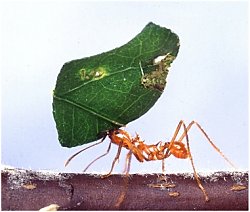
Photo of Atta cephalotes by Scott Bauer. USDA Agricultural Research Service.

Saving the Cerulean Warbler campaign

I last wrote about the Cerulean Warbler and shade coffee in August 2006, when the American Bird Conservancy (ABC) announced they would be working with coffee growers to  preserve critical wintering habitat around the new 500-acre Cerulean Warbler Bird Reserve in the Rio ChucurÁ­ basin of Santander department, Colombia.

ABC, along with their Bird Conservation Alliance network, has now announced a full-fledged to raise US$100,000 to purchase habitat, train and equip forest guards and local ecotourism guides, and improve reserve infrastructure. The conservation plan is looking to purchase over 1,500 acres currently owned by nearly 20 different owners; some of the land is shade coffee farms. All properties in the reserve will be owned and managed by ProAves Colombia, the major conservation organization there.

You can donate directly, purchase the posh Cerulean Warbler postage stamps, or buy Cerulean Warbler Conservation Coffee, offered by Thanksgiving Coffee Company, roaster of the Songbird Coffee line discussed here.

Although some of the promotional material indicates that the coffee comes from shade plantations that are part of or are adjacent to the Cerulean Warbler Bird Reserve in Santander, it is sourced from COOPERAN, a cooperative in southwestern Antioquia province (A on map, dot is co-op area). The aforementioned reserve is about 180 miles away within the Serrania de los Yariguies Important Bird Area (S on map, dot is Reserve).

Although it is a different location, this area is also important to Cerulean Warblers, as well as the endangered Yellow-eared Parrot (below), and other North American migrants. The very endangered Gorgeted Wood-Quail, another target species, is not found in the area where the coffee is sourced, but is found in the Reserve.

Santander has more extensive shade coffee farms versus Antioquia, which has only about 10% in typica varieties grown by traditional shade methods [1,2].  Thanksgiving Coffee sources its other Colombian coffees from the same co-op (although it is not labeled shade-grown), so they are apparently building on an existing relationship. A page (in Spanish) on the ProAves site notes that COOPERAN farmers are sharing their experience with farmers from the Reserve region.

There are 4,600 members in the COOPERAN cooperative.  One subgroup in the co-op mentioned as a Thanksgiving source was represented in the 2005 Cup of Excellence competition. I found information on one of the Los Sauces farm, El Clavel, which states the coffee there is 30% shade grown. ABC reassured that the Colombian conservation partner ProAves visits the farm(s) to make sure that the coffee is grown under shade.

Support of this campaign is highly worthwhile. Although the coffee does not come from the official Reserve, there is arguably more need for encouraging shade coffee farming in Antioquia, where less than 3% of the native forest remains. Just $1.50 of each bag of coffee goes to ABC, so don’t forget to donate directly to help purchase habitat.

Cerulean Warbler Technical Group el Grupo Cerleo page.

More on the partnership with COOPERAN (also in Spanish).

[1] Colorado, G., and T. Cuadros. 2006.  Geographic distribution and habitat use by Cerulean Warbler in natural vegetation and agro-ecosystems of northern Colombia. Final report to Nature Conservancy and USFWS. Medellin, Colombia.  56 pp.

[2] Armenteras, D., A. RincÁ³n, and N. Ortiz. 2005. Ecological Function Assessment in the Colombian Andean Coffee-growing Region. Sub-global Assessment Working Paper. Millennium Ecosystem Assessment, United Nations.

Biodynamic farming: flim-flam alert

Every so often when I am researching a coffee farm to determine if their methods preserve biodiversity, I come across one that uses “biodynamic” farming methods; some are even certified by the Demeter Association.

What the hell is biodynamic farming?

Biodynamic farming includes many of the concepts of organic farming and is based on the anthroposophical teachings of Rudolf Steiner, a philosopher and “social tinkerer.”  In the biodynamic view, the farm as a whole is seen as an organism, with heavy emphasis on the spiritual/holistic aspect.

For instance, planting of crops is done according to cosmic rhythms to enhance, for example, pest control by blocking the fertility influences of particular planets on particular pests.  The life forces of a farm are said to be strengthened by creating various homeopathic-like preparations (e.g., derived from flower blossoms stuffed into deer urinary bladders which have been placed in the sun during summer, buried in earth during winter and retrieved in the spring).  These are then placed in compost piles or manure. According to the Biodynamic Farming and Gardening Association, “These preparations bear concentrated forces within them and are used to organize the chaotic elements within the compost piles.”  Using these preparations is required for Demeter certification, and the certification standards are built around the elaborate development of these concoctions.

A study published in the journal of the Soil Science Society of America (64:1651-1659) comparing soils fertilized with biodynamic versus nonbiodynamic compost found no differences in the various soil biotic parameters measured.  Another paper, in the Journal of Agricultural and Environmental Ethics, concluded that “Steiner’s instructions are occult and dogmatic and cannot contribute to the development of alternative or sustainable agriculture.”

While many of the organic aspects of biodynamic farming are positive, biodynamic certification is mostly meaningless and basically a marketing ploy. Considering that farms pay a $470 fee ($310 a year for renewals) plus annual inspection fees and a 0.5% royalty on gross sales, the most notable thing biodynamic certification adds to coffee is cost.